

Knowledge hub › For students › A Christmas Carol: the story
A Christmas Carol: the story, stave by stave
On Christmas Eve three spirits visit a mean old businessman, and by Christmas morning he is a changed man. Each stave is retold in plain English, with the main characters and ideas.
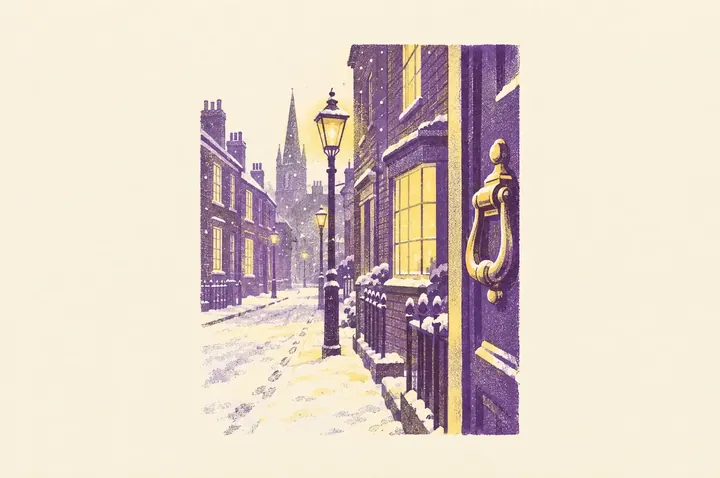
In A Christmas Carol, Charles Dickens’s novella of 1843, the mean businessman Ebenezer Scrooge is visited on Christmas Eve by the ghost of his partner, Jacob Marley, then three spirits. They show him his past, the present and a lonely death to come. He wakes a changed, generous man. It is Section B of AQA GCSE English Literature Paper 1.
A Christmas Carol is a short novel, or novella, by Charles Dickens. It was first published in 1843. Dickens called its five chapters staves. A stave is a verse of a song, so each chapter is like a verse of a carol.
- 1843the year A Christmas Carol was first publishedCharles Dickens Museum
- 5staves, Dickens’s name for its chaptersProject Gutenberg text
- 1834the law after which many poor people could get help only inside a workhouseUK Parliament
In the exam it is Section B of Literature Paper 1. The question prints an extract, then asks about the novella as a whole, so you need the whole story.
Read the transcript
This is the complete revision guide to A Christmas Carol for AQA GCSE English Literature. I’m Hannah, and I teach English. In one video you’ll get the plot, the characters, the themes, the context, the terms to know, every quotation worth learning, and what the examiners reward. Paper 1 Section B: one question on an extract and the novel as a whole (AQA’s wording; the paper prints the staves as chapters). 30 marks, about 50 minutes, no AO4.
Answers are placed in a level by best fit. Let’s start with the plot, part by part. Stave 1. Christmas Eve. Scrooge refuses Fred’s invitation and the charity collectors.
At home, Marley’s ghost, in chains, warns him that three spirits will come. Stave 2. The Ghost of Christmas Past: Scrooge as a lonely schoolboy, his sister Fan, Fezziwig’s ball, Belle ending their engagement and, years later, with her family. Stave 3. The Ghost of Christmas Present: the Cratchits’ dinner and Tiny Tim, Christmas in far places, Fred’s party.
The spirit warns that Tim will die if nothing changes, then shows Ignorance and Want. Stave 4. A silent phantom: businessmen joking about a death, Old Joe buying the dead man’s things, the Cratchits mourning Tim, a neglected grave with Scrooge’s name on it. Stave 5. Christmas morning.
Scrooge sends the prize turkey, promises money to the charity collector and goes to Fred’s dinner. He raises Bob’s salary, and becomes “a second father” to Tim, who does not die. Now the characters. Ebenezer Scrooge. A rich, miserly moneylender who learns, through the visits of four ghosts, to care for other people.
Jacob Marley. Scrooge’s dead business partner, who returns in chains to warn him. Bob Cratchit. Scrooge’s underpaid clerk; a loving father who stays cheerful in poverty. Tiny Tim.
Bob’s young son, who is disabled and seriously ill; his fate depends on Scrooge’s change. Fred. Scrooge’s nephew, who keeps inviting him to Christmas dinner and refuses to give up on him. The Ghost of Christmas Past. A strange, glowing spirit who shows Scrooge his lonely childhood, Fezziwig and Belle.
The Ghost of Christmas Present. A jolly giant surrounded by food, who shows Scrooge how others keep Christmas, and reveals Ignorance and Want. The Ghost of Christmas Yet to Come. A silent, hooded phantom who shows Scrooge his lonely death and Tiny Tim’s.
Belle. The woman Scrooge was engaged to, who leaves him because he loves money more than her. Mr Fezziwig. Scrooge’s first employer, whose generous Christmas ball shows what a good master can do. The themes.
For each one, here’s the idea in a sentence. That sentence is the start of a thesis. Social responsibility. We are responsible for each other; the rich cannot ignore the poor. Redemption and change.
Anyone can change if they face the truth about themselves. Poverty and class. Dickens shows the poor as people with dignity and attacks the systems that failed them. Family. Families, rich or poor, have the love that Scrooge has shut out.
Christmas. A time for generosity and community, and a symbol of the values Dickens wants kept all year. The context. Use it where it explains a choice the writer made. One clause inside a point does more than a paragraph of history.
A Christmas Carol was published on 19 December 1843. Under the Poor Law Amendment Act of 1834, the workhouse was meant to become the main form of help for poor people who could work. Conditions were made harsh on purpose. Thomas Malthus argued in 1798 that population grows faster than the food supply. Some readers used this to argue against helping the poor.
When Dickens was 12, his family was deep in debt: he was sent to work in a blacking warehouse, and his father was imprisoned in the Marshalsea debtors’ prison. In 1843 Dickens read a government report on children’s working conditions and visited the Field Lane Ragged School in London. In October 1843 he spoke in Manchester about education for working people, shortly before he began writing the novella. The terms to know. Name a method only when you can say what it does.
Stave: A verse of a song. Dickens calls his five chapters staves, so the novella is shaped like a carol. The exam paper from AQA calls them chapters, so Stave 3 is printed as Chapter 3, and the question says the novel as a whole. Narrator: Talks to the reader with humour from the first line, “Marley was dead: to begin with.” In Stave 2 he stands “in the spirit at your elbow”. Allegory: Characters who stand for ideas, such as Ignorance and Want (Lesson 20).
Juxtaposition: Contrasts side by side: Scrooge’s small fire against Bob’s, “so very much smaller that it looked like one coal” (Lesson 5). Listing: Words piled up into a judgement: “a squeezing, wrenching, grasping, scraping, clutching, covetous, old sinner!” (Lesson 3). Pathetic fallacy: The fog and cold of Stave 1 against the “clear, bright, jovial” morning of Stave 5. Cyclical structure: Stave 5 returns to the people of Stave 1, so readers can measure the change (Lesson 28). Didactic purpose: Writing to teach.
In the Preface Dickens hopes to “raise the Ghost of an Idea”, and that it will “haunt their houses pleasantly”. The quotations. These are the 15 I’d want every student to know by heart. For each one: who says it, where, and why it matters. “solitary as an oyster”.
Narrator, 1. Simile: Scrooge is closed off, but an oyster can hold a pearl. “Bah!” … “Humbug!”. Scrooge, 1.
Scrooge dismisses Christmas, and with it kindness and community. “decrease the surplus population”. Scrooge, 1. Echoes Malthus; Scrooge sees the poor as a number, not as people. “Mankind was my business”.
Marley’s Ghost, 1. Marley realises too late that caring for others was his real job. “I wear the chain I forged in life”. Marley’s Ghost, 1. Metaphor: every selfish act added a link; we make our own punishment.
“A solitary child, neglected by his friends, is left there still.”. Ghost of Christmas Past, 2. The young Scrooge was lonely; Dickens builds sympathy. “The happiness he gives, is quite as great as if it cost a fortune.”. Scrooge, 2.
Scrooge praises Fezziwig and begins to see what a good employer is. “Another idol has displaced me”. Belle, 2. Money (a “golden” idol) has replaced love in Scrooge’s heart. “God bless us every one!”.
Tiny Tim, 3. Tiny Tim’s blessing includes everyone, even Scrooge. “If he be like to die, he had better do it, and decrease the surplus population.”. Ghost of Christmas Present, 3. The spirit throws Scrooge’s own words back at him.
“This boy is Ignorance. This girl is Want.”. Ghost of Christmas Present, 3. Allegory: society’s neglect of poor children will lead to its own doom. “Beware them both”.
Ghost of Christmas Present, 3. A direct warning to Scrooge and to Dickens’s readers. “I will honour Christmas in my heart, and try to keep it all the year.”. Scrooge, 4. Scrooge’s promise at the grave: the moment he decides to change.
“I am as light as a feather”. Scrooge, 5. Simile: the weight of his old life has gone. “He became as good a friend, as good a master, and as good a man, as the good old city knew”. Narrator, 5.
Repetition of “good” shows how complete the change is. Finally, what the examiners reward. AO1, response. An argued answer to the question, set out in a thesis, with short references from the extract and other staves. Both bullets matter, in either order: students do not have to start with the extract.
A how far question needs a judgement. AO2, methods. How Dickens makes meaning: the narrator, the stave structure, the spirits and contrast as well as single words. Level 6 analysis is convincing, critical and exploratory. AO3, context.
Context in AQA’s wide sense: the ideas in the question, 1840s London, the ghost story, readers then and now and the novella’s universal ideas. Use it where it explains Dickens’s purpose. One clause inside a point does more than a paragraph of history; examiners ask for Malthus and the Poor Laws in a sentence. And how answers lose marks: Retelling the plot; treating Scrooge as a real person with no writer behind him; staying in the extract; context bolted on at the end; pre-learned paragraphs that do not fit the question. That’s everything in one place.
Watch it again in a week, and pause on any section you couldn’t have explained yourself. Everything in this video comes from our A Christmas Carol scheme of learning for schools. If you’re a teacher, Lesson 3 of every scheme is free at btl.education. Thank you for watching.
Stave 1: Marley’s Ghost
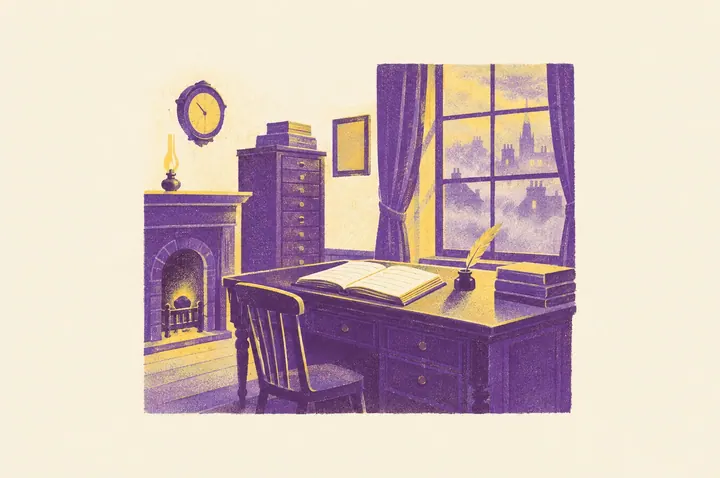
It is Christmas Eve in London, foggy and dark by three in the afternoon. Ebenezer Scrooge, a rich and mean businessman, is at work in his counting-house, which is his office. His clerk, Bob Cratchit, copies letters next to a fire so small it looks like one coal.
Scrooge’s nephew, Fred, calls in to wish him a merry Christmas and invite him to dinner. Scrooge answers “Bah!” and “Humbug!” and says no. Two gentlemen ask him to give money to help the poor. Scrooge asks “Are there no prisons?” and says the poor can go to the workhouses. If they would rather die, he says, they should do it and “decrease the surplus population”. He gives nothing, and he lets Bob have Christmas Day off only because he has to.
That night the knocker on his door turns, for a moment, into the face of Jacob Marley, his business partner, who died seven years ago. Later Marley’s ghost comes into Scrooge’s room, wrapped in a long chain of cash-boxes, keys, padlocks and ledgers. Marley says he made the chain himself, “link by link”, in a life spent on money. Scrooge’s own chain, he warns, was as heavy and as long as Marley’s seven Christmas Eves ago, and it has grown since. Three spirits will visit Scrooge. They are his only hope of escaping Marley’s fate.
Stave 2: The First of the Three Spirits
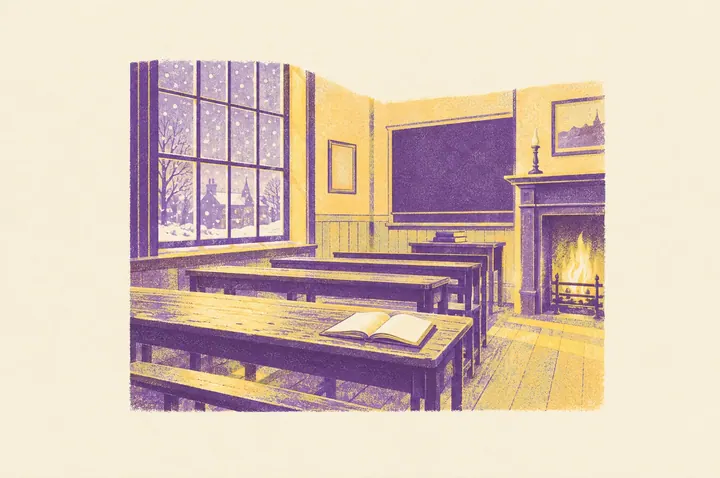
The bell strikes one, and the Ghost of Christmas Past arrives. It looks like a child and an old man at the same time, and a bright light shines from its head. It takes Scrooge back into his own past.
He sees himself as a lonely boy, left at school over Christmas, reading by a weak fire, and he cries. His little sister, Fan, runs in to take the boy home. Next he is a young man working for Mr Fezziwig, who throws a Christmas party for everyone in his warehouse. Scrooge says Fezziwig’s kindness was worth as much as a fortune, then says he would like a word with his own clerk.
The spirit shows him Belle, the young woman he was going to marry. She ends their engagement because money has taken her place in his heart. She calls it an idol, “A golden one.” Then he sees Belle years later, happily married, with children all around her. Her husband says he saw Scrooge that afternoon, “Quite alone in the world”. Scrooge cannot bear it. He pushes the spirit’s cap down over its light and falls asleep in his own bed.
Stave 3: The Second of the Three Spirits
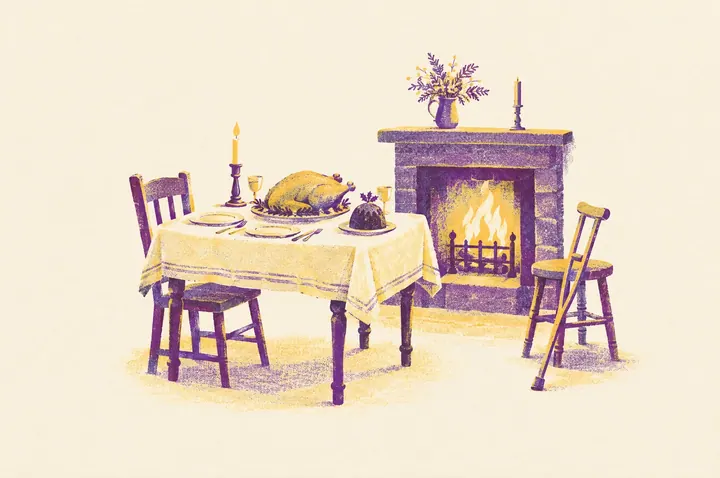
The bell strikes one again. The next room is hung with holly and piled high with food, and on top sits the Ghost of Christmas Present, a jolly giant in a green robe. He takes Scrooge out into the streets on Christmas morning.
They visit the Cratchits, who have very little money and are happy together. Bob comes home from church with his youngest son, Tiny Tim, on his shoulder. Tiny Tim has a little crutch and an iron frame to support his body. The family share a goose and a small pudding as if it were a feast, and Tiny Tim says “God bless us every one!”
Scrooge asks if Tiny Tim will live. The spirit sees “a vacant seat” by the fire: if nothing changes, the child will die. Then the spirit throws Scrooge’s own words back at him. If the boy is going to die, he had better do it, and decrease the surplus population. Scrooge hangs his head in shame. Bob still drinks to Scrooge’s health, though his wife is angry about it.
The spirit shows Scrooge people keeping Christmas in hard places, such as miners, lighthouse keepers and sailors. At Fred’s party, Fred says he feels sorry for his uncle and will invite him again every year. Scrooge joins in the guessing games, though nobody can hear him.
At the end, the spirit brings two thin, wretched children out from the folds of his robe. “This boy is Ignorance. This girl is Want.” The spirit tells Scrooge to beware them both, most of all the boy. When Scrooge asks if they have anywhere to go, the spirit answers with Scrooge’s own question: “Are there no prisons?” The clock strikes twelve, and a hooded phantom comes towards him.
Stave 4: The Last of the Spirits
The Ghost of Christmas Yet to Come is a tall phantom in a black robe. It never speaks. It only points. It shows Scrooge what may happen in the future.
Some businessmen joke about a man who has just died: one will go to the funeral only if lunch is provided. In a dirty shop, three people sell a dealer called Old Joe the things they have taken from the dead man, even the curtains from round his bed. His body lies alone, with nobody to watch over it. When Scrooge asks to see anyone who feels emotion at the death, the spirit can show him only a couple who owed him money, and what they feel is relief.
At the Cratchits’ house it is very quiet. Tiny Tim has died, and Bob weeps for him: “My little, little child!”
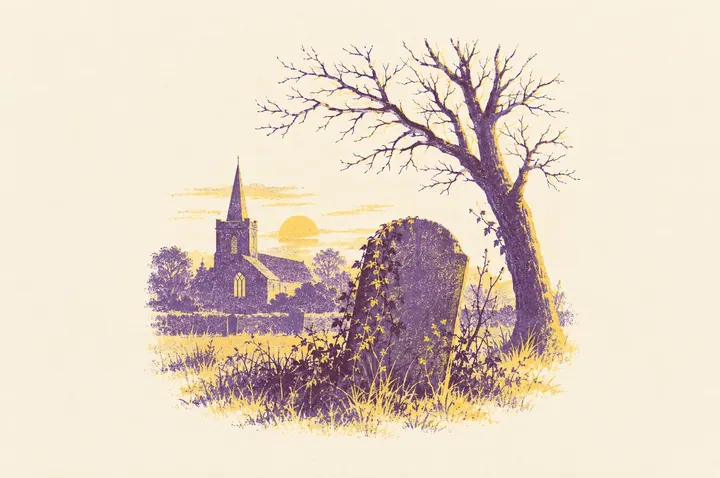
Last of all, the spirit points to an uncared-for grave in a churchyard. On the stone Scrooge reads his own name. The lonely dead man was him. He begs for a chance to change: “I am not the man I was.” He promises, “I will honour Christmas in my heart, and try to keep it all the year.” As he prays, the phantom shrinks and turns into his own bedpost.
Stave 5: The End of It
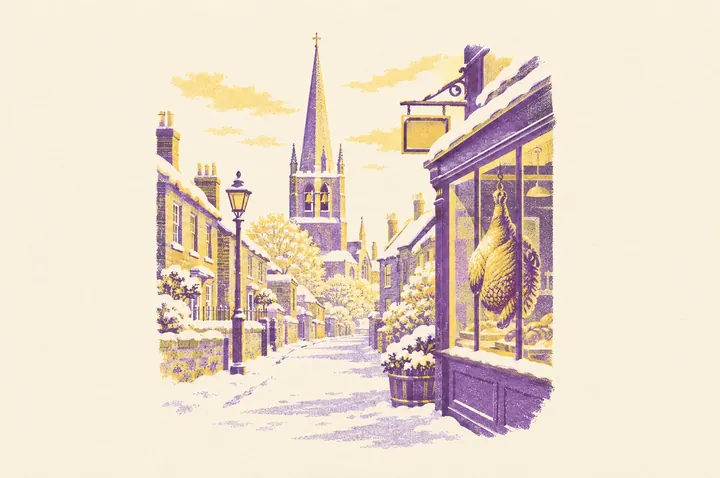
Scrooge is in his own bed, and it is Christmas morning. The spirits have done it all in one night. He laughs and cries at once: “I am as light as a feather”. He pays a boy to fetch the prize turkey from the poulterer’s shop and sends it to the Cratchits without saying who it is from.
In the street he meets one of the gentlemen collecting for the poor and promises a large gift. He goes to church, then to Fred’s house, and asks, “Will you let me in, Fred?” He is welcomed in for dinner.
The next morning Bob arrives eighteen and a half minutes late. Scrooge pretends to be angry, then raises his salary and promises to help his family. He keeps his word and does more. Tiny Tim does not die, and Scrooge becomes a second father to him. The book ends with Tiny Tim’s words: “God bless Us, Every One!”
The main characters
- Ebenezer Scrooge: a rich, mean businessman who has shut himself away from other people, and who changes.
- Jacob Marley: Scrooge’s dead business partner, who comes back in chains to warn him.
- Bob Cratchit: Scrooge’s poorly paid clerk and a loving father.
- Tiny Tim: Bob’s youngest son, who is disabled and seriously ill. His life depends on Scrooge changing.
- Fred: Scrooge’s cheerful nephew, the son of his sister Fan, who keeps inviting him to dinner.
- Mr Fezziwig: Scrooge’s first employer, who is generous to his workers.
- Belle: the woman Scrooge was going to marry, who leaves him because he loves money more.
- The three spirits: the glowing Ghost of Christmas Past, the giant Ghost of Christmas Present and the silent Ghost of Christmas Yet to Come.
The main ideas
Responsibility for other people. Marley realises too late that “Mankind was my business”. Dickens argues that the rich cannot ignore the poor.
Poverty. Dickens shows the Cratchits as a loving, hard-working family who deserve help. After a law of 1834, many poor people could get help only inside a workhouse, where the regime was deliberately harsh and often cruel. Readers are meant to be shocked when Scrooge praises the workhouses.
Change. Scrooge changes step by step, from tears for his younger self to begging at his own grave. Dickens shows that anyone can change if they face the truth about themselves.
Family. Fan, Belle’s children, the Cratchits and Fred all show Scrooge the love he has shut out.
Christmas. For Dickens, Christmas stands for kindness and sharing, and he wants readers to keep its spirit all year, as Scrooge does.
What to do next
Learn the quotations on A Christmas Carol: quotations to learn, and practise with How to answer the extract question. You can read the whole novella free on Project Gutenberg.
Frequently asked questions
What happens in A Christmas Carol in short?
On Christmas Eve, the ghost of Jacob Marley warns Scrooge that three spirits will visit him. They show him his past, the present and a possible future, ending at his own grave. On Christmas morning he wakes a changed man and helps the Cratchits.
Why are the chapters of A Christmas Carol called staves?
A stave is a verse of a song. Dickens called his five chapters staves, so each chapter is like a verse of a carol.
Who are the three spirits in A Christmas Carol?
The Ghost of Christmas Past, a glowing figure like a child and an old man at once; the Ghost of Christmas Present, a jolly giant in a green robe; and the Ghost of Christmas Yet to Come, a silent phantom in a black robe.
Does Tiny Tim die in A Christmas Carol?
Only in the future that the last spirit shows Scrooge in Stave 4. Once Scrooge changes, Tiny Tim does not die, and Scrooge becomes a second father to him.
When was A Christmas Carol published?
It was first published in 1843.
Where does A Christmas Carol come in the GCSE exam?
It is Section B of AQA Literature Paper 1. The question prints an extract, then asks about the novella as a whole.
Sources
- Project Gutenberg, Charles Dickens, A Christmas Carol in Prose; Being a Ghost Story of Christmas (1843; ebook 46)
- Charles Dickens Museum, First edition of ‘A Christmas Carol’
- UK Parliament, Poor Law reform
- AQA, GCSE English Literature 8702 specification