
Revising GCSE English
Free help for AQA GCSE English Literature and Language. Start wherever you like: watch how each paper works, read up on your texts, learn how to write it, or practise. No sign-up.
Your exam, paper by paper
Each AQA English paper in about four minutes: the questions, the marks and the timing.
AQA English Language Paper 1, question by question
5 minutes · captions available
Every question on Paper 1: what it asks, how many marks it carries, how long to spend and what a strong answer does.
AQA English Language Paper 2, question by question
4 minutes · captions available
Every question on Paper 2: the two sources, summary, language, comparison and the viewpoint writing task.
AQA English Literature Paper 1 explained
4 minutes · captions available
The Shakespeare play and the 19th-century novel: the extract-to-whole question, timing, and what examiners reward.
AQA English Literature Paper 2 explained
4 minutes · captions available
The modern text, the poetry anthology and the unseen poems: the questions, the timing and how they are marked.
Know your texts
The story, the characters and the quotations to learn, text by text.


Power and Conflict poetry
Paper 2 · the anthology
- Power and Conflict poems
Every poem (15)
Ozymandias · London · The Prelude · My Last Duchess · The Charge of the Light Brigade · Exposure · Storm on the Island · Bayonet Charge · Remains · Poppies · War Photographer · Tissue · The Emigrée · Kamikaze · Checking Out Me History

Any text
Revising and the exam day
Nothing for this text yet. Every guide for students
How to write it
Strategies for every kind of answer: a thesis, a paragraph, the extract question, comparing poems and Section B. Pick the one you need next.
 How to write a What–How–Why paragraphA What–How–Why paragraph makes a point, shows how the writer gets it across and explains why the writer did it. A model paragraph on Macbeth shows each part at work.
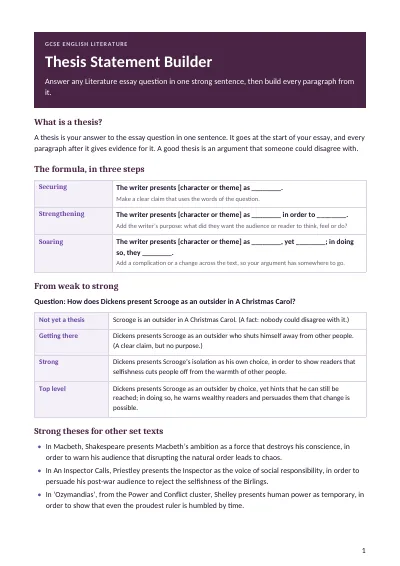
 Thesis statementsA thesis is your answer to the question in one sentence, at the start of your essay. Build one with the frame that suits you, then compare it with examples for the set texts.
 The extract questionBoth questions on Literature Paper 1 print an extract and ask about the whole text. You must write about both. Give each one about 50 minutes, with the first ten for reading and planning.
 Comparing poemsIn Section B of Literature Paper 2 one poem is printed and the other comes from memory. Much of the work happens before you write: choosing the second poem and deciding how the two connect.
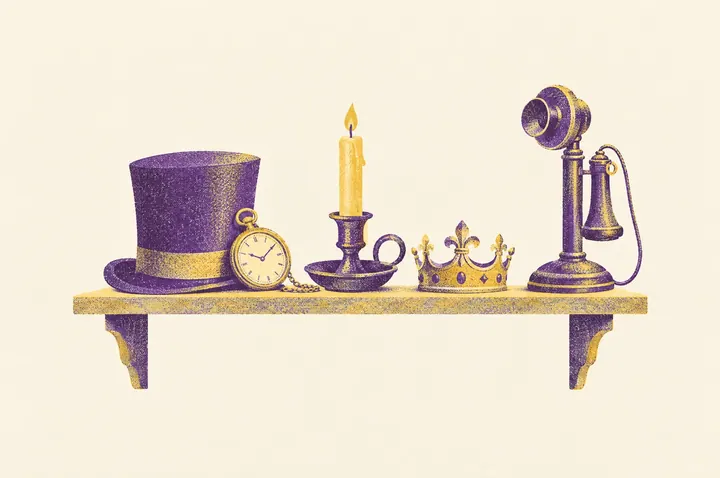 Using contextContext earns marks in four of the five Literature sections and in neither Language paper. It works when it explains the writer’s purpose, and it wastes time when it turns into a history lesson.
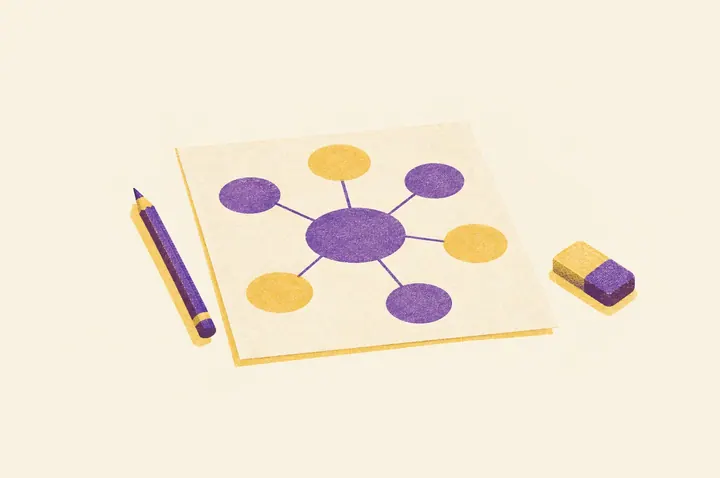 Section B writingQuestion 5 is worth 40 marks on each Language paper, and 16 of them are for accuracy. Five minutes of planning and five of checking protect both parts of the mark.
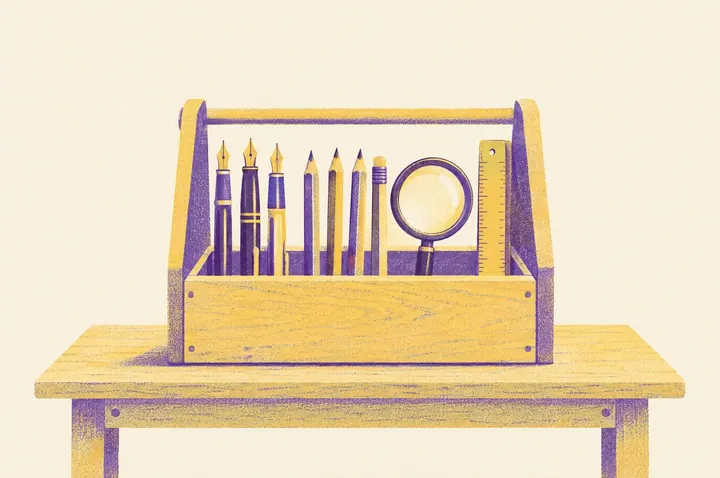 Subject terminologyAQA’s examiners say the name of a technique carries no value on its own. Learn a short list of terms well, and always say what the method does to the reader.
Every one of these works for any text. Every guide for students
Your spoken language presentation
Choosing a topic, planning, the ten minutes before you speak and taking questions.
Free practice
Every Literature question AQA set from 2017 to 2025, what each Language source was about and the writing tasks, and sheets to help you plan and revise. Read them here or download them.
AQA Literature Paper 1 past questions
Every question set from 2017 to 2025 for Section A (Shakespeare) and Section B (the 19th-century novel).
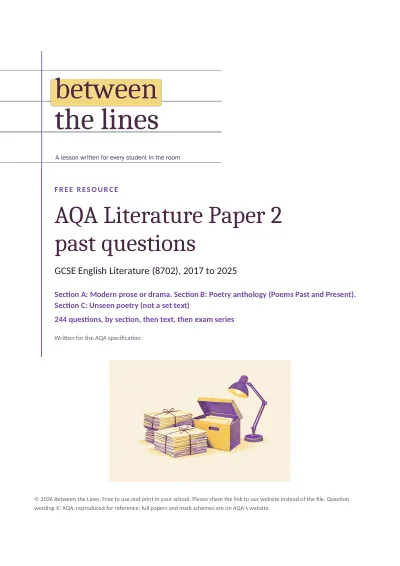
AQA Literature Paper 2 past questions
Every question set from 2017 to 2025 for Section A (modern texts), Section B (the anthology) and Section C (unseen poetry).
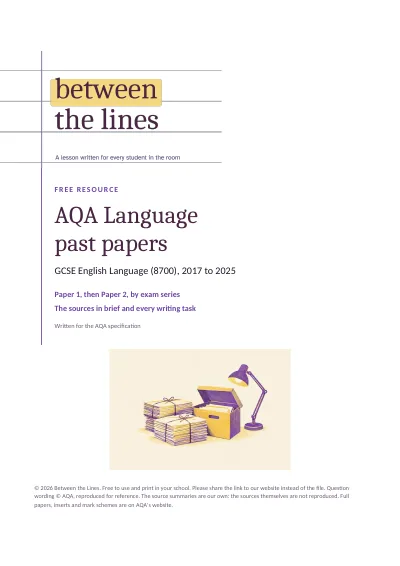
AQA Language past papers, 2017 to 2025
Paper 1 and Paper 2, series by series: what each source was about and the writing tasks.
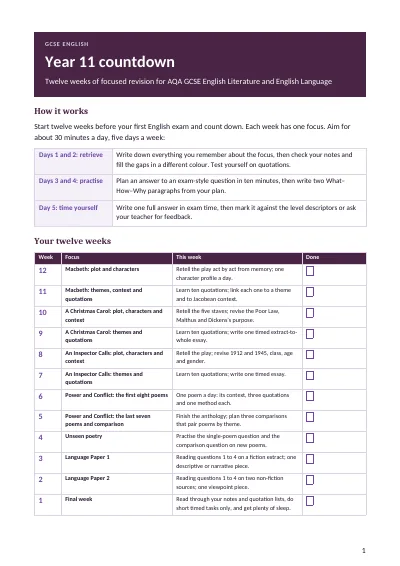
Days to go
The four AQA English papers in summer 2027. All four are in the morning; check the times with your school.
Revision packs and essay marking are on the page for parents and carers.