
Knowledge hub › For students › Plan a presentation
Plan a presentation in twenty minutes
Alastair Greener’s four-part structure, hook, message, recap and call to action, turned into a twenty-minute plan for your spoken language presentation or any talk in class.
AQA’s criteria for the spoken language endorsement ask you to organise and structure your presentation: “makes an attempt to organise and structure” at Pass, and “organises and structures his or her presentation clearly and appropriately to meet the needs of the audience” at Merit (AQA specification, 4.4). This page gives you a structure and a way to plan with it in twenty minutes.
The structure comes from Alastair Greener, President of the Professional Speaking Association UK and Ireland for 2026. He calls it HMRC: hook, message, recap, call to action. You deliver the parts in that order, but you plan the message first, because a hook is much easier to write once you know where the talk is going.
If you have not chosen a topic yet, start with your spoken language presentation, explained, which shows how to turn a topic into a question.
The twenty minutes at a glance
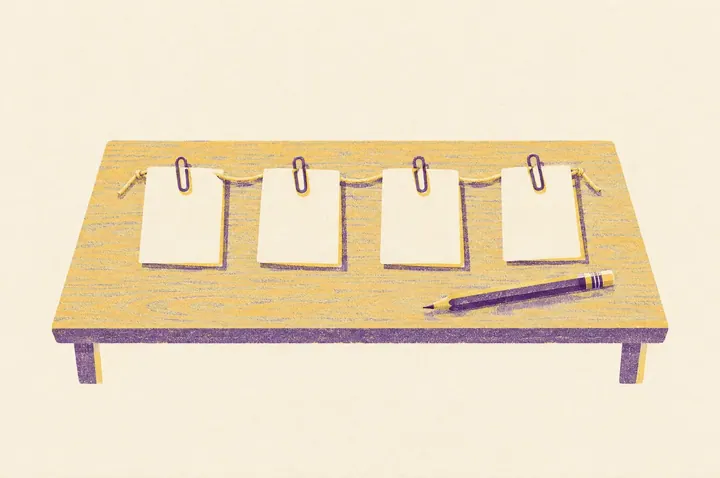
You need a timer, a pen, and four cards or a sheet of paper folded into four.
- 0 to 5 minutes: the message
- 5 to 10 minutes: the middle
- 10 to 13 minutes: the hook
- 13 to 16 minutes: the recap
- 16 to 18 minutes: the call to action
- 18 to 20 minutes: four note cards
The example below uses a question from AQA’s notes and guidance: should there be more sport in schools?
0 to 5 minutes: the message
Alastair asks two questions about the message. What value will your audience get from listening to you? What problem are you solving? In class, your audience is your class, so ask what a room of Year 11s gets from your talk. Alastair’s shorthand for this is WIIFM: what’s in it for me?
Write the message as one sentence. Alastair recommends one central idea running through a talk, and AQA’s guidance makes the same point: knowing your main point gives your talk an arc that helps you organise it.
Example message: every student should get at least an hour of sport a week, right up to their last exam.
Two tests. Can you say it in one breath? Could a listener reply “so what?” If so, add the reason it matters to them.
5 to 10 minutes: the middle
Choose two or three points that prove the message and write one example under each. Alastair’s advice is to keep it simple and use stories and examples, supported by facts and figures. AQA’s guidance lists the kinds of evidence that work: well-chosen statistics, anecdotes, quotations from experts in the field, the media or government data. Use only figures you can name a source for, because you may be asked.
Then add the two things that lift a talk.
The first is the other side. What would someone who disagrees say, and what is your answer? AQA links “consideration of alternative viewpoints with reasoning” to Merit. For the example, the other side is that exam years need every hour of revision; the answer is that one hour a week is a small cost for the only lesson that gets everyone moving.
The second is a solution. If your talk describes a problem, say what should be done. AQA’s guidance says solutions are “often overlooked”.
Do not cram. Alastair warns that too much information makes a talk hard to follow.
10 to 13 minutes: the hook
Alastair’s kinds of hook:
- a question that involves the audience straight away
- a dramatic statement
- a startling statistic
- a story
- a sneak preview of what is coming
AQA’s guidance notes that many students open well with “imagine” scenarios, rhetorical questions, statistics or dramatic statements. It is less keen on “In this talk I will...”, which is clear but gives everything away in the first line.
Example hook: “Think about the last time you were out of breath. Was it in a lesson?”
Write the hook out in full. Alastair recommends learning your opening line word for word, so you can deliver it with impact even when you are nervous.
13 to 16 minutes: the recap
Alastair starts from the old advice: tell people what you are going to say, tell them, then tell them what you have said. AQA’s guidance says that by Merit, “recap forming part of the talk” is expected.
Write one or two sentences that bring your points back together in fresh words. A recap that repeats the whole talk at speed sounds like a repeat.
Then try what Alastair calls bookending: refer back at the end to something from the start, so the talk comes full circle. If you opened with the last time your audience was out of breath, come back to it here.
16 to 18 minutes: the call to action
Alastair says a call to action should make your audience “think, do or feel something different”. In class, make it small and real enough to happen. Example: if anyone suggests swapping PE for revision, ask for one lesson a week to stay.
AQA’s guidance describes endings that work: students who restate their opinion and simply say thank you, and students who leave a strong closing image and ask the audience to take the issue seriously. It also describes endings that are “frustratingly 'unfinished'”, where students just stop. Learn your last line word for word, the same as your first.
18 to 20 minutes: four note cards
One card for each part. Your middle points can go on the message card or on a fifth. Write only a few words on each, except your first and last lines, which go on in full. Number the cards in the corner.
AQA’s guidance says “Note cards are continually seen to be the most effective support to a speaker”, and that reading from a script reduces your engagement with the audience. When the timer ends, say your first line out loud.
After the twenty minutes
Twenty minutes gets you a plan. Then rehearse out loud with a timer, more than once, and leave room for several questions inside AQA’s ten minutes. AQA’s tip is to use a mirror, friends or family, or to record yourself and listen back. Our guides to the ten minutes before you speak and taking questions and feedback cover what comes next.
Frequently asked questions
Do I have to use HMRC for the spoken language endorsement?
No. AQA does not require any particular structure. Its criteria ask you to organise and structure your presentation, and HMRC is one clear way to do that.
How long should my talk be?
AQA’s guide is no more than ten minutes for the whole assessment, questions included. Ask your teacher how long they want the talk itself to run.
Should I write the talk out in full?
Plan it on cards and learn your first and last lines. AQA’s guidance says reading entirely from notes is unlikely to get you to the higher grades.
Can I use a statistic in my hook?
Yes, if you can name where it comes from. Your audience can ask about it, and AQA wants you to “own the information”.
Does HMRC work for a Paper 2 speech?
The same four parts work for a written speech. See writing a speech for Paper 2 Question 5 and Language Paper 2, question by question.
Adapted from Present Yourself in a Minute with Alastair Greener.
Sources
- AQA, GCSE English Language 8700 specification: scheme of assessment, 4.4 Non-exam assessment
- AQA, Notes and guidance: supporting student success in the spoken language endorsement (version 1.2, October 2025)
- AQA, Spoken Language endorsement for GCSE English Language
- SME Today, Communication expert takes on President role for national speaking association (24 March 2026)
- Alastair Greener, Present Yourself in a Minute films P2 to P6 (HMRC), N6 (WIIFM), N18 (opening and closing lines) and N47 (bookending)