

Knowledge hub › For teachers › Recording day, for teachers
Recording day for the spoken language endorsement: AQA’s rules and a plan for the day
What AQA asks you to record, how many students, by when and how the files reach them, followed by a practical plan for the day itself. AQA’s rules and our own advice are marked separately.
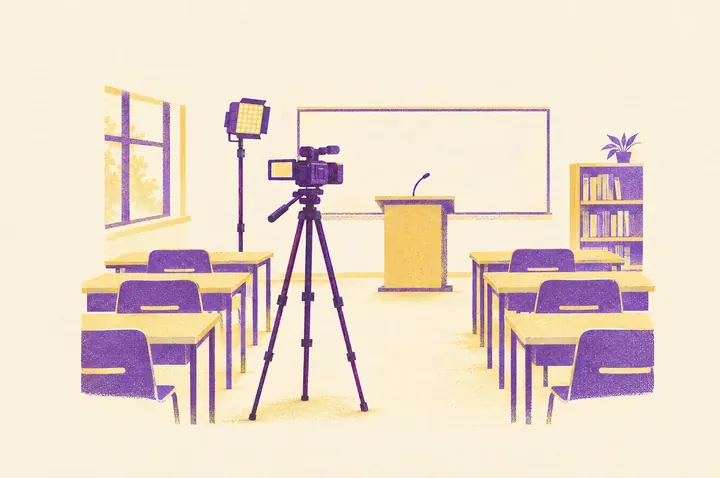
AQA’s audiovisual evidence guidance is blunt: “Awarding bodies will not be able to verify the school/college assessment of Spoken language if the recordings submitted are of poor quality.” This page brings AQA’s rules together, then adds our advice for the day. The criteria are on our page on running the spoken language endorsement.
What each recording must contain (AQA’s rules)
- Complete and unedited, including the questions and feedback. Anything before or after that is not part of the assessment “should not be recorded or should be edited out”.
- Identified at the start: the student states their name and the school or college, or holds an A4 sign up to the camera.
- Clear and audible: a stable, clear image of the student, and everyone taking part clearly audible.
- Support materials in view: film from the audience’s point of view so notes or slides are visible. Slide contents can be uploaded as a separate file.
- The teacher in the audience: JCQ’s instructions for non-examination assessments (effective 1 September 2026) say the audience “must always include the teacher”.
- Run as an exam: AQA asks for a formal exam session where possible. Mobile phones are not permitted, no one enters or leaves during presentations, and the audience must not distract the presenter.
If you record several students in one file, the start and end of each assessment must be clearly identified.
How many students, and which (AQA’s rules)
From the specification and AQA’s sampling page:
- 30 students or fewer: record every student.
- More than 30: record 30, with at least 10 at each of Distinction, Merit and Pass. Where a grade has fewer than 10 students, send all of them and make up the 30 from the other grades.
- Worked example (AQA’s): 21 Distinction, 14 Merit and 3 Pass students gives a sample of 10 Distinction, 10 Merit, all 3 Pass and 7 more from Distinction or Merit.
- Leave out students graded Not Classified and students carrying a grade forward.
- Representative: the sample should represent your teaching groups, and where more than one teacher assessed, “the sample must cover a range of assessors”.
- Parental interest: a student assessed by a teacher with a personal interest in them is sent in addition to the sample.
- Spares: AQA recommends recording slightly more than the minimum at each grade. A sample that ends up slightly short at one grade needs no further action.
When, and the deadline (AQA’s rules)
The audiovisual guidance says assessments “can take place at any time during the two-year course” as long as the sample is submitted by 7 May for the summer series. AQA’s notes and guidance add that, as a summative assessment, it is expected in the final year of the course.
For the June 2027 series:
- Centre marks submission opens on Monday 5 April 2027 (AQA).
- Enter and submit a grade for every student. The sample screen only appears once all grades are in.
- On the View and upload sample screen, upload the files, tag each to its student, tick the checkbox and submit.
- The deadline is Friday 7 May 2027 (key dates). AQA’s upload FAQs also ask for sample files within three days of submitting grades.
Extensions are granted only for extenuating circumstances. Teachers can be given upload permission; submitting is usually the exams officer’s job.
Files and uploads (AQA’s rules)
- Any device is fine, including webcams, video cameras and iPads. Supported formats include .mp4 and .mov.
- Size: AQA suggests 720p rather than 1080p, which gives “files less than half the size”, usually without a significant loss of quality.
- File names: centre number, component code, candidate number, then name and grade, separated by underscores. AQA’s example: `92345_8700-C_0001_Joe Bloggs Pass.mp4`. Following the pattern tags each file to its student automatically.
- Batches: up to 50 files at a time.
- No cloud uploads: files must come from a computer or the school network, not directly from OneDrive, Google Drive or similar.
- Originals and storage: uploaded files are converted for streaming, so keep your own copies, stored in a secure area of the school network.
Running the day (our advice)
AQA’s documents stop at the recording, so this section is our advice.
Room. Choose for sound: a small classroom away from corridors and the canteen, soft furnishings if possible, a sign on the door. Don’t seat questioners with their backs to a bright window. AQA’s guidance for learners with communication or hearing needs makes that point about lip-reading, and it helps every face on camera.
Camera. Tripod, audience eye line, horizontal frame, wide enough for hands and note cards. Set it once and leave it.
Sound. A camera microphone at the back will not catch a question from the front row. Put a separate microphone between speaker and audience, record ten seconds of a student and ten of a questioner, and listen back on headphones before the first real talk.
Order and timing. A talk and its questions take ten minutes at most, so with changeovers about four students an hour is realistic. Keep a paper log of times, candidate numbers, file names and anything that happened.
File names on the day. Name each file with everything except the grade, and add the grade after internal standardising, because grades can move.
Students waiting. Alastair Greener’s advice for the last minutes before speaking is to stop worrying about the content and think about the audience.
Consent and safeguarding
- Consent (JCQ rule): obtain informed consent from parents or carers at the beginning of the course if videos of students will be used as evidence.
- Concerns (JCQ rule): if safeguarding, confidentiality or faith concerns might stop you recording the number required, contact the awarding body at the earliest opportunity.
- Communication and hearing needs (AQA guidance): where the school chooses the sample, mainstream schools do not have to record learners with communication or hearing needs if they do not want to.
- Devices (our advice): use school devices, move files to the secure network the same day, check they play, then delete them from the camera.
- Retention (JCQ rule for marked work): keep securely until after the deadline for reviews of moderation, or until any appeal, malpractice or other results enquiry is complete, whichever is later.
- Outside filming (ICO): a company filming for you processes personal data on the school’s behalf, and the ICO says “there must be a written contract (or other legal act) in place”. The crew also come under your safeguarding policy.
When a recording fails
AQA’s documents do not say what to do when a recording fails on the day. Our advice:
- Play the first and last few seconds of every file as soon as each student finishes. AQA encourages schools to check recordings play back.
- Run a second recorder for sound.
- The grade comes from the teacher’s assessment; the recording is evidence for monitoring a sample. If a file fails, a spare student at the same grade can take its place.
Two rules do apply. If a student misses their scheduled presentation, the endorsement outline says the school must organise an alternative session. If work is lost after the event, JCQ’s instructions say AQA centres apply online through AQA Centre Services rather than sending Form 15.
Frequently asked questions
How many spoken language presentations do we have to record?
With 30 or fewer students, all of them. With more than 30, record 30, with at least 10 at each grade, or all of a grade if there are fewer than 10. Leave out Not Classified and carry-forward students.
What is the spoken language endorsement deadline for 2027?
7 May 2027 for the June 2027 series. Grades for every student go in first, from 5 April 2027, then the sample.
Do we need parental consent to film the spoken language endorsement?
JCQ asks schools to obtain informed consent from parents or carers at the start of the course if videos will be used as evidence.
What if a spoken language recording fails?
AQA does not cover this directly. Our advice: check each file straight away, run a backup sound recorder, and record spare students at each grade.
Adapted from Present Yourself in a Minute with Alastair Greener.
Sources
- AQA, Notes and guidance: spoken language endorsement audio-visual evidence guidance (version 1.2, March 2024)
- AQA, GCSE English Language 8700 specification, section 5: non-exam assessment administration
- AQA, Sampling arrangements: GCSE English Language, spoken language endorsement (8700/C)
- AQA, Notes and guidance: non-exam assessment (version 1.2, October 2025)
- AQA and the awarding bodies, Spoken Language endorsement for GCSE English Language
- AQA, GCSE English Language key dates
- AQA, Submit marks and grades and Submitting student samples
- AQA, Online sample submissions FAQs (version 2.7, September 2026) and quick start guide
- JCQ, Instructions for conducting non-examination assessments (effective 1 September 2026), sections 4.7, 6.5 and 8.2 and Appendix 2
- Awarding bodies, Arrangements for learners with communication issues and/or hearing needs
- Information Commissioner’s Office, Contracts
- Alastair Greener, Present Yourself in a Minute: films N49 (the moment before you speak) and N75 (expect the unexpected)