

Knowledge hub › For students › The Merchant of Venice: the story
The Merchant of Venice: the story, act by act
A merchant borrows money from the man he has insulted for years and promises a pound of his own flesh if he cannot pay. Read what happens in every act, then the characters and ideas.
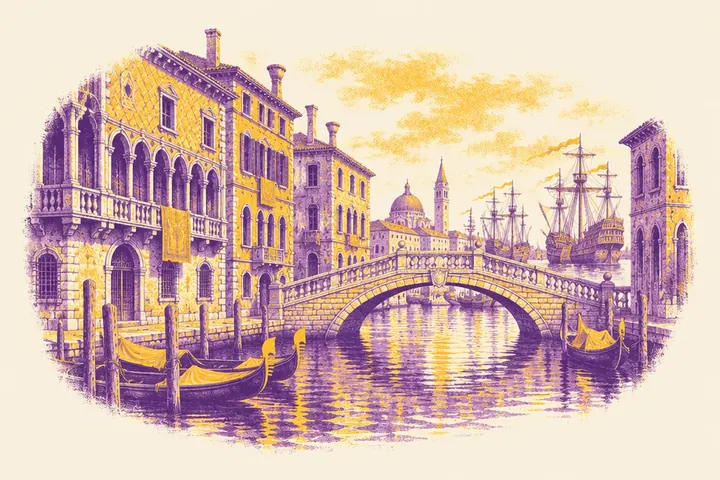
In Shakespeare’s The Merchant of Venice, Antonio borrows three thousand ducats from Shylock, a Jewish moneylender he has insulted for years, and promises a pound of his own flesh if he cannot repay. His ships are lost, and Shylock demands the bond. Portia, disguised as a lawyer, defeats Shylock in court, and he is stripped of his wealth and forced to become a Christian. It is Section A of AQA GCSE English Literature Paper 1.
The Merchant of Venice is a play by William Shakespeare. The Royal Shakespeare Company says it was most likely written in 1596 or 1597, and it was first printed in 1600. It is usually listed among his comedies, plays that end in marriages, but its treatment of Shylock makes it one of his most troubling plays.
- 30marks for The Merchant of Venice question, plus 4 for spelling, punctuation and grammarAQA specification
- 40%of your English Literature GCSE comes from Paper 1AQA specification
- 1600the year the play was first printedRoyal Shakespeare Company
The play is full of hatred of Jewish people, spoken openly by the Christian characters. Shakespeare’s first audiences lived in a country with almost no openly Jewish people, because Jews had been expelled from England in 1290. The play shows that prejudice and lets Shylock answer it. In the exam the question prints an extract, then asks about the play as a whole, so you need to know the whole story.
Act 1: The loan and the bond
Antonio, a rich merchant of Venice, opens the play: “In sooth, I know not why I am so sad”. His friends think he is worried about his ships, which are all at sea. Antonio’s young friend Bassanio arrives. Bassanio has spent all his money, and he wants to travel to Belmont to win a rich heiress, Portia: “In Belmont is a lady richly left”. Antonio has no cash to hand, because it is all in his ships, but he tells Bassanio to borrow in his name.
In Belmont, Portia complains to her maid, Nerissa. Her dead father’s will says she must marry the suitor who chooses the right one of three caskets, made of gold, silver and lead. She cannot choose for herself: “so is the will of a living daughter curbed by the will of a dead father”. The two women mock the suitors who have come so far. Then they hear that the Prince of Morocco is on his way.
In Venice, Bassanio asks Shylock, a Jewish moneylender, for three thousand ducats for three months, with Antonio as guarantee. In an aside, words the audience hears but the others do not, Shylock says: “I hate him for he is a Christian”. He hates Antonio even more for lending money without interest, which brings rates down. Antonio enters, and Shylock reminds him how he has been treated: “You call me misbeliever, cut-throat dog, And spit upon my Jewish gaberdine”. A gaberdine is a long coat. Antonio does not apologise. He says he is likely to do it all again.
Shylock offers to lend the money without interest, as a joke, he says, “in a merry sport”. If Antonio cannot repay on time, Shylock may cut a pound of flesh from his body. Bassanio is uneasy. Antonio is sure his ships will be home long before the date, and he signs.
Act 2: Caskets and an elopement
The Prince of Morocco arrives in Belmont. His first words are “Mislike me not for my complexion”: do not dislike me for the colour of my skin. He must swear that if he chooses wrongly he will never marry anyone.
In Venice, Launcelot Gobbo, Shylock’s servant, decides to leave him and work for Bassanio. Shylock’s daughter, Jessica, is sorry to see him go and says “Our house is hell”. She gives him a letter for Lorenzo, a Christian friend of Bassanio. She plans to run away and marry Lorenzo, and to become a Christian.
Bassanio invites Shylock to dinner. Shylock goes, though he says he goes in hate, and he tells Jessica to lock the doors and keep out the noise of the masked party in the street. That night Jessica escapes dressed as a boy, taking a casket of her father’s ducats and jewels. Bassanio sets sail for Belmont with his talkative friend Gratiano.
Morocco chooses the gold casket. Inside is a skull with a scroll that begins “All that glitters is not gold”. He leaves. Portia says she hopes everyone “of his complexion” chooses the same way, which shows that prejudice lives in Belmont too.
Back in Venice, Antonio’s friends Salarino and Salanio laugh at how Shylock ran through the streets crying about his daughter and his money. They have also heard that a ship from Venice has been wrecked. In Belmont, the Prince of Arragon chooses silver and finds a portrait of a fool. Then news comes that a young Venetian has arrived.
Act 3: Revenge, the right casket and the forfeit
In Venice, the rumour grows that Antonio has lost another ship. Salarino and Salanio taunt Shylock about Jessica. Shylock asks what the pound of flesh is good for, and gives his most famous speech. Jews and Christians have the same bodies and feelings: “If you prick us, do we not bleed?” He says he will take revenge because Christians take revenge: “The villany you teach me, I will execute”.
His friend Tubal brings news from Genoa. Jessica has spent huge sums there, and she swapped a ring for a monkey. It was the ring Shylock’s wife, Leah, gave him before they married: “I would not have given it for a wilderness of monkeys”. Tubal also says that Antonio’s ships are lost. Shylock decides to have the bond.
In Belmont, Portia wants Bassanio to wait before he chooses, because she has fallen for him. He rejects gold and silver, saying “The world is still deceived with ornament”, and chooses lead. Inside is Portia’s picture. Portia gives him herself, her house and a ring, and he swears never to part with it. Gratiano will marry Nerissa. Lorenzo and Jessica arrive with a letter from Antonio. All his ships are lost, the bond is due, and Shylock wants his pound of flesh. Portia offers to pay the debt many times over. She and Bassanio marry, and he rushes back to Venice.
In Venice, Antonio has been arrested. Shylock will not listen to him: “Thou call’dst me dog before thou hadst a cause; But, since I am a dog, beware my fangs”. Antonio knows the Duke cannot break the law, because Venice depends on trade with foreigners trusting its courts.
Portia leaves Lorenzo and Jessica in charge of her house. She sends a servant to her cousin, a lawyer called Doctor Bellario, and tells Nerissa they will go to Venice dressed as men.
Act 4: The trial
The whole of Act 4 Scene 1 is the trial, in front of the Duke of Venice. The Duke asks Shylock to show mercy. Shylock refuses and gives no reason except his hatred for Antonio. Bassanio offers six thousand ducats. Shylock says he would not take it for six times as much. When the Christians tell him to free Antonio, he points out that they own “many a purchased slave”, and they would not free those.
Nerissa arrives disguised as a lawyer’s clerk, with a letter from Bellario. Then Portia enters, disguised as a young doctor of law named Balthasar. She tells Shylock that mercy must be given freely: “The quality of mercy is not strain’d”. Shylock answers “I crave the law”. Portia agrees that the bond is legal. Shylock praises her as wise: “A Daniel come to judgment!” He sharpens his knife. Antonio says goodbye to Bassanio, and Bassanio says he would give up his own wife to save his friend, while his wife, in disguise, listens.
At the last moment Portia says “Tarry a little; there is something else.” The bond gives Shylock flesh, but “no jot of blood”. If he spills one drop of Christian blood, he will lose all his lands and goods. Shylock now asks for the money instead, and is refused. Then Portia names another law. A foreigner who plots against the life of a citizen loses half his goods to his victim and half to the state, and his life is at the Duke’s mercy.
The Duke spares Shylock’s life. Antonio asks for two more conditions. Shylock must become a Christian, and he must leave everything he owns to Lorenzo and Jessica when he dies. Shylock says only “I am not well” and leaves, while Gratiano jeers at him.
Bassanio offers the lawyer a reward. Portia asks for his ring, and he refuses. After she has gone, Antonio persuades him, and Gratiano runs after her with the ring. Nerissa sets out to get Gratiano’s ring too.
Act 5: Rings in Belmont
At night in Belmont, Lorenzo and Jessica sit in the moonlight and compare themselves to famous lovers, each speech starting “In such a night”. Music plays. Portia and Nerissa return just before their husbands. Portia sees a candle in her window and says “How far that little candle throws his beams! So shines a good deed in a naughty world.”
Bassanio arrives with Antonio and Gratiano. Nerissa asks Gratiano where her ring is, and the quarrel spreads to Portia and Bassanio. The wives pretend to be furious, and say they slept with the lawyer and the clerk to get the rings back. At last Portia reveals that she was the lawyer. She gives Antonio a letter saying that three of his ships have reached harbour after all. Lorenzo is given the deed that leaves Shylock’s wealth to him and Jessica. The play ends in jokes and couples, and Shylock is not mentioned.
The main characters
- Shylock: a Jewish moneylender in Venice, insulted in public by Antonio for years. He lends three thousand ducats on a bond of a pound of flesh, loses his daughter and his wealth, and is forced to become a Christian.
- Antonio: the merchant of the title, sad from the first line. He borrows from Shylock for Bassanio’s sake, and in court he sets the conditions of Shylock’s sentence.
- Bassanio: Antonio’s young friend, deep in debt, who wins Portia by choosing the lead casket, then gives away her ring.
- Portia: a rich heiress of Belmont, bound by her dead father’s will. Disguised as a young lawyer, she wins the trial.
- Jessica: Shylock’s daughter, who runs away with his money to marry Lorenzo and become a Christian.
- Lorenzo: Bassanio’s Christian friend, who elopes with Jessica.
- Gratiano: Bassanio’s loud friend, who marries Nerissa and mocks Shylock harshly in court.
- Nerissa: Portia’s maid and friend, who goes to court disguised as the lawyer’s clerk.
- Tubal: Shylock’s Jewish friend, who brings news from Genoa.
- Launcelot Gobbo: the clown, who leaves Shylock to serve Bassanio.
- The Princes of Morocco and Arragon: suitors who choose the gold and silver caskets and lose.
- The Duke of Venice: the ruler who hears the case.
The main ideas and context
Prejudice and the outsider. Antonio has spat on Shylock in public, and the Christians call him a dog and a devil. Morocco expects to be judged by his skin, and Portia does judge him by it. The play shows prejudice at work in both Venice and Belmont, and it gives Shylock powerful speeches in reply.
Jewish people in Shakespeare’s England. Edward I expelled the Jews from England in 1290, and they were not allowed to return until 1656. Most of Shakespeare’s first audience had never knowingly met a Jewish person, so their ideas came from sermons, stories and plays. Christopher Marlowe’s The Jew of Malta, first performed around 1589, had already made a Jewish villain popular on the London stage. Many people today see the play as antisemitic, meaning prejudiced against Jewish people, or as a play that shows antisemitism in order to question it.
Money and usury. Usury means lending money at interest. The Church taught that it was a sin for Christians, so in many Christian cities moneylending was one of the few trades open to Jewish people, who were then despised for doing it. Venice was a rich trading city that depended on its laws being trusted by merchants from many nations.
Justice and mercy. Shylock asks for the law, and Portia asks for mercy. Then the court uses the law to take Shylock’s wealth and his faith. Students often ask how merciful the Christians really are.
Appearance and reality. The caskets teach that the outside can lie. Portia and Nerissa pass for men, and the lead casket holds the prize.
Fathers and daughters. Portia obeys a dead father, and Jessica escapes a living one.
Comedy. In Shakespeare’s time a comedy was a play that ended in marriages and restored order. Here the happy ending in Belmont depends on Shylock’s ruin.
Myths about The Merchant of Venice
Myth Shylock is the merchant of Venice.
What the evidence says
The merchant of the title is Antonio. Shylock is a moneylender. Antonio’s first line opens the play, and the whole plot starts with his loan for Bassanio.
Source: William Shakespeare, The Merchant of Venice, Act 1 Scenes 1 and 3 (Globe edition text)
Myth Shylock is simply a villain.
What the evidence says
He does try to kill Antonio, but Shakespeare also shows why he hates. He has been spat on and called a dog, and in Act 3 Scene 1 he argues that a Jew has the same body and feelings as a Christian. The play makes the audience see both sides.
Source: William Shakespeare, The Merchant of Venice, Act 1 Scene 3 and Act 3 Scene 1 (Globe edition text)
Myth Shakespeare made up the story of the pound of flesh.
What the evidence says
The Royal Shakespeare Company says his main source was Il Pecorone, an Italian collection of stories printed in 1558. It already has the loan, the pound of flesh and the lady who saves the merchant dressed as a lawyer.
Source: Royal Shakespeare Company, The Merchant of Venice: dates and sources
The Merchant of Venice in the exam
The Merchant of Venice is one of the Shakespeare plays you can study for Section A of AQA’s Literature Paper 1. Paper 1 lasts 1 hour 45 minutes and makes up 40% of your English Literature GCSE. In Section B of the same paper you answer on your 19th-century novel.
You answer one question. It prints an extract from the play, then asks about the extract and about the play as a whole. It is worth 30 marks, plus 4 marks for AO4: using a range of vocabulary and sentence structures, with accurate spelling and punctuation. Spend about 50 minutes on it. The exam is closed book, so anything you say about the rest of the play comes from memory.
In June 2024, AQA’s examiners wrote that “Responses to The Merchant of Venice demonstrated engagement with the text and the character of Shylock.” When you write about Shylock, write about how Shakespeare presents him and how the Christians treat him, and use the context of the time to explain it.
What to do next
Learn the quotations on The Merchant of Venice: quotations to learn, and practise with How to answer the extract question. For the history behind the play, see Using context in your answers. You can read the whole play free on Project Gutenberg.
Frequently asked questions
What is the bond in The Merchant of Venice?
Shylock lends Antonio three thousand ducats for three months without interest. If Antonio cannot repay in time, Shylock may cut a pound of flesh from his body. Antonio signs because he expects his ships home long before the date.
How does Portia save Antonio?
Disguised as a young lawyer, she agrees that Shylock may have his pound of flesh, but says the bond gives him no blood. If he spills a drop, he loses everything. She then uses another law against him for plotting against a citizen’s life.
What happens to Shylock at the end?
He loses half his wealth to Antonio and half to the state, though Antonio agrees to hold his half for Lorenzo and Jessica. Shylock must become a Christian and leave everything to them when he dies. He does not appear in Act 5.
Is The Merchant of Venice antisemitic?
The Christian characters insult Shylock for being Jewish and force him to give up his faith, and many people find the play antisemitic. Shakespeare also gives Shylock speeches that show the cruelty he suffers. In the exam, explain how the play presents him and how audiences then and now might react.
Which paper is The Merchant of Venice on?
It is on AQA Literature Paper 1, Section A. You get one question on an extract and the whole play, worth 30 marks plus 4 for spelling, punctuation and grammar.
Sources
- Project Gutenberg, William Shakespeare, The Merchant of Venice (ebook 1515)
- Royal Shakespeare Company, The Merchant of Venice: dates and sources
- AQA, GCSE English Literature 8702 specification
- AQA, Report on the examination: Paper 1, June 2024