

Knowledge hub › For students › The Tempest: the story
The Tempest: the story, act by act
A magician on a remote island raises a storm to wreck the ship carrying the men who stole his dukedom. Read what happens in every act, then the main characters and ideas.
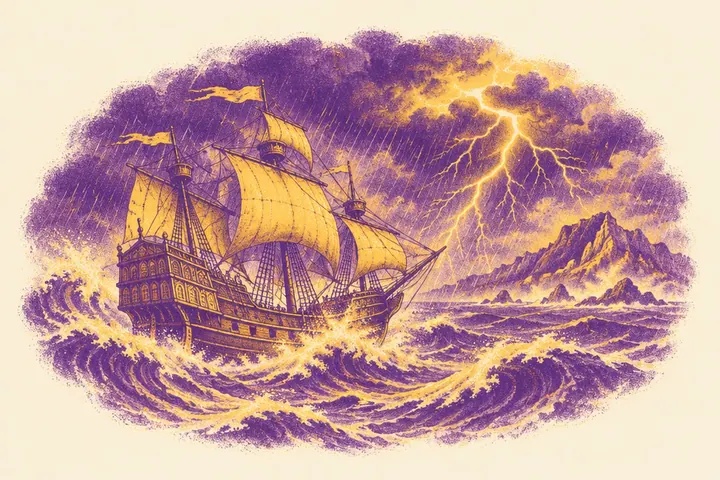
In Shakespeare’s The Tempest, Prospero, the overthrown Duke of Milan, uses magic to wreck his enemies’ ship on his island. His daughter Miranda falls in love with the King of Naples’ son, Caliban plots against him, and his enemies are driven to despair. In the end Prospero forgives them, gives up his magic and sets his spirit Ariel free. It is Section A of AQA GCSE English Literature Paper 1.
The Tempest is a play by William Shakespeare. The Royal Shakespeare Company says its first recorded performance was at court on 1 November 1611, and that it was not printed until the First Folio of 1623, after Shakespeare’s death. It is usually thought to be the last play he wrote on his own.
- 30marks for The Tempest question, plus 4 for spelling, punctuation and grammarAQA specification
- 40%of your English Literature GCSE comes from Paper 1AQA specification
- 1611the year of the first recorded performance, on 1 NovemberRoyal Shakespeare Company
The whole play takes place on one island in a single afternoon, a few hours long. Prospero controls almost everything that happens, so the real questions are what he wants and what kind of ruler he is. In the exam the question prints an extract, then asks about the play as a whole, so you need to know the whole story.
Act 1: The storm and the island
A ship is caught in a terrible storm. On board are Alonso, King of Naples, his brother Sebastian, his son Ferdinand, Antonio, Duke of Milan, and an honest old counsellor, Gonzalo. The Boatswain, the officer in charge of the sailors, tells the noblemen to get out of the way. When Gonzalo reminds him the King is on board, he answers: “What cares these roarers for the name of king?” The roaring waves do not care about rank. The ship seems to split.
On the island, Miranda has watched the wreck and begs her father, Prospero, to calm the sea. He tells her no one is hurt. Then he tells her who they are. Twelve years ago he was Duke of Milan. He loved his books so much that he left the government to his brother Antonio: “Me, poor man, my library Was dukedom large enough”. Antonio made a deal with Alonso, King of Naples, and threw Prospero out. Prospero and Miranda, who was not yet three, were put to sea in “A rotten carcass of a boat”. Gonzalo secretly gave them food, clothes and Prospero’s books of magic. Now, by luck, his enemies have sailed close to the island, and he has raised the storm.
Prospero sends Miranda to sleep and calls his spirit, Ariel. Ariel reports that the ship is safe in harbour and the passengers are scattered around the island. Ferdinand, the King’s son, jumped first, crying “Hell is empty And all the devils are here.” When Ariel asks for the freedom he was promised, Prospero grows angry: “Dost thou forget From what a torment I did free thee?” A witch called Sycorax had trapped Ariel in a pine tree. Prospero freed him, and threatens to trap him in an oak if he complains again. He promises Ariel his freedom in two days.
Next Prospero calls Caliban, Sycorax’s son, whom he keeps as a slave. Caliban says: “This island’s mine, by Sycorax my mother, Which thou takest from me.” At first Prospero was kind to him and taught him to speak. Then Caliban tried to rape Miranda, and now Prospero keeps him in a rock. Caliban answers: “You taught me language; and my profit on’t Is, I know how to curse.”
Ariel, invisible, sings to Ferdinand that his father is drowned: “Full fathom five thy father lies”. The music leads Ferdinand to Miranda. She has never seen a young man and thinks he is “A thing divine”. They fall in love at first sight, which is what Prospero wanted. To make sure Ferdinand does not win her too easily, Prospero calls him a spy, freezes his sword with magic and makes him a prisoner.
Act 2: Plots in the sleeping court
Elsewhere on the island, Alonso grieves for Ferdinand, whom he thinks is drowned. Gonzalo tries to cheer him up and imagines how he would rule the island if he could. There would be no trade, no rulers and no work. Sebastian and Antonio mock him, and Sebastian points out the contradiction: “Yet he would be king on’t.”
Ariel’s music sends everyone to sleep except Sebastian and Antonio. Antonio tempts Sebastian to kill his brother and take the crown of Naples, just as Antonio took Milan: “My strong imagination sees a crown Dropping upon thy head.” When Sebastian asks about his conscience, Antonio answers: “I feel not This deity in my bosom”. They draw their swords. Ariel wakes Gonzalo just in time. The two men claim they drew their swords because they heard lions roaring.
In another part of the island, Caliban is carrying wood and cursing Prospero. He hears Trinculo, the King’s jester, and hides under his cloak. A storm is coming, so Trinculo crawls under the cloak too. Stephano, the King’s drunken butler, arrives with a barrel of wine. He finds what looks like a monster with four legs and two voices. Stephano gives Caliban wine, and Caliban decides Stephano is a god: “I’ll kiss thy foot; I’ll swear myself thy subject.” He leads them off, singing that he has a new master and is free.
Act 3: Love, a murder plot and a harpy
Ferdinand is carrying heavy logs, the punishment Prospero has set him. He does not mind, because he works for Miranda. Miranda offers to carry them for him. Prospero watches, unseen and pleased. Miranda drops all the polite rules of courtship and says: “I am your wife, if you will marry me”. They promise to marry.
Caliban, Stephano and Trinculo are drunk. Caliban asks Stephano to kill Prospero while he sleeps, “Having first seized his books”, because without his books Prospero has no power. Then Stephano can be king of the island and marry Miranda. Ariel, invisible, keeps calling out “Thou liest”, and Stephano blames Trinculo and beats him. When Ariel’s music plays, the two Europeans are scared, but Caliban comforts them: “Be not afeard; the isle is full of noises”. He describes music and dreams so lovely that he cries to dream again.
Alonso and the lords are tired from searching. Strange spirits bring in a banquet, then Ariel appears as a harpy, a monster with a woman’s face and a bird’s body. The food vanishes. Ariel tells Alonso, Antonio and Sebastian: “You are three men of sin”. He reminds them how they threw Prospero and his child out to sea, and says that Ferdinand’s death is their punishment. Alonso is overcome with guilt and runs off, meaning to drown himself. Antonio and Sebastian draw swords to fight the spirits, and Gonzalo sends men after all three.
Act 4: The masque
Prospero tells Ferdinand that his trials were only a test of his love, and gives him Miranda. He warns him not to sleep with her before the wedding. Then he has his spirits perform a masque, a show of music and dance, in which the goddesses Iris, Ceres and Juno bless the couple.
In the middle of the dance, Prospero suddenly remembers Caliban’s plot against his life, and the masque vanishes. Ferdinand is alarmed at how upset he is. Prospero tells him that the whole world will fade away like the show: “We are such stuff As dreams are made on”. Then he calls Caliban “A devil, a born devil, on whose nature Nurture can never stick”. Nature is what you are born with, and nurture is how you are brought up.
Ariel hangs fine clothes on a line outside Prospero’s cell. Caliban, Stephano and Trinculo arrive, soaked and smelly from a filthy pool. Stephano and Trinculo are distracted by the clothes and start trying them on, though Caliban begs them to kill Prospero first. Spirits in the shape of hunting dogs chase them away. Prospero says that soon all his enemies will be at his mercy.
Act 5: Forgiveness and freedom
Ariel reports that the lords are held in a spell, and that if Prospero saw them his feelings would soften. Ariel says his would, “were I human”. Prospero decides: “the rarer action is In virtue than in vengeance”. Rarer means finer. He will forgive them. In a long speech he gives up his “rough magic”, and promises to break his staff and “I’ll drown my book.”
The lords are brought into a magic circle. Prospero appears to them dressed as the Duke of Milan. Alonso gives him back his dukedom and asks his pardon. Prospero forgives Antonio too: “I do forgive Thy rankest fault”. Antonio says almost nothing, and never says he is sorry.
Prospero then reveals Ferdinand and Miranda playing chess. Alonso is overjoyed to find his son alive, and to hear of the marriage. Miranda sees more people than she has ever seen and cries: “O brave new world, That has such people in’t!” Prospero replies: “’Tis new to thee.” The Boatswain arrives to say the ship is whole and ready to sail.
Ariel drives in Caliban, Stephano and Trinculo, still wearing the stolen clothes. Prospero says of Caliban: “this thing of darkness I Acknowledge mine.” Caliban feels foolish for worshipping a drunkard, and promises to “seek for grace”. Prospero invites everyone to his cell for the night. They will sail for Naples in the morning, and Ariel’s last task is to give them calm seas. Then he will be free.
In the Epilogue, Prospero is alone on stage. His magic is gone, and he asks the audience to free him with their applause. The play ends: “Let your indulgence set me free.”
The main characters
- Prospero: the rightful Duke of Milan, overthrown by his brother twelve years earlier. He rules the island by magic, raises the storm, then forgives his enemies and gives up his art.
- Miranda: Prospero’s daughter, who has grown up on the island. She pities the shipwrecked men, falls in love with Ferdinand and proposes to him herself.
- Ariel: a spirit freed by Prospero from a pine tree, who serves him in return. He raises the storm, appears as a harpy and keeps asking for his liberty, which he wins at the end.
- Caliban: Sycorax’s son, who says the island is his. Prospero taught him language and keeps him as a slave. He takes Stephano as a new master and plots Prospero’s death.
- Ferdinand: son of the King of Naples, who thinks his father is drowned. Prospero tests his love by making him carry logs.
- Antonio: Prospero’s brother, who took Milan. He tempts Sebastian to murder the King and is forgiven, though he never says sorry.
- Alonso: King of Naples, who helped Antonio. Grief and guilt change him, and he asks Prospero’s pardon.
- Sebastian: Alonso’s brother, who agrees to Antonio’s murder plan.
- Gonzalo: the honest old counsellor who helped Prospero when he was cast out.
- Stephano and Trinculo: the King’s drunken butler and his jester, who plan to rule the island.
- Sycorax: Caliban’s mother, a witch who died before Prospero arrived. She never appears.
The main ideas and context
Power and control. Prospero controls the island, the storm, his daughter and his servants. Antonio, Sebastian and Stephano all want to rule as well. The play ends with Prospero giving his power up.
Freedom and service. Ariel asks again and again for freedom. Caliban sings of freedom as he takes a new master. The last word of the play is free.
Revenge and forgiveness. Prospero has his enemies at his mercy and chooses to forgive them. Students often ask whether his forgiveness is complete, since he still holds Antonio’s crimes over him.
Colonisation. Colonisation means one people taking over another’s land. Caliban says the island was his and was taken from him. In 1609 an English ship, the Sea Venture, was wrecked off Bermuda, and the Royal Shakespeare Company says an account of the wreck is a source for the play. Ariel mentions “the still-vex’d Bermoothes”, meaning Bermuda. The English were starting colonies in America at this time, and many readers now see Prospero and Caliban as a colonist and the person whose land he takes.
Nature and nurture. Prospero says Caliban can never be taught to be good. Yet Caliban speaks some of the most beautiful lines in the play, and the noblemen plot murder.
Magic and theatre. Prospero’s art makes storms, songs, a banquet and a masque. King James I, who watched the play at court, was very interested in witchcraft. The play sets Prospero’s learned magic, studied in books, against the witchcraft of Sycorax. In the Epilogue Prospero speaks like an actor at the end of a show, which is why many people link him to Shakespeare himself.
Myths about The Tempest
Myth The Tempest is a happy comedy where everything ends well.
What the evidence says
It was printed among the comedies and ends in a marriage, but it is full of anger and plots. Antonio never says he is sorry, Caliban is still a servant, and Prospero says that in Milan every third thought shall be his grave.
Source: William Shakespeare, The Tempest, Act 5 Scene 1 (Standard Ebooks text)
Myth Prospero is always a kind father and master.
What the evidence says
He threatens Ariel with being trapped in an oak, calls Caliban a born devil and is harsh with Ferdinand. He shows great love for Miranda, but he also controls whom she meets and when.
Source: William Shakespeare, The Tempest, Act 1 Scene 2 and Act 4 Scene 1 (Standard Ebooks text)
Myth Shakespeare took the plot from an older story.
What the evidence says
The Royal Shakespeare Company says the plot of The Tempest is Shakespeare’s own. He borrowed ideas from reports of the Bermuda shipwreck, from the French writer Montaigne and from the Roman poet Ovid, but no earlier play or story has the same plot.
Source: Royal Shakespeare Company, The Tempest: dates and sources
The Tempest in the exam
The Tempest is one of the Shakespeare plays you can study for Section A of AQA’s Literature Paper 1. Paper 1 lasts 1 hour 45 minutes and makes up 40% of your English Literature GCSE. In Section B of the same paper you answer on your 19th-century novel.
You answer one question. It prints an extract from the play, then asks about the extract and about the play as a whole. It is worth 30 marks, plus 4 marks for AO4: using a range of vocabulary and sentence structures, with accurate spelling and punctuation. Spend about 50 minutes on it. The exam is closed book, so anything you say about the rest of the play comes from memory.
Because Prospero controls so much, many questions ask about him, about power, or about how he treats Ariel and Caliban. Know how each of those three relationships changes by Act 5.
What to do next
Learn the quotations on The Tempest: quotations to learn, and practise with How to answer the extract question. For colonisation and the court of King James, see Using context in your answers. You can read the whole play free on Standard Ebooks.
Frequently asked questions
How long does the story of The Tempest take?
Only a few hours on a single afternoon. Prospero tells Ariel the work must be finished by six o’clock, and in Act 5 Alonso says the ship was wrecked three hours before.
Why does Prospero raise the storm?
His enemies, Antonio and Alonso, are sailing near the island. The storm brings them ashore so that Prospero can confront them, win back his dukedom and arrange for Miranda to meet Ferdinand.
Is Caliban a monster?
Other characters call him one, and Prospero calls him a born devil. But Caliban says the island was his, and he speaks some of the most beautiful lines in the play. A good answer weighs both views.
Does Prospero really forgive his enemies?
He says he chooses virtue over vengeance and forgives them all, including Antonio’s “rankest fault”. But Antonio never answers, and Prospero still reminds him of his crimes, so some readers think the forgiveness is cold.
Which paper is The Tempest on in GCSE English Literature?
It is on AQA Literature Paper 1, Section A. You get one question on an extract and the whole play, worth 30 marks plus 4 for spelling, punctuation and grammar.
Sources
- Standard Ebooks, William Shakespeare, The Tempest (based on the Globe edition of Clark and Wright)
- Royal Shakespeare Company, The Tempest: dates and sources
- Royal Shakespeare Company, The ship that inspired Shakespeare
- AQA, GCSE English Literature 8702 specification