Knowledge hub › Three levels
One question, three levels of support
In every lesson, every student answers the same question about the same text. The three levels change the support around the task and leave the task alone. Here is the thinking behind that, and how to decide who starts where.
Mixed classes are normal in English, and so is the pull towards writing three tasks: an easier one, a standard one and a harder one. It looks like good adaptation. The trouble is what it does to expectations.
The case against separate tasks
The Department for Education’s framework for new teachers is direct about it:
“Adaptive teaching is less likely to be valuable if it causes the teacher to artificially create distinct tasks for different groups of pupils or to set lower expectations for particular pupils.”
The same standard asks teachers to adapt lessons “whilst maintaining high expectations for all, so that all pupils have the opportunity to meet expectations”.
A separate, easier task decides in advance which students will meet the question that matters. A shared task with different support keeps the question the same for everyone and changes how much help each student gets on the way to answering it.
The Education Endowment Foundation’s guidance on special educational needs makes a related point: “To a great extent, good teaching for pupils with SEND is good teaching for all.” Scaffolding is one of the five strategies it recommends, alongside explicit instruction, cognitive and metacognitive strategies, flexible grouping and technology.
What changes at each level
Here is the task page from Lesson 3 of the A Christmas Carol scheme in each student pack. The question is the same on all three: “How does Dickens present Scrooge as cut off from other people?”
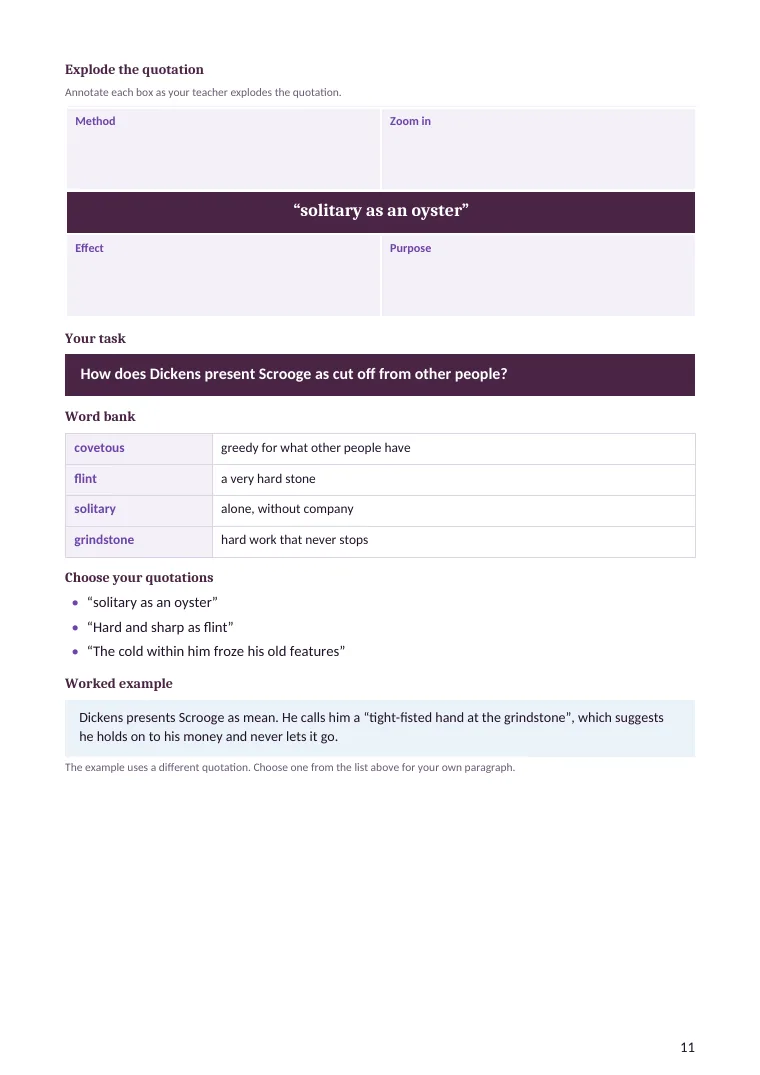
Securing
aiming for a 4
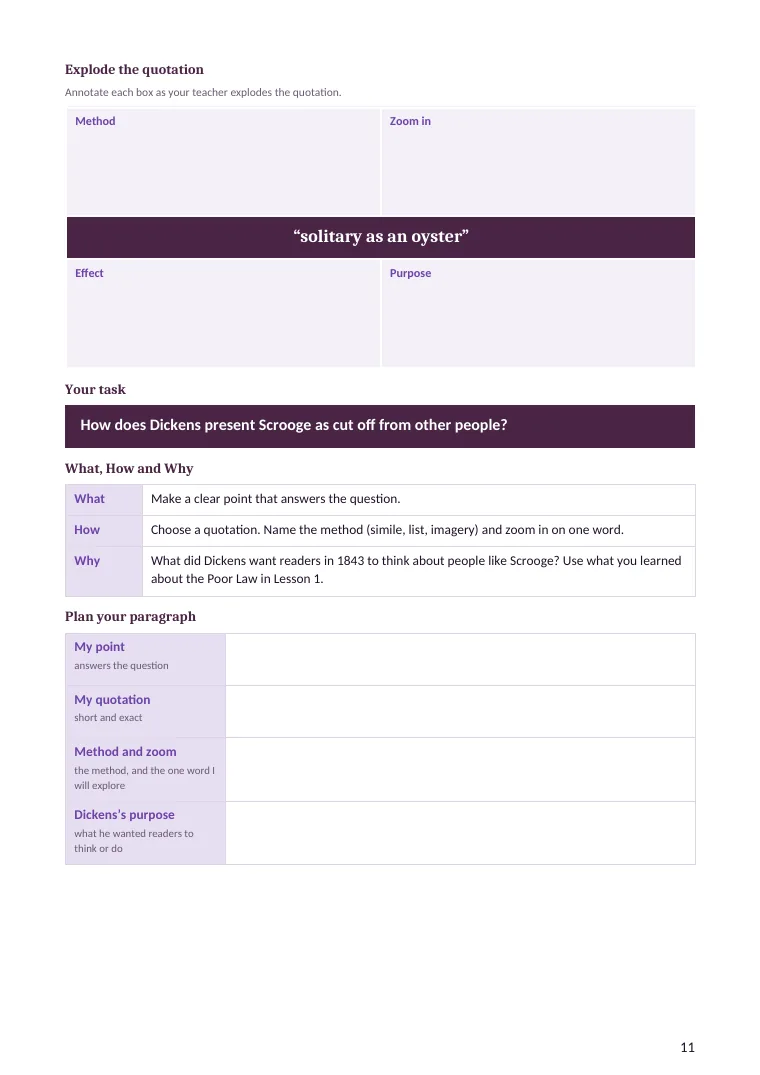
Strengthening
aiming for grades 5 to 6
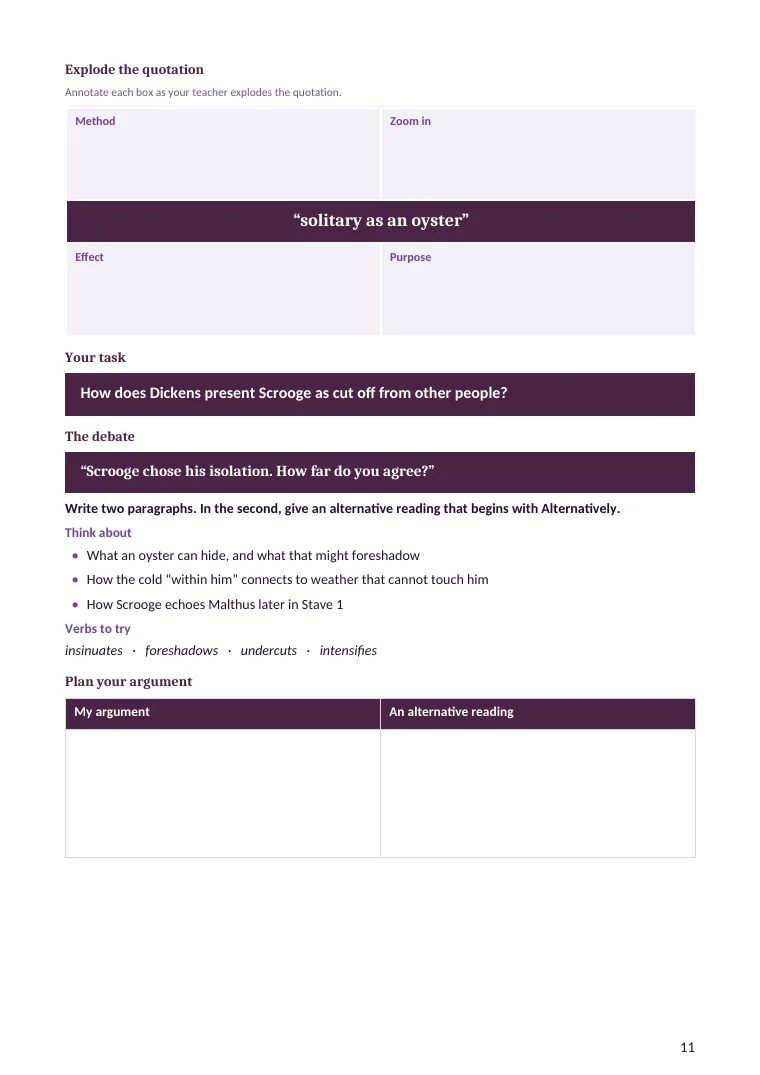
Soaring
aiming for grades 7 to 9
- Securing (aiming for a 4): a word bank with short definitions, a choice of exact quotations, a worked example on a different quotation, and sentence starters for What, How and Why.
- Strengthening (aiming for grades 5 to 6): prompts for each part of the paragraph, a paragraph planner and a success checklist.
- Soaring (aiming for grades 7 to 9): a debatable statement to argue with, prompts that push towards alternative readings, and precise analytical verbs. No sentence starters.
The worked example at Securing uses a different quotation from the ones students choose from. Students see every move a good paragraph makes, and they still have to make those moves themselves.
Naming the levels
Securing, Strengthening and Soaring are verbs. Each names what the work is doing and the grade it is aiming for, which is a description of today’s task and says nothing fixed about the student. The levels are printed in words only, with no colour coding, so nobody spends Year 11 as the red group.
The evidence on grouping by attainment within a class is a reason for care. The EEF’s Teaching and Learning Toolkit puts the average impact of within-class attainment grouping at two months’ additional progress, from very limited evidence, and notes that “studies that measured literacy outcomes found no difference, on average”. It warns that without the flexibility to move between groups, some pupils “may suffer from a lack of confidence leading to lower engagement, and subsequently attainment”.
So the levels are a starting point for one task, and students move between them. The student packs tell students so: “Everyone in your class answers the same question in every lesson. Only the support changes, so you can move between packs as you improve.”
Deciding who starts where
The hinge question decides it. In Lesson 3, before anyone writes, the class answers a three-option question on mini-whiteboards: which reading of “solitary as an oyster” does the text best support? The teacher notes say what each wrong answer tells you.
From there the notes are specific:
- Students who chose the literal reading, or who struggled with the Do Now, start on Securing.
- Anyone who completes the Securing frame in ten minutes moves to the Strengthening prompts for a second paragraph.
- Students who can already build a thesis start on Soaring.
The exit ticket closes the loop. At the end of Lesson 3, you sort the tickets into three piles to plan the start of the next lesson, so tomorrow starts from what students wrote today.
In practice
- Give each student the pack that suits them, printed or as a PDF, and keep copies of the next level’s task page to hand so a student can move up mid-lesson.
- Let a student try a level higher when they want to. The support they need is still there if the attempt stalls.
- Share the model paragraph with the whole class at the end. Everyone sees the same standard, whatever support they had on the way.
Sources
- Department for Education, Initial teacher training and early career framework (2024), Standard 5
- Education Endowment Foundation, Special educational needs in mainstream schools (2020)
- Education Endowment Foundation, Teaching and Learning Toolkit: within-class attainment grouping