Knowledge hub › Whole-class feedback
Whole-class feedback without raw marks
Read the answers, write one sheet for the class and spend the next lesson acting on it. Here is what the evidence supports, where it runs out, and how the Feedback Loop kits in our schemes run it.
Writing a comment in every book is slow, and the evidence that it pays off is thin. Whole-class feedback replaces the comments with one sheet. For the Chartered College of Teaching, Tom Sherrington and Sara Stafford describe teachers reading “a whole set of books – without marking each individual student’s work” and then sharing feedback “as a whole-class activity in the following lesson”. Students then act on it.
Why departments moved away from marking every book
In 2016 the Department for Education’s review group on marking said marking should be “meaningful, manageable and motivating”. It warned: “The quantity of feedback should not be confused with the quality.” It was concerned that extensive written comments on every piece of work had become common practice “when there is very little evidence that this improves pupil outcomes in the long term”.
The time involved is real. In the DfE’s 2019 workload survey, secondary teachers who marked during the survey week reported spending 6.3 hours on it.
Inspection is not a reason to keep doing it either. Ofsted’s current inspection information says: “We do not specify the frequency, type or volume of marking and feedback.”
What the evidence says
The Education Endowment Foundation’s 2021 guidance on feedback is the place to start. Its first three recommendations are “Lay the foundations for effective feedback”, “Deliver appropriately timed feedback that focuses on moving learning forward” and “Plan for how pupils will receive and use feedback”.
On written comments against spoken feedback, it says:
“The method of delivery (and whether a teacher chooses to use written or verbal feedback) is likely to be less important than ensuring that the principles of effective teacher feedback (Recommendations 1–3) are followed.”
It also says feedback only counts once students use it: “Teachers should also provide opportunities for pupils to use feedback. Only then will the feedback loop be closed so that pupil learning can progress.”
The guidance includes a case study close to whole-class feedback as most departments run it. At Grove School in Wiltshire, “teachers read books but rarely write in them. They then use a handwritten sheet of comments which summarises the strengths and targets for the entire class”. Teachers there found it “quicker than offering extensive written feedback on all work”. The DfE’s framework for new teachers names it too, as one of the “alternative approaches to providing feedback (e.g. using whole class feedback or well supported peer- and self-assessment)”.
The same guidance is clear about the limits: “No evidence was found on the use of specific techniques (such as whole-class feedback or one-to-one verbal discussions).” Whole-class feedback is a manageable way to follow the principles. It hasn’t been tested as a technique in its own right.
Keep it specific
The risk with one sheet for thirty students is feedback so general that nobody acts on it. Daisy Christodoulou gave a good example in Tes in 2018: in place of telling pupils to “use vocabulary more appropriately”, a teacher might plan an activity that teaches the whole class “why ‘cheesy’ is not an appropriate word to describe Romeo - and why ‘sentimental’ is”.
The sheet is a plan for teaching. Name the mistake, show a better version and give students a task that makes them use it.
How the Feedback Loop kits run it
Every scheme has Feedback Loop mini assessments planned into the sequence. A kit takes 25 minutes of a lesson:
- Students read four common mistakes and a tip (3 minutes).
- They answer three short questions, one each on What, How and Why (9 minutes).
- They write one What–How–Why paragraph (13 minutes).
You mark the three short answers against the answers in the kit and place each paragraph in an AQA level, using the indicative content for that task. The paragraph gets no mark. Then you fill in one whole-class feedback sheet:
- what went well, and what would make the work even better, each with an example
- a tally of the common mistakes you saw
- the spread of levels across the class
- students to praise and students to support
- what to re-teach at the start of the next lesson
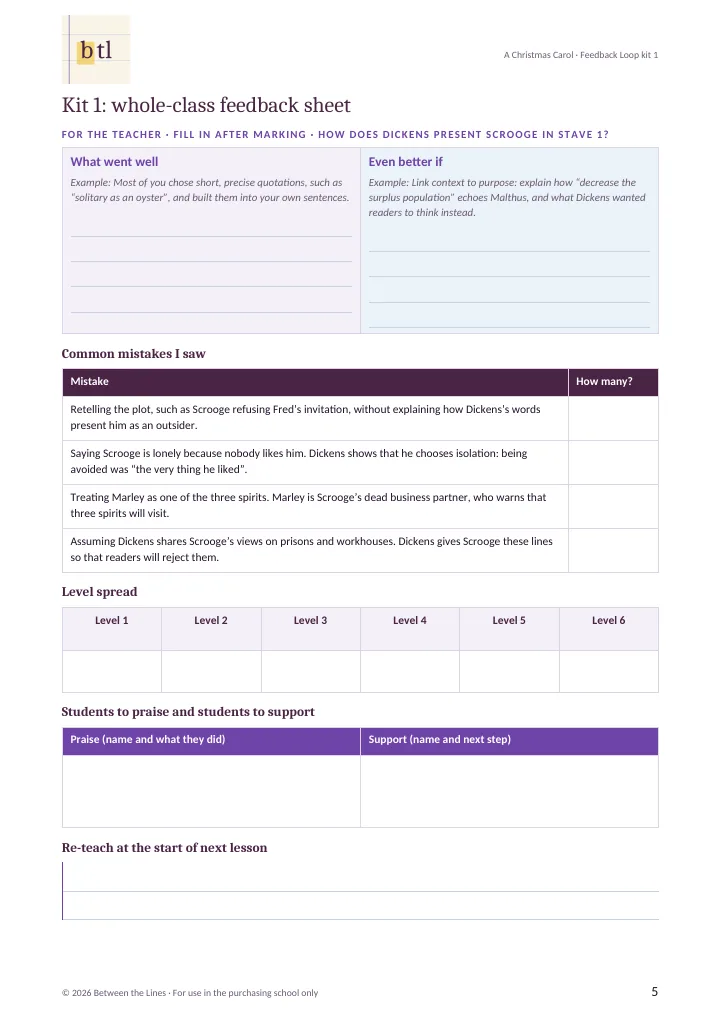
Next lesson, students get their sheets back with a level circled, hear the feedback and complete the improvement task for their level in green pen, then try the next level’s task if they have time. Every level has its own task, so a student at Level 2 and a student at Level 5 both leave with a clear next step.
Why levels and no marks
A raw mark tells a student very little about what to do next. A level does: the descriptor for the level above is the target, and the improvement task is written to reach it. Placing work in levels also keeps the conversation in the language students will meet in the exam, from AQA’s level headings such as “Explained, structured comments” up to “Convincing, critical analysis and exploration”.
Sources
- Tom Sherrington and Sara Stafford, Effective feedback: whole-class marking, Chartered College of Teaching (2019)
- Department for Education, Eliminating unnecessary workload around marking (2016)
- Department for Education, Teacher workload survey 2019
- Ofsted, Inspection information for state-funded schools, for use from September 2026
- Education Endowment Foundation, Teacher feedback to improve pupil learning (2021)
- Department for Education, Initial teacher training and early career framework (2024), Standard 6
- Daisy Christodoulou, Why whole-class feedback beats ‘vague written comments’, Tes (2018)