
Unseen poetry: videos to go with the book
Free videos to go with the Between the Lines revision book for Unseen poetry. Watch one, then go back to the book and write: the exam is sat by hand.

Start here
Watch the complete guide before you start the book.
Read the transcript
This is the complete guide to unseen poetry, the last section of AQA English Literature Paper 2. I’m Hannah, and I teach English. You can’t revise the poem you’ll be given, but you can revise everything you need to read it: the terms, how the two questions work, form and structure, and a routine for the exam. Section C is the last section of Paper 2 (2 hours 15 minutes, 96 marks). It carries 32 marks, so students who overrun on the modern text or the anthology lose time here.
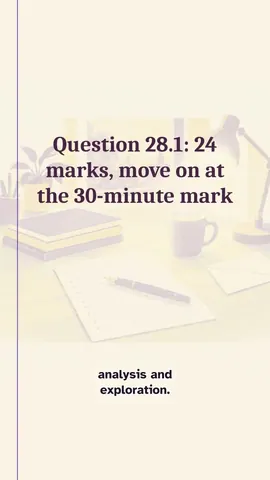
Practise the 45 minutes as one block. Question 28.1: 24 marks, move on at the 30-minute mark. AO1 and AO2. In one poem, how does the poet present a named subject? Marked in AQA’s six Literature levels of four marks each, from Level 1 (1 to 4 marks), Simple, explicit comments, to Level 6 (21 to 24 marks), Convincing, critical analysis and exploration.
Top answers open with a thesis about the whole poem, zoom out to say what the whole poem does and where it changes, then move through it in order, and analyse language, form and structure, each method tied to the focus of the question. Context earns no marks. Pitfalls: paraphrase line by line; naming methods with no effect; never reaching the end of the poem. Question 28.2: 8 marks, about 10 minutes. AO2 only.
What are the similarities and/or differences between the methods the two poets use to present a shared subject? Marked in four levels of two marks each, with AQA’s headings: Level 1 (1 to 2 marks), Simple comment on one or both poems; Level 2 (3 to 4 marks), Clear comparison; Level 3 (5 to 6 marks), Thoughtful comparison; Level 4 (7 to 8 marks), Critical, insightful comparison. Two or three points, each with a method in both poems and its effect; compare point by point, or one poem then the other with clear links. Pitfalls: a second essay on the new poem; comparing what the poems are about; spending longer on 28.2 than its 8 marks deserve. The terms to know.
Name a method only when you can say what it does. Speaker: The voice in the poem. It may or may not be the poet. Imagery: Language that creates a picture or a sense impression: sight, sound, touch, taste or smell. Simile: A comparison using like or as.
Metaphor: A comparison that says one thing is another. Personification: Giving human qualities to something that is not human. Alliteration: Words close together that begin with the same sound. Sibilance: Repeated s and sh sounds. Rhyme scheme: The pattern of rhymes at the ends of lines, written as letters (ABAB).
Half-rhyme: Words whose sounds nearly rhyme, such as once and France. Enjambment: A sentence that runs on from one line into the next with no pause. Caesura: A pause in the middle of a line, usually marked by punctuation. Stanza: A group of lines in a poem, separated by a space. Sonnet: A fourteen-line poem with a set rhyme scheme, often about love.
Volta: The turn in a poem, where the thought or mood changes. Refrain: A line or phrase that is repeated. Tone: The attitude or feeling a poem’s voice conveys: bitter, tender, calm. Juxtaposition: Placing two contrasting ideas or images side by side. Semantic field: A group of words linked by meaning, such as words about cold.
These add to the terms above. The examples come from the poems in the unit. Quatrain and couplet: Stanzas of four lines and of two. Teasdale’s six couplets make each image in ‘There Will Come Soft Rains’ a calm, closed unit (Lesson 2). Petrarchan sonnet: An octave of eight lines, then a sestet of six, with a volta between.
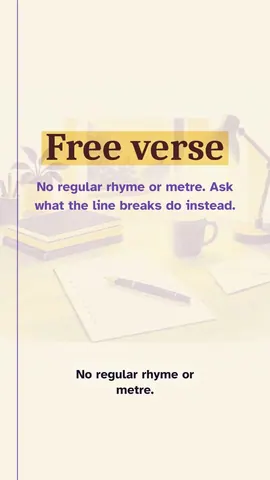
‘Remember’ turns at line 9 on “Yet” (Lesson 3). Shakespearean sonnet: Three quatrains and a final couplet, which often sums up or twists the argument. Free verse: No regular rhyme or metre. Ask what the line breaks do instead. Metre: The pattern of stressed and unstressed syllables.
Iambic pentameter has five beats (da-DUM) and sits close to speech, as in ‘Remember’ and ‘The Tropics in New York’. Count the beats before naming a metre. Line length: Long lines can unroll slowly, like the memory in ‘Piano’ (Lesson 4). Short lines of two or three beats tighten ‘The Self-Unseeing’ (Lesson 7). End-stopped line: A line that ends with punctuation and a pause.
Next to enjambment it can make a statement sound final. Shift in tense: From “will” to “would” in ‘There Will Come Soft Rains’: the poem stops predicting and starts imagining (Lesson 2). Anaphora: Lines that begin the same way: “O well for” opens two lines of ‘Break, Break, Break’ (Lesson 6). Apostrophe: Speaking to someone absent or to a thing, as in “O Sea!” in ‘Break, Break, Break’. Onomatopoeia and assonance: Words that sound like what they mean (“The steam hissed” in ‘Adlestrop’); repeated vowel sounds, which can slow a line.
Cyclical structure: The ending returns to the opening. ‘Break, Break, Break’ brings back its first line and the sea in its last stanza (Lesson 6). Reading an unseen poem in the exam. Read the question first and underline its focus. It tells students what to look for.
Read the poem twice: once for sense, once with a pen. On the first reading ask what happens, who speaks and what changes (Lesson 1). Look at the shape before the words: stanzas, line lengths, rhyme and where the poem turns. Reread the title and the last line. Write a one-sentence thesis about the whole poem that answers the question (Lesson 9).
Zoom out before you zoom in: one or two sentences on what the whole poem does and where it changes. AQA’s June 2024 report found that answers which worked through a poem in order without this overview tended to describe it. Annotate only what answers the question: three or four moments, in order, each with a method. Write about the speaker, and name the poet when they mean the choices behind it. Read and plan for about 5 minutes, write 28.1 for about 25, and move on to 28.2 at the 30-minute mark.
Give 28.2 about 10 minutes and keep 5 to check. For 28.2, read the second poem with the first in mind and find two or three methods the poets use differently (Lesson 10). That’s everything in one place. Watch it again in a week, and pause on any section you couldn’t have explained yourself. Everything in this video comes from our Unseen poetry scheme of learning for schools.
If you’re a teacher, Lesson 3 of every scheme is free at btl.education. Thank you for watching.
How to read an unseen poem
How the two questions work and the words to know, then a poem read and analysed from scratch, the way you will in the exam.
 Play the video: Form, structure, metre and sound: the terms for any unseen poem, 2 minutes 6 seconds
Comparing two poems
Question 27.2 asks you to compare. Two pairs of poems, compared step by step.
Model answers explained
Write your own answers first, then watch.
Read the transcript
This is the end-of-unit assessment from our Unseen poetry scheme: Questions 28.1 and 28.2 on two poems, with three complete model answers at Level 3, Level 4 and Level 6. I’m Hannah. I’ll read each answer, then tell you why it sits in that level and what would move it up. Question 28.1: In ‘What lips my lips have kissed’, how does the poet present the speaker’s feelings about loves that are over? Question 28.2: In both ‘What lips my lips have kissed’ and ‘Let It Be Forgotten’ the speakers describe feelings about love that is over.
What are the similarities and/or differences between the methods the poets use to present these feelings? Here it is. ‘What lips my lips have kissed’. What lips my lips have kissed, and where, and why, I have forgotten, and what arms have lain Under my head till morning; but the rain Is full of ghosts to-night, that tap and sigh Upon the glass and listen for reply, And in my heart there stirs a quiet pain For unremembered lads that not again Will turn to me at midnight with a cry. Thus in the winter stands the lonely tree, Nor knows what birds have vanished one by one, Yet knows its boughs more silent than before: I cannot say what loves have come and gone, I only know that summer sang in me A little while, that in me sings no more.
That poem is by Edna St. Vincent Millay. ‘Let It Be Forgotten’. Let it be forgotten, as a flower is forgotten, Forgotten as a fire that once was singing gold, Let it be forgotten for ever and ever, Time is a kind friend, he will make us old. If anyone asks, say it was forgotten Long and long ago, As a flower, as a fire, as a hushed footfall In a long forgotten snow.
That poem is by Sara Teasdale. Before the answers, here’s what a marker is looking for in this question. For 28.1, look for a thesis about the whole poem, a sentence that zooms out to the turn at line 9, and analysis of how Millay presents a speaker who has forgotten her lovers and still grieves. Strong answers explore the trailing list “and where, and why”, the personified rain “full of ghosts” that “tap and sigh”, the restrained “a quiet pain”, the paradox of “unremembered lads”, and the extended metaphor of “the lonely tree” whose boughs are “more silent than before”. The best treat the sonnet form as a method and read the last lines, “summer sang in me / A little while”, as grief for lost youth as well as lost love.
For 28.2, look for two or three methods compared: Millay’s dark, wintry imagery against Teasdale’s flower and fire “that once was singing gold”, Millay’s volta against Teasdale’s repeated “forgotten”, and the hushed, wintry silence that ends both poems. The speaker looks back on past lovers; nothing in the poem is explicit, but read it before the lesson so you can answer questions calmly. And here’s how I’d plan it. Read ‘What lips my lips have kissed’ twice before you write. On the first reading, work out what happens and who is speaking.
On the second, underline four or five quotations about the speaker’s feelings and label the method in each. Write a one-sentence thesis for 28.1: what does the speaker feel about the loves that are over, and does that feeling change from the start of the sonnet to the end? Zoom out before you zoom in: in a sentence or two, say what the whole poem does and where it turns (here, at line 9). Then plan three or four paragraphs, usually in the order of the poem. Leave the second poem until 28.1 is finished.
Move on at the 30-minute mark. For 28.2, read ‘Let It Be Forgotten’ and choose two or three methods to compare, such as imagery, repetition or form. Note a quotation from each poem for each method. Give 28.2 about 10 minutes. Compare point by point, or write about one poem and then the other and link them with words such as both, whereas and similarly.
Write about methods and their effects: context earns no marks in either question. The pitfalls to avoid. Spending 40 minutes on 28.1 and rushing 28.2. Move on at the 30-minute mark; 8 marks need about 10 minutes, not more. Retelling the speaker’s love life in ‘What lips my lips have kissed’ instead of analysing how Millay presents her feelings.
Comparing what the two poems are about in 28.2, with no methods named, or writing two separate commentaries that never link. Point by point or one poem then the other are both fine if the methods and their effects are compared. Adding a paragraph about Millay’s life or the date of the poem. Context earns no marks in this section. The first answer was written at Securing, the level of support for students aiming at a grade 4.
It sits in Level 3, explained, structured comments, which is 9 to 12 marks. Question 28.1. In ‘What lips my lips have kissed’, the speaker feels sad and lonely about loves that are over. She has forgotten the people she loved, yet on a rainy night she still feels the pain of losing them. At the start, the speaker says she has forgotten “What lips my lips have kissed, and where, and why”.
This shows she has had many lovers and cannot remember them now. Then the mood changes with “but the rain / Is full of ghosts to-night”. The poet uses personification, because the rain taps and sighs like a person. The ghosts are the past loves coming back. This makes the reader feel the speaker is haunted by her memories.
The speaker says there is “a quiet pain” in her heart. The gentle adjective “quiet” shows the pain is soft and low. It does not go away. She calls the lovers “unremembered lads”, so she cannot even picture them, and she knows they will “not again” come back to her. This makes her seem lonely.
In the second part of the poem the poet uses the image of “the lonely tree” in winter. The tree does not know which birds have gone, yet its branches are “more silent than before”. The tree is like the speaker. She cannot say exactly what she has lost. She can only feel the silence.
At the end the speaker says “summer sang in me / A little while”. Summer is a happy season, so this means she was young and in love. Now it “sings no more”. The poem ends sadly, and the reader feels sorry for the speaker because her happy time is over. Question 28.2.
Both poems are about love that is over, and both poets use nature imagery. Millay uses rain “full of ghosts” and a tree in winter to show the speaker is sad and lonely. Teasdale uses a flower and a fire “that once was singing gold”, which sound beautiful, so her memory seems happier. Both poems also use repetition. Teasdale repeats the past participle “forgotten” again and again, which shows the speaker wants to let the love go.
Millay repeats the verb “knows” in “Nor knows” and “Yet knows”, which shows the speaker cannot forget the feeling. Both poems end in silence. Millay’s tree has silent “boughs” and Teasdale ends with “a long forgotten snow”. This makes both endings feel quiet and cold. So why does it sit there, and what would move it up?
For 28.1 this answer sits in Level 3 (Explained, structured comments, 9 to 12 marks): it works through the poem in order, uses short quotations and explains what each one shows about the speaker’s feelings. Methods such as personification and imagery are named, and single words such as “quiet” are explained, though the effects stay simple. The 28.2 answer is at Level 2 (Clear comparison, 3 to 4 marks): it compares imagery, repetition and the endings and comments on what is similar and different, though the effect of each method stays brief. To move up, it needs a thesis about the whole poem, a sentence that zooms out to the turn at line 9, and in 28.2 a clear effect for each method compared. AQA does not link levels to grades: the grade labels in this pack are our rough guide.
The second answer was written at Strengthening, for students aiming at grades 5 and 6. It sits in Level 4, clear understanding, which is 13 to 16 marks. Question 28.1. In ‘What lips my lips have kissed’, Millay presents a speaker who has forgotten her past lovers and yet still grieves for them. The poem is a sonnet, and it turns at line 9: the first eight lines describe a rainy night full of half-memories, and the last six compare the speaker to a tree in winter before she speaks plainly.
Across the poem, regret turns into a quiet acceptance that her time of love is over. The opening line sounds careless. The list “and where, and why” suggests so many lovers that the details no longer matter. The enjambment of “what arms have lain / Under my head till morning” runs the memory over the line break, as if it slips away while she speaks. Then “but the rain / Is full of ghosts to-night” changes the mood.
The rain is personified: the ghosts “tap and sigh” and “listen for reply”. The speaker cannot answer them, because she cannot remember who they were. The speaker names her feeling as “a quiet pain” for “unremembered lads that not again / Will turn to me at midnight with a cry”. The soft adjective “quiet” suggests a pain that is low and constant, and the casual noun “lads” makes the lovers sound young and ordinary. The octave ends on “cry”, so a night that began with gentle rain ends on a sound of longing.
At the volta the poet turns to an extended metaphor: “Thus in the winter stands the lonely tree, / Nor knows what birds have vanished one by one”. The tree is the speaker, the birds are her lovers, and winter is a time of life when love has gone. The repeated verb in “Nor knows” and “Yet knows” shows the difference between memory and feeling. The tree cannot count the birds, yet it can feel that its boughs are “more silent than before”. This helps the reader understand a loss that is hard to put into words.
The last lines move from metaphor to plain statement: “I cannot say what loves have come and gone”. The final image is of summer singing: “summer sang in me / A little while, that in me sings no more”. The sibilance of “summer sang” and “sings” makes the line musical, and then “no more” ends the music. The speaker is grieving for her own youth as much as for any lover, and Millay makes the reader feel how quickly that summer passed. Question 28.2.
Both poems look back on love that is over, and both poets use nature imagery, though with different effects. Millay’s images are dark and wintry: rain “full of ghosts” and “the lonely tree”. Teasdale’s are bright and warm, a flower and a fire “that once was singing gold”. The wistful adverb “once” shows Teasdale’s love has ended, yet the memory still glows, whereas Millay’s memories come back as ghosts. The poets use form and repetition differently.
Millay writes a sonnet that turns at line 9 from the rainy night to the winter tree, which gives her speaker time to think the loss through. Teasdale’s poem is two short stanzas built on the repeated past participle “forgotten”, which sounds as if the speaker is trying to persuade herself. Both poems end in silence. Millay’s tree has boughs “more silent than before”, and Teasdale ends on “a hushed footfall / In a long forgotten snow”. Both endings are quiet.
Millay’s speaker feels the silence as a loss, whereas Teasdale’s speaker seems to want it. So why does it sit there, and what would move it up? For 28.1 this answer sits in Level 4 (Clear understanding, 13 to 16 marks): it opens with a clear thesis, zooms out to the turn at line 9 and explains well-chosen quotations from the whole poem. It explains methods precisely, including the enjambment, the personified rain, the extended metaphor of the tree and the sibilance of the last lines, and says what the poet wants the reader to feel. The 28.2 answer is at Level 3 (Thoughtful comparison, 5 to 6 marks): it compares imagery, form and the endings, with a clear effect for each.
To reach Level 5 in 28.1, it needs one developed argument running through the answer and more than one reading of the ending; in 28.2, it needs an argument about why the poems differ, with the effects analysed in more detail. The third answer was written at Soaring, for students aiming at grades 7 to 9. It sits in Level 6, convincing, critical analysis and exploration, which is 21 to 24 marks. Question 28.1. In ‘What lips my lips have kissed’, Millay presents a speaker who has lost the memory of her loves and kept the grief.
That paradox drives the whole sonnet: she cannot say who she loved, yet she feels their absence exactly. Read as a whole, the poem moves from a rainy night of half-memories in the octave to a calm, wintry self-portrait in the sestet, and it ends by mourning something larger than any lover: the “summer” of her own youth. The opening line is a deliberate shrug. The doubled noun in “What lips my lips” and the trailing list “and where, and why” make the lovers sound countless and interchangeable. Yet the line is also a confession, and the frankness of “what arms have lain / Under my head till morning” makes no apology.
The turn comes inside the third line: “but the rain / Is full of ghosts to-night”. The weather takes over the work of memory. The ghosts “tap and sigh / Upon the glass and listen for reply”, and the glass becomes a barrier between the speaker and her past. It is the ghosts who listen; the speaker has nothing to say to them. The octave names the feeling only once, as “a quiet pain”.
The restrained adjective suggests a grief that has settled in for good. The paradox of “unremembered lads”: the lads are gone from her mind and present in her heart. The enjambment after “not again” holds the reader on the line break before the verb arrives, so the loss feels final before it is explained. At the volta the speaker steps back from her own voice into an extended metaphor. “Thus in the winter stands the lonely tree” places her in the season of age, and the birds that “have vanished one by one” are the loves that left without her noticing.
The repeated verb in “Nor knows” and “Yet knows” divides two kinds of knowledge: the tree cannot count what it has lost, yet it feels that its “boughs” are “more silent than before”. Silence is what the speaker has in place of memory. The last three lines return to the first person. “I cannot say” admits defeat, and “I only know” claims the one certainty left. The sibilance of “summer sang in me” turns youth into music, and the closing clause, “that in me sings no more”, moves from past tense to present and falls away in single syllables.
The poem could be read as a cool, unsentimental account of a free life. It could also be read as quiet fear of growing old. Millay keeps both readings open, and the restraint of the language is what makes the loss hurt. Question 28.2. Both speakers look back on love that is over, and both poems are about forgetting.
The difference lies in where each poem places it. Teasdale’s speaker asks for forgetting as a future act, “Let it be forgotten”, while Millay’s speaker reports it as already done, “I have forgotten”. Each poet then uses her methods to suggest that forgetting is harder than the speaker claims. Teasdale relies on repetition. The past participle “forgotten” appears six times in eight lines, and the more it is repeated, the less it sounds achieved: a memory that has to be dismissed this often is still present.
Millay works through structure. Her sonnet turns at line 9 from the haunted octave to the image of the tree, and the turn lets her show what survives forgetting, the silence of the “boughs”. Teasdale’s repetition reveals the memory by insisting on its absence; Millay’s volta reveals the feeling by moving away from the memory. Their nature imagery carries the same contrast. Teasdale’s flower and fire “that once was singing gold” stay bright as they fade, so the love is mourned as something beautiful.
Millay’s rain “full of ghosts” makes the past restless, and her winter tree turns it into an absence. Both poems end in silence, Teasdale’s in “a long forgotten snow” and Millay’s in boughs “more silent than before”, and both measure what is gone in song: Teasdale’s fire “was singing”, and Millay’s summer “sings no more”. Teasdale’s speaker seems to choose the silence, whereas Millay’s speaker has to live in it. So why does it sit there, and what would move it up? For 28.1 this answer sits in Level 6 (Convincing, critical analysis and exploration, 21 to 24 marks): its argument, that the speaker has lost the memory of her loves and kept the grief, runs from the opening overview to the last line.
It zooms in on single words such as “quiet”, “unremembered” and “knows”, treats the volta and the extended metaphor as methods, and explores two readings of the ending. The 28.2 answer is at Level 4 (Critical, insightful comparison, 7 to 8 marks): it builds one comparative argument about forgetting and analyses how repetition, structure and imagery create different effects in each poem. To push it further, a student could compare sound more closely, such as Millay’s measured pentameter against Teasdale’s long, swaying lines and short replies. When classes sit this essay, the same three things come up in the feedback. Move on to 28.2 at the 30-minute mark.
Several answers spent nearly all the time on 28.1, and 8 marks were left with three lines. In 28.2, compare methods: say how each poet does it and what the effect is, joined by whereas or similarly. Point by point or one poem then the other both work if you link them. Zoom out before you zoom in: say in a sentence what the whole poem does and where it turns. Then zoom in on one word in each quotation, and leave out paragraphs about Millay’s life.
And here’s the improvement task for each level. Find the one that matches your own answer, and redraft one paragraph in green pen. Levels 1 and 2: Pick one quotation from ‘What lips my lips have kissed’, such as “the rain / Is full of ghosts to-night”. Write three sentences: what it shows about the speaker’s feelings, which method Millay uses, and what one word suggests. Then write one 28.2 sentence that starts: Both poets end with winter, but ____.
Levels 3 and 4: Redraft one 28.1 paragraph so it zooms in on one word and links to another part of the poem, such as the turn to the tree at line 9. Then redraft one 28.2 point so it names a method in both poems, for example the nature imagery, and explains how the effects differ. Levels 5 and 6: Rewrite your 28.1 thesis so it says what the speaker has forgotten and what she still feels. Then write a 28.2 point on repetition and structure: how Teasdale’s repeated “forgotten” keeps the memory alive, compared with Millay’s volta, and what each poet makes the reader feel. This assessment and its models are part of our Unseen poetry scheme of learning for schools.
If you’re a teacher, Lesson 3 of every scheme is free at btl.education. Thank you for watching.
The exam and writing your argument
How Paper 2 works, how to start an essay with a thesis, and a plan for the last twelve weeks.
AQA English Literature Paper 2 explained
4 minutes · captions available
The modern text, the poetry anthology and the unseen poems: the questions, the timing and how they are marked.

Read the transcript
If there’s one sentence that changes a Literature essay, it’s the first one. I’m Hannah, and I teach English, and this video is about the thesis: how to write one for any GCSE English Literature question. A thesis is your answer to the essay question in one sentence. It goes at the start of your essay, and every paragraph after it gives evidence for it. A good thesis is an argument that someone could disagree with.
That’s the test. If nobody could disagree with it, it’s a fact, and a fact gives your essay nowhere to go. Here’s the formula. It has three steps, and each one matches one of our levels of support. Step one, Securing.
The writer presents, then the character or theme, as, then your idea. Make a clear claim that uses the words of the question. Step two, Strengthening. Add in order to, and the writer’s purpose: what did they want the audience or reader to think, feel or do? Step three, Soaring.
Add yet, and a complication or a change across the text, then in doing so, and what the writer achieves. Now your argument has somewhere to go. Let’s build one. The question: How does Dickens present Scrooge as an outsider in A Christmas Carol? Not yet a thesis: Scrooge is an outsider in A Christmas Carol.
That’s a fact. Nobody could disagree with it. Getting there: Dickens presents Scrooge as an outsider who shuts himself away from other people. A clear claim, but no purpose. Strong: Dickens presents Scrooge’s isolation as his own choice, in order to show readers that selfishness cuts people off from the warmth of other people.
Top level: Dickens presents Scrooge as an outsider by choice, yet hints that he can still be reached; in doing so, he warns wealthy readers and persuades them that change is possible. Listen to what changed. The top-level thesis has a claim, a complication and a purpose, and every paragraph of the essay now has a job: prove one part of that sentence. Here are three more, for other set texts. In Macbeth, Shakespeare presents Macbeth’s ambition as a force that destroys his conscience, in order to warn his audience that disrupting the natural order leads to chaos.
In An Inspector Calls, Priestley presents the Inspector as the voice of social responsibility, in order to persuade his post-war audience to reject the selfishness of the Birlings. In ‘Ozymandias’, from the Power and Conflict cluster, Shelley presents human power as temporary, in order to show that even the proudest ruler is humbled by time. Your turn. Here are five questions. Pause the video and write a thesis for each.
Start with the Securing frame if you need it, then try to add a purpose and a complication. One: How does Dickens present the importance of family in A Christmas Carol? Two: How does Dickens use the Ghost of Christmas Yet to Come to frighten Scrooge into changing? Three: How does Shakespeare present Lady Macbeth as a powerful woman? Four: How does Shakespeare present guilt in Macbeth?
Five: How does Priestley present Sheila as a character who changes? Then check each one. Does it answer the question that was asked? Does it use the words of the question? Does it make an argument someone could disagree with?
Does it name the writer’s purpose? And will every paragraph you plan support it? The Thesis Statement Builder is free to download and print at btl.education. Keep it next to you every time you plan an essay. Thank you for watching.
Read the transcript
Twelve weeks before your first English exam is the right moment to start a plan, and this is ours. It’s called the Year 11 countdown, it’s free to download and print, and in this video I’ll take you through it week by week. I’m Hannah, and I teach English. One focus a week. About thirty minutes a day, five days a week.
That’s all it asks. Every week runs the same way. Days 1 and 2: retrieve. Write down everything you remember about the focus, then check your notes and fill the gaps in a different colour. Test yourself on quotations.
Days 3 and 4: practise. Plan an answer to an exam-style question in ten minutes, then write two What–How–Why paragraphs from your plan. Day 5: time yourself. Write one full answer in exam time, then mark it against the level descriptors or ask your teacher for feedback. Retrieve first, because what you can remember without your notes is what you’ll have in the exam.
Then practise, then time yourself. The order matters. Here are the twelve weeks. The countdown uses Macbeth, A Christmas Carol and An Inspector Calls as its set texts; if you study different ones, swap yours in. Week 12: Macbeth: plot and characters.
Retell the play act by act from memory; one character profile a day. Week 11: Macbeth: themes, context and quotations. Learn ten quotations; link each one to a theme and to Jacobean context. Week 10: A Christmas Carol: plot, characters and context. Retell the five staves; revise the Poor Law, Malthus and Dickens’s purpose.
Week 9: A Christmas Carol: themes and quotations. Learn ten quotations; write one timed extract-to-whole essay. Week 8: An Inspector Calls: plot, characters and context. Retell the play; revise 1912 and 1945, class, age and gender. Week 7: An Inspector Calls: themes and quotations.
Learn ten quotations; write one timed essay. Week 6: Power and Conflict: the first eight poems. One poem a day: its context, three quotations and one method each. Week 5: Power and Conflict: the last seven poems and comparison. Finish the anthology; plan three comparisons that pair poems by theme.
Week 4: Unseen poetry. Practise the single-poem question and the comparison question on new poems. Week 3: Language Paper 1. Reading questions 1 to 4 on a fiction extract; one descriptive or narrative piece. Week 2: Language Paper 2.
Reading questions 1 to 4 on two non-fiction sources; one viewpoint piece. Week 1: Final week. Read through your notes and quotation lists, do short timed tasks only, and get plenty of sleep. In 2027 your four English papers are spread over four weeks: Literature Paper 1 on Wednesday 12 May, Literature Paper 2 on Wednesday 19 May, Language Paper 1 on Monday 24 May and Language Paper 2 on Tuesday 8 June. After each paper, spend about thirty minutes a day on the next one only.
From 12 to 18 May, Literature Paper 2: An Inspector Calls quotations, one Power and Conflict comparison plan a day, and one unseen poem in forty-five minutes. From 19 to 23 May, Language Paper 1: reread your Week 3 notes, practise Questions 2 to 4 on a new fiction extract, and plan one Question 5 a day. From 24 May to 7 June, Language Paper 2: practise Questions 1 to 4 on pairs of non-fiction sources, write one timed viewpoint piece a week, and do one full paper in an hour and forty-five minutes in the last week. And the night before an English exam. Read through your quotation lists once.
Leave new material alone. Pack at least two black pens in a see-through pencil case. You may highlight the question paper but not your answers. Watches aren’t allowed in the exam room, so plan to time yourself by the room clock. Remind yourself of the timings for each question on the paper.
There’s a table at the bottom of the countdown to write them in. And go to bed at your usual time. The Year 11 countdown is free at btl.education, along with a guide for parents and carers and the Thesis Statement Builder. Print it, stick it on the wall, and tick each week off. Good luck.
Thank you for watching.