

Knowledge hub › For teachers › Feedback students can use
Feedback students can use: what a national survey found
In a UK survey of 4,067 people, a third of the 16 and 17 year old students who answered wanted feedback from their teachers or tutors "as often as possible". What the figure tells an English department, what it doesn’t, and three things to try.

Ask any English department how often students get feedback and you’ll hear a range of answers, most of them involving a weekend. Ask the students and you may hear something different. A UK survey asked them directly.
What the survey asked
Communication Habits and Preferences 2024 is a survey of 4,067 people in the UK, aged from 8 to over 78, carried out by Generationally Speaking. Research consultant Kate Thompson designed and analysed it, and fieldwork ran from July to September 2024.
Respondents aged 16 and over who were in education were asked two questions about their teachers or tutors: how often they would prefer to get feedback on their performance, and how often they actually got it.
What the students said
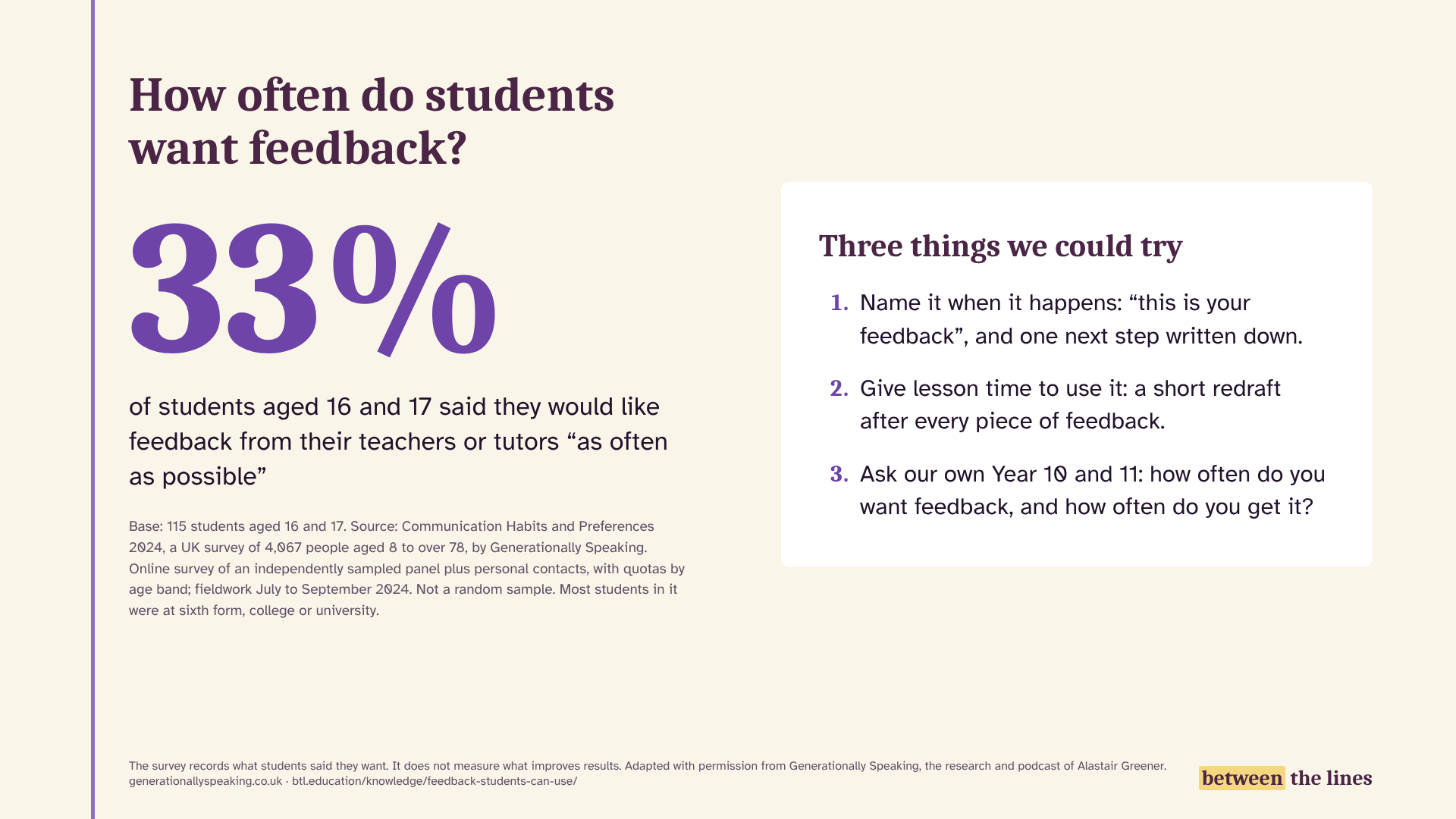
- 33% of the 115 students aged 16 and 17 said they would like feedback “as often as possible”.
- 30% of the same age group said they actually got feedback weekly.
- 60% of students aged 16 and over said they got feedback less often than they would like. Only 11% said they got it more often than they would like.
Alastair Greener’s book, Generationally Speaking: How to bridge the generation gap and communicate with confidence (Right Book Press, 2025), reports the same 33% figure for 16 and 17 year olds on page 145.
How much weight to put on it
The figure is worth using, with its limits attached.
- The method. It was an online survey of an independently sampled panel, topped up with personal contacts, with quotas set by age band so that every generation was covered. It is not a random sample, and the published results note that households in socio-economic group AB are over-represented against the national profile.
- The base. The 33% is 38 of 115 students. Each student is worth just under one percentage point, so treat it as “about a third”.
- Who the students were. Of the 333 students aged 16 and over in the sample, 10% were doing GCSEs and 9% studied at a secondary school. Most were at sixth form, college or university. The 16 and 17 year olds are the nearest the survey gets to a Year 11 class, a year or so further on.
- What “feedback” meant. The question didn’t define it. A student might have been thinking of a mark, a written comment, a conversation or a whole-class slide.
- What it doesn’t show. It records what students said they wanted. It says nothing about whether more frequent feedback would help them learn more, and we make no claim that it would.
What the research on feedback adds
The Education Endowment Foundation’s guidance report Teacher feedback to improve pupil learning (2021) points in a slightly different direction from the students. Its third recommendation is “Plan for how pupils will receive and use feedback”, and it says: “Teachers should also provide opportunities for pupils to use feedback. Only then will the feedback loop be closed so that pupil learning can progress.”
On frequency, it is cautious. School feedback policies, it says, “should not over-specify features such as the frequency or method of feedback.”
Read together, the survey and the guidance suggest a sensible compromise for an English department: shorter feedback, more often, with lesson time to use it, and no rule about how many times a term.
How whole-class feedback fits
That compromise is close to how our schemes are built. Every four to eight lessons, depending on the unit, a Feedback Loop kit sets a twenty-five minute progress check inside a lesson, marked in AQA’s levels with no raw mark. The teacher reads the work, notes the patterns and fills in one whole-class feedback sheet: what went well, what would be even better when, the level spread and what to re-teach. A feedback lesson follows, with an improvement task at each of the three levels of support.
It gives a class feedback every few weeks without a weekend of individual marking, and the lesson after it is where students use it. There is more on the method in whole-class feedback, and on running it across a department in marking mocks as a department.
Three things a department could try
- Name it when it happens. Students may not count a whole-class feedback slide or a comment at the desk as feedback. Say “this is your feedback on Tuesday’s paragraph”, and ask them to write down one thing to do next.
- Give lesson time to use it. After each piece of feedback, one short redraft: the same paragraph rewritten using the “even better when”. This is the step the EEF says closes the loop.
- Ask your own students. Put the survey’s two questions to a Year 10 or Year 11 class: how often would you like feedback on your English, and how often do you feel you get it? Compare their answers with the survey, and with how often you think you give it.
There is a one-slide version of this page for a department meeting, with the figure, its base and method, and these three suggestions.
Download the slide (PDF) · Download the slide (PNG)
Frequently asked questions
Does more frequent feedback raise grades?
The survey can’t tell us that, and we don’t claim it. It measured what students said they wanted. The EEF’s guidance puts the weight on whether pupils use feedback, and advises against fixing its frequency in policy.
Were any of the students doing GCSEs?
Some. Of the 333 students aged 16 and over, 10% were doing GCSEs. Most were on degree courses or doing A levels, AS levels or Highers.
Can I quote the 33% in a department meeting?
Yes, with the base and method attached: 33% of 115 students aged 16 and 17, in Communication Habits and Preferences 2024, an online panel survey of 4,067 people in the UK. The slide on this page is set out that way.
What counts as feedback in our schemes?
The whole-class feedback sheet after each Feedback Loop kit, and the feedback lesson that follows it, where students act on it. The common thread is a next step and time to take it.
Where can I read the full results?
Generationally Speaking publishes the full survey results free, with an explanation of the method.
Adapted with permission from Generationally Speaking, the research and podcast of Alastair Greener. generationallyspeaking.co.uk
Sources
- Generationally Speaking, Communication Habits and Preferences 2024: UK survey of 4,067 (method, sample, AB over-representation, students’ feedback tables)
- Generationally Speaking, Communication Habits and Preferences 2024, survey report (September 2024), slides 3 and 4 (method and sample), 69 (students in the sample), 73 and 74 (preferred and actual feedback)
- Generationally Speaking, How often does Gen Z want feedback at work? UK data answers (5 September 2026), section on students
- Alastair Greener, Generationally Speaking: How to bridge the generation gap and communicate with confidence (Right Book Press, 2025), chapter 15, page 145
- Education Endowment Foundation, Teacher feedback to improve pupil learning (2021), and its summary of recommendations