

Knowledge hub › For students › Frankenstein: the story
Frankenstein: the story, part by part
A young scientist gives life to a body he has built, then runs from it. Read the whole story in nine parts, then the characters, the ideas and how the novel is examined.
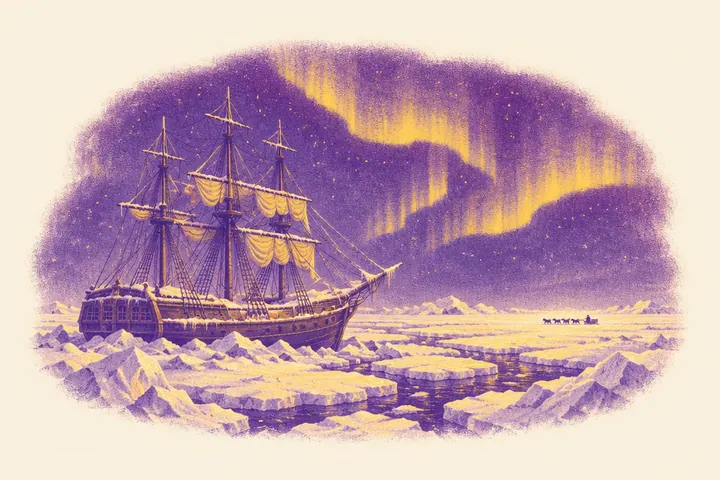
In Mary Shelley’s novel Frankenstein (1818), the young scientist Victor Frankenstein builds a creature and brings it to life, then runs from it in disgust. The creature, rejected by everyone it meets, takes revenge on Victor’s family, and Victor chases it to the Arctic, where he dies. It is Section B of AQA GCSE English Literature Paper 1.
Mary Shelley was born in London in 1797 and died in 1851. Frankenstein was first published in London on New Year’s Day 1818, without her name on it. In 1831 she published a revised edition, and that is the text we quote here.
- 24chapters in the novel, after the four letters that open itProject Gutenberg text (1831 edition)
- 1818the year Frankenstein was first published, in London, without the author’s nameEncyclopaedia Britannica
- 30marks for the Frankenstein question, with no marks for spelling, punctuation and grammarAQA specification
The novel is three stories, one inside another: Walton’s letters hold Victor’s story, and Victor’s story holds the creature’s. In the exam it is Section B of Literature Paper 1. The question prints an extract, then asks about the novel as a whole, so you need the whole story.
Part 1: Walton’s letters
This part covers Letters 1 to 4. Robert Walton, an English explorer, writes to his sister, Margaret Saville. In Letter 1 he is in St Petersburgh in Russia, planning to sail to the North Pole. He dreams of finding a land of warmth and light: “What may not be expected in a country of eternal light?”
In Letter 2 he has hired a ship at Archangel. He is lonely, and he tells Margaret: “I bitterly feel the want of a friend”.
In Letters 3 and 4 the ship is trapped in ice. One day the crew see a sledge pulled by dogs, driven by a figure “of gigantic stature”. The next morning they find a second sledge on a piece of floating ice, with a man close to death beside it. He is Victor Frankenstein. As he recovers, he and Walton become friends. When Walton talks about his ambition, Victor cries out “Do you share my madness?” He decides to tell Walton his story as a warning, and Walton writes it down.
Part 2: A young scientist
This part covers Chapters 1 to 4, told by Victor. He grows up in Geneva in a loving, wealthy family. When he is about five, his mother adopts an orphan girl she finds living with a poor family by Lake Como in Italy. Her name is Elizabeth Lavenza. Victor calls her “my more than sister”. His closest friend is Henry Clerval.
Victor always wants to know how the world works: “It was the secrets of heaven and earth that I desired to learn”. At thirteen he finds a book by Cornelius Agrippa, an old writer on magic, and his father calls it “sad trash” without explaining why. At fifteen he sees lightning smash an oak tree to a “blasted stump”, and he becomes fascinated by electricity.
At seventeen he is sent to university at Ingolstadt in Germany. Just before he leaves, his mother dies of scarlet fever, caught while nursing Elizabeth. At Ingolstadt, Professor Waldman’s lecture on modern chemistry fires him up. Victor vows: “more, far more, will I achieve”.
After two years of hard study he discovers how to give life to dead matter. He collects body parts from charnel houses and dissecting rooms, and works alone at the top of his house, in his “workshop of filthy creation”. He imagines that “A new species would bless me as its creator and source”. Looking back, he warns Walton: “Learn from me, if not by my precepts, at least by my example, how dangerous is the acquirement of knowledge”.
Part 3: The creation and its cost
This part covers Chapters 5 to 8. It is “a dreary night of November”. At one in the morning, by candlelight, Victor sees “the dull yellow eye of the creature open”. The creature is horrible: “His yellow skin scarcely covered the work of muscles and arteries beneath”. Victor has worked for nearly two years, and now “breathless horror and disgust filled my heart.” He runs from the room.
He wakes from a nightmare to see the creature by his bed, reaching out a hand, and runs again. The creature disappears. Victor collapses with a fever, and his friend Clerval nurses him for months.
Later a letter comes from his father. Victor’s little brother William has been found dead near Geneva, with “the print of the murderer’s finger” on his neck. A small portrait of their mother that William was wearing is missing.
Victor travels home. Near Geneva, in a huge thunderstorm, a flash of lightning shows him the creature. He is sure at once: “Nothing in human shape could have destroyed that fair child.”
At home he learns that Justine Moritz, a kind young servant, has been arrested. The portrait was found in her pocket. Victor says nothing, sure that nobody would believe him. Elizabeth speaks up for her, but Justine is found guilty and hanged, after a priest pushes her into a false confession. Victor feels “the never-dying worm alive in my bosom”, a picture of hell, because he knows he is to blame.
Part 4: Meeting on the ice
This part covers Chapters 9 and 10. Victor is sunk in guilt and despair. In August, about two months after Justine’s death, he travels into the Alps, to the valley of Chamounix beneath Mont Blanc.
He climbs to the glacier on Montanvert, known as the sea of ice. The creature comes towards him at superhuman speed. Victor screams “Begone, vile insect!”, but the creature stays calm. He says: “I ought to be thy Adam; but I am rather the fallen angel”. In Milton’s poem Paradise Lost, Adam is the man God made and loved, and the fallen angel is Satan, thrown out of heaven. The creature says “I was benevolent and good; misery made me a fiend.” He asks Victor to hear his story. They go to a hut on the mountain, and the creature begins.
Part 5: The creature learns about people
This part covers Chapters 11 to 14, told by the creature, inside Victor’s story. At first he can make no sense of the world. He lives in a forest, eating berries, and learns about fire by burning his hand in one.
He walks into a village. The people scream and throw stones at him. He hides in a lean-to shed, a hovel, built against the wall of a cottage in the woods. Through a crack he watches the family inside: a blind old man called De Lacey, his son Felix and his daughter Agatha. They are poor but gentle with each other.
When he sees they are hungry, he stops stealing their food and collects firewood for them at night instead. He learns their words by listening. Then he sees his own reflection in a pool and is horrified by what he looks like.
In spring Felix’s love, Safie, arrives. She speaks no French, so Felix teaches her, and the creature learns alongside her. From a history book that Felix reads aloud, he learns about wealth, poverty and cruelty. He has no family and no name, and he asks himself what he is.
Part 6: Rejection and revenge
This part covers Chapters 15 and 16. The creature finds some books in the woods, among them Paradise Lost, which he reads as true history. In the pocket of the coat he took from Victor’s room, he finds Victor’s journal of the experiment. He cries: “Hateful day when I received life!” and “Accursed creator!”
He decides to make friends with the old, blind De Lacey first, while the young people are out. De Lacey listens kindly. Then Felix, Safie and Agatha come back. Agatha faints, Safie runs out, and Felix beats the creature to the ground. The creature could fight back, but he runs away.
That night, alone in the woods, he says “I, like the archfiend, bore a hell within me”. The family leave the cottage for ever, and he burns it down. From then on, he says, “I declared everlasting war against the species”.
He sets off for Geneva to find Victor. On the way he saves a girl from drowning, and a man with her shoots him. Near Geneva he meets a small boy. The boy screams and says that his father is M. Frankenstein. The creature strangles him. It is William. He takes the portrait of the mother, then finds Justine asleep in a barn and slips it into her dress. He ends his story with a demand: Victor must make him a female companion.
Part 7: The promise of a companion
This part covers Chapters 17 to 20. The creature argues his case: “I am malicious because I am miserable.” If Victor refuses, he threatens, “if I cannot inspire love, I will cause fear”. If Victor agrees, the pair will go to the wilds of South America. Victor agrees.
Back in Geneva, he puts off the work, and promises to marry Elizabeth after one journey. He travels round Britain with Clerval, then goes alone to a bare island in the Orkneys to work on the female.
One night he starts to think. The female might be more evil than the creature, and the two of them might have children, a “race of devils”. He looks up and sees the creature grinning at the window. Victor tears the half-made female to pieces. Later the creature threatens him: “I shall be with you on your wedding night.”
Victor sinks the remains in the sea. Out in his boat, he falls asleep, and the wind drives him to the coast of Ireland.
Part 8: The wedding night
This part covers Chapters 21 to 23. The Irish townspeople take Victor to the magistrate, Mr Kirwin, because a young man has been found strangled on the beach the night before. Victor is shown the body. It is Clerval. Victor lies ill in prison for two months. Then he is cleared, and his father takes him home.
In Geneva, Victor marries Elizabeth. He thinks the creature means to kill him that night, and he carries pistols and a dagger. They spend the night at an inn at Evian, by Lake Geneva. While Victor searches the house, he hears a scream. He finds her dead, “thrown across the bed”, with “the murderous mark of the fiend’s grasp” on her neck. The creature grins at him through the window, then escapes into the lake.
A few days after Victor gets home, his father dies of grief. Victor tells the whole story to a magistrate in Geneva, who does not really believe him.
Part 9: The chase to the ice
This part covers Chapter 24, where Victor ends his story and Walton’s letters begin again. Victor leaves Geneva for ever and swears to hunt the creature down. The creature leads him across Russia into the frozen north, leaving messages carved on trees and stones: “My reign is not yet over”. Victor follows him across the ice by sledge until the ice breaks up. That is where Walton found him.
Walton now writes again, under the heading Walton, in continuation. Victor is weaker. He asks Walton to kill the creature if he dies first. The crew, afraid of being crushed by the ice, ask Walton to turn back, and he agrees. Victor tells him: “Seek happiness in tranquillity, and avoid ambition”. Then he dies.
That night, Walton hears a voice in the cabin. The creature is standing over Victor’s body. Full of grief and guilt, he says “the fallen angel becomes a malignant devil.” He tells Walton he will go to the far north and burn himself on a funeral pile. He leaps from the cabin window onto a raft of ice, and he is “lost in darkness and distance.”
The main characters
- Victor Frankenstein: a young scientist from Geneva who builds the creature, runs from it and hides the truth until his family is dead. He dies on Walton’s ship.
- The creature: the being Victor makes, about eight feet tall, who is never given a name. He is gentle at first and teaches himself to speak and read. He turns to murder after every human he meets rejects him.
- Robert Walton: an English explorer heading for the North Pole, who writes the letters that hold the story. He is ambitious like Victor, and in the end he turns back.
- Elizabeth Lavenza: an orphan adopted by Victor’s parents, who marries Victor and is killed on their wedding night.
- Henry Clerval: Victor’s closest friend, who nurses him after the creation. The creature strangles him in Ireland.
- Alphonse Frankenstein: Victor’s father, who dies of grief after Elizabeth’s death.
- William Frankenstein: Victor’s young brother, the creature’s first victim.
- Justine Moritz: a servant in the family, wrongly found guilty of William’s murder and hanged.
- The De Laceys: the blind old De Lacey, his son Felix and daughter Agatha, whom the creature watches and secretly helps. Safie, Felix’s love, joins them.
- M. Waldman: Victor’s chemistry professor at Ingolstadt, whose lecture sets Victor’s ambition alight.
- Margaret Saville: Walton’s sister, to whom every letter is written.
The main ideas and context
Ambition and dangerous knowledge. Victor wants to break the line between life and death, and Walton wants to reach the Pole. Victor tells his story as a warning, and Walton turns back.
Creation and responsibility. Victor gives life and then abandons what he made, like a parent who runs from a newborn baby. The novel asks whether the creature, his creator or the people who turned him away are to blame for his crimes.
Isolation. Walton wants a friend, and Victor shuts himself away with his secret. The creature is shut out of every family he meets, and his demand for a mate is a demand not to be alone.
Appearance and prejudice. Everyone who sees the creature judges him by his face. Only the blind De Lacey listens.
Science. Galvanism was the study of electricity’s effect on the body, named after the Italian scientist Luigi Galvani, who made the legs of dead frogs twitch with electric current. In 1803 his nephew, Giovanni Aldini, made the face and limbs of an executed criminal move in the same way in London.
Nature and the sublime. The Romantic poets valued feeling and nature. The sublime was the mix of awe and terror that vast scenes, such as mountains, glaciers and storms, could cause. Victor meets the creature in a storm and on a glacier.
The summer of 1816. Encyclopaedia Britannica describes how Mary Shelley, Percy Shelley, Lord Byron and John Polidori spent a cold, stormy summer at the Villa Diodati near Geneva. Byron suggested that each of them write a ghost story, and Mary’s became Frankenstein.
Myth and religion. The subtitle, The Modern Prometheus, refers to the Titan in Greek myth who stole fire from the gods for humans and was punished for it. The novel opens with lines from John Milton’s Paradise Lost (1667), in which Adam asks God why he made him.
Myths about Frankenstein
Myth Frankenstein is the name of the monster.
What the evidence says
Frankenstein is Victor’s surname. Shelley never gives the creature a name. Victor calls him the creature, the wretch, the daemon and the fiend. The creature himself says “I am thy creature” to Victor in Chapter 10.
Source: Mary Shelley, Frankenstein (1831 edition), Chapter 10
Myth The monster is a grunting brute who cannot speak.
What the evidence says
In the novel the creature teaches himself to speak and read by watching the De Laceys. He reads Paradise Lost and argues his case to Victor in long, skilful speeches.
Source: Mary Shelley, Frankenstein (1831 edition), Chapters 10 to 17
Myth Victor brings the creature to life with a bolt of lightning in a castle.
What the evidence says
That scene comes from films. In the novel Victor works alone in a room at the top of a house in the university town of Ingolstadt, and Shelley does not say exactly how he gives the creature life. Victor refuses to tell Walton his method.
Source: Mary Shelley, Frankenstein (1831 edition), Chapters 4 and 5
Frankenstein in the exam
Frankenstein is one of the 19th-century novels on AQA Literature Paper 1. The paper lasts 1 hour 45 minutes.
You answer one question on Frankenstein. It prints an extract from the novel, then asks you to write about the extract and about the novel as a whole. It is worth 30 marks. There are no marks for spelling, punctuation and grammar in this section. Spend about 50 minutes on it. The exam is closed book, so quotations from outside the extract come from memory.
Check who is speaking in your extract. Walton, Victor and the creature each tell their part in their own words, and each wants you to see things his way.
What to do next
Learn the quotations on Frankenstein: quotations to learn, and practise with How to answer the extract question. For the history and science behind the novel, see Using context in your answers. You can read the whole 1831 text free on Project Gutenberg.
Frequently asked questions
How many chapters are there in Frankenstein?
The 1831 text has four letters from Walton, then 24 chapters. Victor tells most of the story. The creature tells his own story in Chapters 11 to 16, and Walton’s letters return near the end of Chapter 24.
Who is the narrator of Frankenstein?
There are three: Walton, Victor and the creature. Each story sits inside the one before, which is called a frame narrative.
Why does the creature kill people?
He says he was born good and that misery made him evil. Everyone who sees him attacks him or runs away, even his own creator. He kills to make Victor suffer as he suffers.
How does Frankenstein end?
Victor dies on Walton’s ship in the Arctic. The creature grieves over his body and says he will burn himself to death in the far north. Walton sails home.
Is Frankenstein on Paper 1 or Paper 2?
It is on AQA Literature Paper 1, Section B. You get one question with a printed extract, worth 30 marks, and you write about the extract and the novel as a whole.
Sources
- Project Gutenberg, Mary Wollstonecraft Shelley, Frankenstein; or, The Modern Prometheus (1831 edition; ebook 42324)
- Encyclopaedia Britannica, Frankenstein; or, The Modern Prometheus
- AQA, GCSE English Literature 8702 specification