

Knowledge hub › For students › Julius Caesar: the story
Julius Caesar: the story, act by act
A group of Roman senators kill their leader to save the republic, and lose everything they hoped to save. Read what happens in every act, then the main characters and ideas.
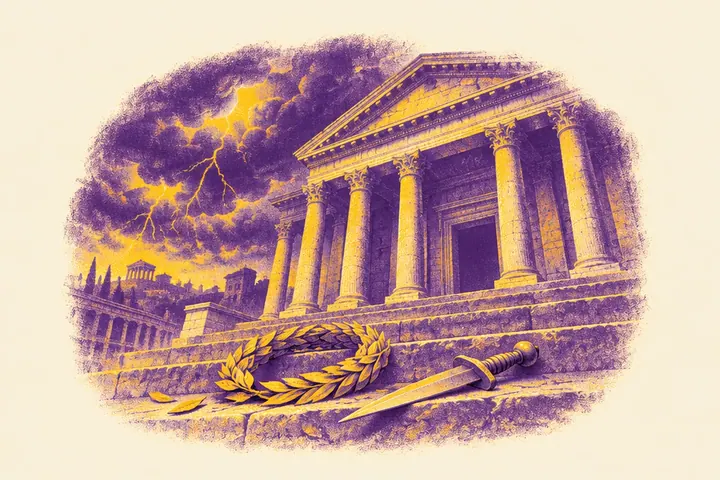
In Shakespeare’s tragedy Julius Caesar, a group of Roman senators led by Cassius and Brutus stab Caesar to death because they fear he will make himself king. Mark Antony’s funeral speech turns the people against them, civil war follows, and both Cassius and Brutus die by their own swords at Philippi. It is Section A of AQA GCSE English Literature Paper 1.
Julius Caesar is a tragedy by William Shakespeare, set in ancient Rome. A tragedy is a play that ends in the deaths of its main characters. It was first staged in 1599, the year the Globe theatre opened in London, and it was first printed in 1623, in the collection of Shakespeare’s plays known as the First Folio.
In the exam it is Section A of Literature Paper 1. The question prints an extract, then asks about the play as a whole, so you need to know the whole story. The title character dies halfway through, so the play is as much about Brutus, and about what happens after the killing, as it is about Caesar.
- 30marks for the Julius Caesar question, plus 4 for spelling, punctuation and grammarAQA specification
- 1599the year a traveller, Thomas Platter, saw the play at the GlobeInternet Shakespeare Editions
- 1623the year the play was first printed, in the First FolioEncyclopaedia Britannica
Act 1: The crown and the plot
Rome is celebrating. Caesar has come home in triumph after a victory over the family of Pompey, the great general who was once his ally. Two tribunes, Flavius and Marullus, are officials whose job is to protect the ordinary people. They find workmen taking the day off to cheer Caesar. Marullus is furious that the crowd has forgotten Pompey so quickly: “You blocks, you stones, you worse than senseless things!” The tribunes send them home.
It is the feast of Lupercal, a Roman festival. Caesar walks through the streets with his wife Calpurnia and his friend Mark Antony. A soothsayer, a fortune-teller, calls out of the crowd: “Beware the ides of March.” The ides is the 15th day of the month. Caesar calls him a dreamer and walks on.
Cassius and Brutus stay behind. Brutus is a respected senator and Caesar’s friend. When they hear the crowd shout, Brutus says he fears the people have chosen Caesar for king, and Cassius starts to work on him. Cassius tells stories that show Caesar is only a weak man. He once had to save him from drowning in the river Tiber, and he saw him shaking with fever in Spain. Yet now Caesar “doth bestride the narrow world Like a Colossus”, a giant statue, while other men walk under his legs. Cassius says they have only themselves to blame: “The fault, dear Brutus, is not in our stars, But in ourselves, that we are underlings.” Brutus says he will think about it.
Caesar comes back. He sees Cassius and says to Antony, “Yond Cassius has a lean and hungry look”. He thinks too much, and men like that are dangerous. Then Casca, a blunt senator, tells Brutus and Cassius what happened. Antony offered Caesar a crown three times, and he refused it each time, more and more unwillingly. The crowd cheered, and Caesar collapsed with the falling sickness, a fit. Casca adds that Flavius and Marullus have been “put to silence” for pulling scarves off Caesar’s statues.
Alone, Cassius plans to throw letters through Brutus’s window, written in different handwriting as if from many citizens, all praising Brutus and hinting at Caesar’s ambition. That night there is a terrible storm full of strange sights, such as a lion loose in the street. Cassius says the heavens are warning Rome against Caesar. He wins Casca to the plot and sends Cinna, another conspirator, to plant the letters.
Act 2: The orchard and Caesar’s house
In his orchard before dawn, Brutus cannot sleep. He talks to himself and makes up his mind: “It must be by his death”. He has no personal reason to hate Caesar, but he fears what Caesar will become if he is crowned. He decides to think of him “as a serpent’s egg”, a danger that must be killed before it hatches. His servant brings a letter found at the window: “Brutus, thou sleep’st: awake!”
The conspirators arrive with their faces hidden in their cloaks. Brutus joins them, and he soon starts to overrule Cassius. He says they need no oath, because Romans keep their word. He will not invite the great speaker Cicero to join. Cassius wants to kill Antony as well, but Brutus says no: “Let us be sacrificers, but not butchers”. They must kill Caesar’s spirit, not shed more blood than they need. Decius Brutus says he will make sure Caesar comes to the Senate.
When they leave, Brutus’s wife Portia comes out. She knows something is wrong and begs him to tell her. She has given herself “a voluntary wound Here, in the thigh” to prove she can keep a secret. Brutus promises to tell her everything.
At Caesar’s house the storm is still raging. Calpurnia has dreamed three times that Caesar was murdered. The priests’ sacrifice has gone badly too. Caesar says “Cowards die many times before their deaths”, but in the end he agrees to stay at home for her sake. Then Decius arrives. He tells Caesar that Calpurnia dreamed of his statue “spouting blood”, which he says is a good sign, and that the Senate means to give him a crown that day. If he stays at home, people will laugh. Caesar changes his mind and goes.
In the street, a teacher called Artemidorus waits with a letter warning Caesar, naming every conspirator. Portia waits at home, desperate for news.
Act 3: The ides of March
Caesar passes the soothsayer and says, “The ides of March are come.” The soothsayer answers: “Ay, Caesar; but not gone.” Artemidorus tries to hand over his letter, but Caesar puts it aside.
At the Senate, Metellus Cimber kneels and asks Caesar to bring his brother home from exile. Caesar refuses. He says he cannot be moved: “But I am constant as the northern star”, the one star that never moves in the sky. Casca cries “Speak, hands for me!” and stabs him first. The others follow. When Brutus stabs him, Caesar says “Et tu, Brute! Then fall, Caesar.” and dies. Et tu means and you.
The conspirators shout “Liberty! Freedom! Tyranny is dead!” Brutus tells them to bathe their hands in Caesar’s blood and walk out into the market place. Antony comes and shakes each man’s bloody hand. He asks to speak at Caesar’s funeral. Cassius is against it, but Brutus agrees, as long as Antony speaks after him and does not blame them.
Left alone with the body, Antony shows what he really feels: “O, pardon me, thou bleeding piece of earth, That I am meek and gentle with these butchers!” He predicts a terrible civil war, and that Caesar’s ghost will “let slip the dogs of war”.
In the Forum, the city’s great meeting place, Brutus speaks to the crowd in prose. He explains why he killed his friend: “Not that I loved Caesar less, but that I loved Rome more.” The crowd cheers him and wants to make him a new Caesar, which shows they have not understood him at all. Then he leaves Antony to speak.
Antony begins “Friends, Romans, countrymen, lend me your ears”. He says he has come to bury Caesar, not to praise him. Again and again he repeats “For Brutus is an honourable man”, until the words sound like an insult. He reminds the crowd that Caesar refused the crown three times. He weeps. He teases them with Caesar’s will, then comes down to the body and shows them each stab wound in the cloak. Brutus’s was “the most unkindest cut of all”. Then he reads the will: Caesar has left every citizen money and given his gardens to the people. The crowd riots and runs to burn the conspirators’ houses. Antony says to himself: “Mischief, thou art afoot”. Brutus and Cassius have fled the city.
In the street the mob meet a poet called Cinna. He has the same name as one of the conspirators. He tells them he is Cinna the poet, but they shout “Tear him for his bad verses” and kill him anyway.
Act 4: The quarrel and the ghost
Antony, Octavius and Lepidus now rule Rome together. They make a list of enemies who must die, even their own relatives. When Lepidus goes out, Antony calls him “a slight unmeritable man”, fit only for running errands.
Brutus and Cassius are camped with their armies near Sardis, in what is now Turkey. They meet in Brutus’s tent and have a bitter quarrel. Brutus says Cassius has “an itching palm”, meaning he takes bribes. Brutus reminds him that they killed Caesar for justice: “Remember March, the ides of March remember”. Cassius offers Brutus his dagger and tells him to kill him. In the end they make up.
Then Brutus tells Cassius that Portia is dead. She grew desperate while he was away and killed herself by swallowing fire. News comes that seventy senators have been put to death in Rome, Cicero among them. The enemy are marching to Philippi. Cassius wants to wait for them to come to him. Brutus overrules him again and says they must attack at once: “There is a tide in the affairs of men”, and if they miss it, they will fail.
Late at night, as Brutus sits reading, the ghost of Caesar appears. Brutus asks what it is, and it answers: “Thy evil spirit, Brutus.” It tells him he will see it again at Philippi, then vanishes.
Act 5: Philippi
Before the battle, the two sides meet and trade insults. Cassius tells his friend Messala that it is his birthday, and that he has seen bad omens: two eagles that followed their army have flown away, and ravens, crows and kites fly over them instead. Brutus and Cassius say goodbye in case they never meet again.
The battle is confused. Brutus attacks Octavius’s army too early and wins, but his soldiers start looting, and Antony’s army surrounds Cassius. Cassius sends his friend Titinius to find out whether some troops are friends or enemies. His servant Pindarus watches from a hill and wrongly reports that Titinius has been captured. In fact they are friends welcoming him. Cassius gives Pindarus his sword, the one he used on Caesar, and tells him to kill him. He dies saying “Caesar, thou art revenged, Even with the sword that kill’d thee.” Titinius returns with a wreath of victory, finds Cassius dead and kills himself too.
Brutus finds their bodies and says “O Julius Caesar, thou art mighty yet!” Caesar’s spirit seems to be turning the conspirators’ swords against themselves. There is a second battle, and Brutus loses. He tells his friends that the ghost has appeared to him again. His servant Strato agrees to hold the sword. Brutus runs onto it, saying “Caesar, now be still”.
Antony and Octavius find the body. Antony praises Brutus: “This was the noblest Roman of them all”. He says the others killed Caesar out of envy, and Brutus alone did it for the good of Rome. Octavius orders an honourable burial, and the play ends.
The main characters
- Julius Caesar: Rome’s greatest general. He refuses a crown three times, ignores every warning, and is stabbed to death in Act 3. He returns as a ghost to haunt Brutus.
- Brutus: a respected Roman noble and Caesar’s friend, who joins the plot for the good of Rome. He lets Antony speak at the funeral, loses at Philippi and runs on his own sword.
- Cassius: the leader of the plot, who resents Caesar’s rise and works on Brutus with flattery and forged letters. At Philippi he wrongly believes all is lost and has his servant kill him.
- Mark Antony: Caesar’s loyal friend, whom Brutus thinks harmless. His funeral speech turns the crowd against the conspirators, and he then rules with Octavius and Lepidus.
- Casca: a blunt conspirator who mocks the crown scene and strikes the first blow.
- Decius Brutus: a conspirator who flatters Caesar and twists Calpurnia’s dream to bring him to the Senate.
- Portia: Brutus’s wife, who wounds herself to prove she can keep his secret. She takes her own life while he is at war.
- Calpurnia: Caesar’s wife, whose dream of his murder almost keeps him at home.
- Octavius: Caesar’s young great-nephew, who rules Rome with Antony and Lepidus and speaks the play’s last lines.
- The Soothsayer: the fortune-teller who warns Caesar to beware the ides of March.
- The citizens: the crowd of Rome, who cheer Caesar, then Brutus, then Antony, and riot after the funeral.
The main ideas and context
Power and ambition. Rome was a republic, ruled by the Senate, not by a king. The Romans had driven out their last king centuries before, and an ancestor of Brutus led them. The conspirators fear that Caesar wants to be king. The play never settles whether he does.
Honour. Brutus believes he is acting honourably, and almost everyone, even his enemies, agrees. Yet his honour makes him trust people who do not deserve it. Antony turns the word honourable into a weapon in his funeral speech.
Persuasion and rhetoric. Rhetoric is the art of persuasive speech. Boys at Elizabethan grammar schools studied it in Latin and practised arguing both sides of a question. Cassius persuades Brutus, Decius persuades Caesar, and Brutus and Antony both persuade the crowd. Brutus appeals to reason in plain prose. Antony appeals to feelings in verse, with tears, the will and the body, and he wins.
The crowd. The citizens change sides quickly and can be led by whoever speaks best. Their murder of Cinna the poet shows how dangerous a crowd can be.
Fate and omens. The soothsayer, the storm, Calpurnia’s dream and the ghost all seem to warn of what is coming. Yet Cassius says men are “masters of their fates”, and every disaster in the play needs someone’s choice.
The fear of civil war. When the play was first staged in 1599, Elizabeth I was in her sixties. She had no children and had named no heir, and many people feared that her death would bring civil war. The play shows a ruler killed and a country torn apart. Shakespeare took the story from Plutarch’s Lives, in Thomas North’s English translation of 1579.
Myths about Julius Caesar
Myth Julius Caesar is the main character of the play.
What the evidence says
Caesar has fewer lines than Brutus, Cassius or Antony, and he dies in Act 3 Scene 1, halfway through the play. Brutus is on stage far more and is the one whose choices drive the tragedy. Caesar’s spirit, though, hangs over the second half, and he comes back as a ghost.
Source: William Shakespeare, Julius Caesar, Act 3 Scene 1 and the whole play
Myth Antony tells the crowd outright that Brutus is a traitor.
What the evidence says
Antony never openly attacks the conspirators. He keeps calling Brutus “an honourable man” and says he has not come to praise Caesar. He lets the crowd reach their own conclusions from the will, the cloak and the wounds, which makes his speech far more powerful.
Source: William Shakespeare, Julius Caesar, Act 3 Scene 2
Myth Caesar wants to be crowned king, and the play says so.
What the evidence says
Caesar refuses the crown three times in Act 1. Casca thinks he was unwilling to let it go, and Cassius and Brutus fear his ambition, but Brutus himself admits he has never seen Caesar let his feelings rule his reason. The play leaves you to decide.
Source: William Shakespeare, Julius Caesar, Act 1 Scene 2 and Act 2 Scene 1
Julius Caesar in the exam
Julius Caesar is one of the Shakespeare plays you can study for Section A of AQA’s Literature Paper 1. Paper 1 lasts 1 hour 45 minutes. In Section B of the same paper you answer on your 19th-century novel.
You answer one question. It prints an extract from the play, then asks about the extract and about the play as a whole. It is worth 30 marks, plus 4 marks for AO4: using a range of vocabulary and sentence structures, with accurate spelling and punctuation. Section A is the only part of Paper 1 that carries these marks. Spend about 50 minutes on it. The exam is closed book, so anything you say about the rest of the play comes from memory.
What to do next
Learn the quotations on Julius Caesar: quotations to learn, and practise with How to answer the extract question. For the history behind the play, see Using context in your answers.
Frequently asked questions
When is Julius Caesar killed in the play?
He is stabbed to death in Act 3 Scene 1, on the ides of March, which is 15 March. That is halfway through the play. The second half shows what happens to Rome and to the men who killed him.
Why does Brutus kill Caesar?
Brutus fears that Caesar will become a king and a tyrant, and he puts the good of Rome above his friendship. He also believes the forged letters Cassius plants, which make it seem that the people want him to act. He says he has no personal reason to hate Caesar.
Who is the hero of Julius Caesar?
Many readers see Brutus as the tragic hero. He is noble and means well, but his trust in others and his poor decisions, such as letting Antony speak, lead to his downfall. Antony calls him the noblest Roman of them all.
What does Et tu, Brute mean?
It is Latin for and you, Brutus. Caesar says it when he sees his friend among the men stabbing him. It shows his shock that Brutus, of all people, has betrayed him.
Which paper is Julius Caesar on in GCSE English Literature?
It is on AQA Literature Paper 1, Section A. You get one question on an extract and the whole play, worth 30 marks plus 4 for spelling, punctuation and grammar.
Sources
- Internet Shakespeare Editions, Julius Caesar: stage history
- Encyclopaedia Britannica, Julius Caesar
- AQA, GCSE English Literature 8702 specification