Knowledge hub › For students › Jekyll and Hyde: the story
Jekyll and Hyde: the story, chapter by chapter
A lawyer sets out to find out why his respectable friend protects a violent stranger, and the answer is worse than he could imagine. Each chapter is retold in plain English, with the characters and ideas.
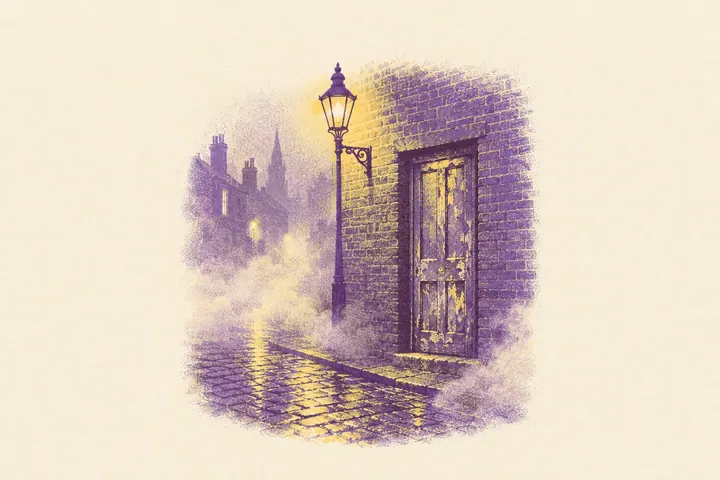
The Strange Case of Dr Jekyll and Mr Hyde is a short novel, or novella, by Robert Louis Stevenson. Stevenson was born in Edinburgh in 1850, and the novella was first published in January 1886. It has 10 chapters, and each one has its own title, such as Story of the Door.
- 10chapters in the novella, the last two written as documents by Lanyon and JekyllProject Gutenberg text
- 1886the year the novella was first published, in LondonThe Morgan Library & Museum
- 30marks for the Jekyll and Hyde question, with no marks for spelling, punctuation and grammarAQA specification
For most of the book we follow Mr Utterson, a lawyer, as he tries to solve a mystery. Why does his friend Dr Jekyll protect a violent man called Edward Hyde? The full answer only comes in the last two chapters. In the exam it is Section B of Literature Paper 1. The question prints an extract, then asks about the novella as a whole, so you need the whole story.
Read the transcript
This is the complete revision guide to The Strange Case of Dr Jekyll and Mr Hyde for AQA GCSE English Literature. I’m Hannah, and I teach English. In one video you’ll get the plot, the characters, the themes, the context, the terms to know and every quotation worth learning. Let’s start with the story, in the order you read it. Chapters 1 and 2.
Enfield tells Utterson how a man called Hyde trampled a girl, then paid her family with a respectable man’s genuine cheque. Utterson reads Jekyll’s will, which leaves everything to Hyde, and fears his friend is being blackmailed or disgraced. Utterson waits at the door until he meets Hyde, who fills him with a disgust he cannot explain. Chapters 3 to 5. Jekyll turns pale when Utterson mentions Hyde, claims he can be rid of him at any moment, and asks Utterson to help Hyde.
Nearly a year later a maid sees Hyde beat Sir Danvers Carew, an elderly Member of Parliament, to death with a cane. Jekyll shows Utterson a letter signed by Hyde, and Guest notices that its handwriting is almost the same as Jekyll’s. Chapters 6 and 7. After Hyde disappears, Jekyll returns to his friends and good works, and for two months he is at peace. Suddenly Jekyll shuts himself away, and Lanyon dies of a shock, refusing to speak of Jekyll and leaving Utterson a sealed envelope.
At his window, Jekyll’s smile turns to terror and despair, and Utterson and Enfield walk away in horrified silence. Chapter 8. Poole fetches Utterson because the voice in Jekyll’s cabinet has changed and he has seen a small, masked figure he believes is Hyde. Utterson and Poole break down the cabinet door with an axe and find Hyde dead, poisoned, in clothes far too large for him. Jekyll has vanished.
Utterson finds a will naming him, a note from Jekyll and a sealed packet, and takes them home to read. Chapter 9. Jekyll’s letter asks Lanyon to fetch a drawer of powders from his cabinet and give it to a messenger at midnight. The messenger is a small man in clothes far too big for him, and Lanyon feels disgust as soon as he sees him. The man drinks the mixture and turns into Jekyll in front of Lanyon, and the shock destroys Lanyon’s health.
Chapter 10. Jekyll hid his pleasures to protect his reputation, and made a drug to split his good and evil sides into two bodies. At first he enjoyed being Hyde, but Hyde grew stronger, and Jekyll began to change without taking the drug. When his supply of salt ran out, Jekyll knew he would soon be Hyde for ever, and wrote this statement. Now the characters.
Dr Henry Jekyll. A respected doctor and scientist who hides his pleasures behind a respectable life, and makes a drug that turns him into Hyde. Edward Hyde. Jekyll’s other self: small, young and violent, he tramples a child and murders Carew, and everyone who meets him feels disgust. Gabriel John Utterson.
Jekyll’s lawyer and friend, through whose eyes most of the story is seen. Reserved and loyal, he protects his friends’ reputations. Richard Enfield. Utterson’s distant cousin, a man about town, who tells the story of the door and believes in asking no questions. Dr Hastie Lanyon.
A doctor and old friend of Jekyll who calls his science balderdash. He dies of shock after seeing the transformation. Poole. Jekyll’s butler, loyal and frightened, who brings Utterson to break down the cabinet door. Sir Danvers Carew.
An elderly, courteous Member of Parliament beaten to death by Hyde in the street. Mr Guest. Utterson’s clerk, who notices that Hyde’s handwriting and Jekyll’s are almost the same. The maid. The witness at the window whose account of the Carew murder is the reader’s only view of it.
The themes. For each one, here’s the idea in a sentence. That sentence is the start of a thesis. Duality. Every person has two sides; Jekyll tries to separate them and is destroyed.
Reputation and secrecy. Respectable men keep silent to protect each other, and that silence lets evil grow. Science and religion. Jekyll’s experiment goes beyond what science and religion allow, and both doctors die. Violence and the beast within.
Hyde is described as an ape and a troglodyte, voicing fears that civilised people hide something primitive. Setting and the city. London’s fog, back streets and two-faced houses mirror the double lives of its gentlemen. Narrative and mystery. The story is pieced together like a legal case, and the truth arrives only in the last two documents.
The context. Use it where it explains a choice the writer made. One clause inside a point does more than a paragraph of history. The Strange Case of Dr Jekyll and Mr Hyde was published in January 1886. Robert Louis Stevenson was born in Edinburgh in 1850.
As a child he was raised in a strict Presbyterian faith, and his nurse filled his head with stories of sin and hell. Edinburgh was a divided city: the elegant New Town and the crowded, poor Old Town. In the 1780s William Brodie, a respected Edinburgh cabinet-maker and town councillor, was a burglar by night. He was hanged in 1788, and Stevenson later co-wrote a play about him. Victorian gentlemen were judged by their reputation: their manners, their friends and their privacy.
A scandal could end a career, which made blackmail a real fear. Charles Darwin’s On the Origin of Species (1859) and The Descent of Man (1871) argued that humans had evolved from earlier animals. Some readers feared that the beast was still inside them. In the 1870s and 1880s writers on crime, such as the Italian doctor Cesare Lombroso, claimed that criminals were throwbacks to an earlier stage of evolution and could be spotted by their faces. The novella belongs to the Gothic tradition of the double, where a character meets a darker version of themselves.
The terms to know. Name a method only when you can say what it does. Duality: Having two sides. Jekyll’s statement claims that “man is not truly one, but truly two” (Chapter 10). Narrator: Most chapters follow Utterson in the third person; Chapters 9 and 10 are first-person documents by Lanyon and Jekyll.
Pathetic fallacy: Weather that matches the mood, such as the fog over Soho in Chapter 4. Gothic: Fiction of fear, secrets, dark settings and the supernatural. Stevenson moves the Gothic from castles to the London street. Physiognomy: The Victorian belief that character shows in the face. Utterson reads “Satan’s signature upon a face” (Chapter 2).
Epistolary: Told through letters and documents. The last two chapters are written statements. The quotations. These are the 18 I’d want every student to know by heart. For each one: who says it, where, and why it matters.
“like some damned Juggernaut”. Enfield, Chapter 1. Simile: Hyde is an unstoppable machine that feels nothing as it crushes a child. “a blind forehead of discoloured wall”. Narrator, Chapter 1.
Personification: the building has a face with no eyes, as closed and secret as the life behind it. “the more it looks like Queer Street, the less I ask”. Enfield, Chapter 1. The gentleman’s rule: the stranger a situation looks, the less you ask. Silence protects reputations.
“I shall be Mr. Seek”. Utterson, Chapter 2. Wordplay on hide and seek: the lawyer turns detective, and the novella becomes a search. “Satan’s signature upon a face”.
Utterson, Chapter 2. Religious metaphor: Hyde’s evil seems written on his body, as Victorian ideas of physiognomy claimed. “Something troglodytic”. Utterson, Chapter 2. Adjective meaning cave-dwelling: Hyde seems a throwback to an earlier, less human stage, which fed fears after Darwin.
“the moment I choose, I can be rid of Mr. Hyde”. Jekyll, Chapter 3. Dramatic irony: Jekyll claims control he does not have. “with ape-like fury”.
Narrator (the maid’s account), Chapter 4. Animal imagery: Hyde attacks like an ape, and the respectable Carew is beaten to death in the street. “like a district of some city in a nightmare”. Narrator, Chapter 4. Simile: London in the fog becomes a dream world where respectable streets turn sinister.
“Henry Jekyll forge for a murderer!”. Utterson, Chapter 5. Exclamation: Utterson’s horror that his respectable friend may be shielding a killer. “He had his death- warrant written legibly upon his face”. Narrator, Chapter 6.
Metaphor: what Lanyon has learned is killing him. Rational science cannot survive the truth. “abject terror and despair”. Narrator, Chapter 7. Jekyll’s face at the window: the respectable mask slips in a moment.
“a pale moon, lying on her back”. Narrator, Chapter 8. Personification: even the moon looks unnatural on the last night, so the setting signals that something is wrong. “sorely contorted and still twitching”. Narrator, Chapter 8.
Hyde’s body in Jekyll’s clothes: the mystery is solved and deepened at once. “man is not truly one, but truly two”. Jekyll, Chapter 10. Jekyll’s theory of human nature: every person is a divided self. “I felt younger, lighter, happier in body”.
Jekyll, Chapter 10. Tricolon of comparatives: becoming Hyde is a release, which is what makes it so dangerous. “my new power tempted me until I fell in slavery”. Jekyll, Chapter 10. Metaphor of addiction: Jekyll’s freedom becomes slavery.
“I bring the life of that unhappy Henry Jekyll to an end”. Jekyll, Chapter 10. The final line: Jekyll writes of himself in the third person, as if he is already someone else. That’s everything in one place. Watch it again in a week, and pause on any section you couldn’t have explained yourself.
Everything in this video comes from our Jekyll and Hyde scheme of learning for schools. If you’re a teacher, Lesson 3 of every scheme is free at btl.education. Thank you for watching.
Chapter 1: Story of the Door
Mr Utterson is a lawyer. He is serious and quiet, and he does not judge his friends. Every Sunday he goes for a walk with his distant cousin, Mr Enfield. On one walk they pass a shabby door in a side street in London. The building has no windows on the street side, only “a blind forehead of discoloured wall”.
Enfield tells a story about the door. At three o’clock one winter morning, he saw a small man run into a girl of about eight or ten at a street corner. The man “trampled calmly over the child’s body” and walked on. Enfield caught him. The girl’s family and a doctor gathered round, and everyone hated the man on sight. They made him pay £100 to the family. He went through the door and came back with £10 in gold and a cheque for the rest, signed with the name of a famous, respectable man. The cheque was genuine.
Enfield thinks the respectable man is being blackmailed. He has not asked any questions, because his rule is “the more it looks like Queer Street, the less I ask.” The small man’s name is Hyde. Utterson already knows the name on the cheque. The two men agree never to talk about the story again.
Chapter 2: Search for Mr Hyde
At home, Utterson takes his friend Dr Jekyll’s will out of his safe. It leaves everything to “friend and benefactor Edward Hyde”. If Jekyll disappears for more than three months, Hyde is to take his place at once. Utterson has always disliked the will. Now he fears it is linked to something disgraceful.
He visits Dr Lanyon, an old friend of his and of Jekyll’s. Lanyon says he fell out with Jekyll more than ten years ago over his “unscientific balderdash”, and he has never heard of Hyde.
Utterson has nightmares about the story and starts to watch the door at all hours. He tells himself: “If he be Mr. Hyde,” then “I shall be Mr. Seek.” At last, on a frosty night, Hyde arrives. Utterson asks to see his face. Hyde shows it, gives his address in Soho, then snarls and goes inside. Utterson cannot say what is wrong with him, but he feels disgust and fear. He thinks Hyde seems “hardly human”.
Round the corner is Jekyll’s handsome house. The shabby door turns out to be the back way into Jekyll’s laboratory, an old dissecting room. Jekyll is out. Poole, the butler, tells Utterson that the servants all have orders to obey Hyde. Utterson goes home afraid that Jekyll is paying for some old sin.
Chapter 3: Dr Jekyll Was Quite at Ease
Two weeks later, Jekyll gives a dinner party, and Utterson stays behind. Jekyll is a handsome man of about fifty. He jokes about the will and calls Lanyon a “hide-bound pedant”. When Utterson mentions Hyde, Jekyll turns pale. He says the matter is private, and that “the moment I choose, I can be rid of Mr. Hyde.” He asks Utterson to promise that, if anything happens to him, he will help Hyde get his rights. Utterson does not like it. Still, he promises.
Chapter 4: The Carew Murder Case
Nearly a year later, in October, a maid looks out of her window at night under a full moon. She sees a polite old gentleman with white hair stop to speak to a small man. It is Hyde. Suddenly Hyde loses his temper, clubs the old man to the ground with a heavy cane and, “with ape-like fury”, tramples and beats him to death. The maid faints.
The dead man is Sir Danvers Carew, a Member of Parliament. He was carrying a letter addressed to Utterson. Half of the broken cane is found, and Utterson recognises it: he gave it to Jekyll years ago.
Utterson takes a police officer, Inspector Newcomen, to Hyde’s rooms in Soho. Thick brown fog covers the city, and Soho looks “like a district of some city in a nightmare”. The rooms have been searched in a hurry. Papers have been burned, and the other half of the cane is behind the door. Hyde has disappeared, and nobody can describe him clearly. All they agree on is a feeling that something is deformed about him.
Chapter 5: Incident of the Letter
Utterson visits Jekyll, for the first time in his private room, which is called the cabinet, above the laboratory. Jekyll looks “deathly sick”. He swears he is finished with Hyde. He shows Utterson a letter signed by Hyde, which says Hyde has a safe way to escape. Jekyll says the letter was delivered by hand, but Poole says no letter came to the house that day.
Utterson shows the letter to his clerk, Mr Guest, who knows a lot about handwriting. Just then a note from Jekyll arrives. Guest compares the two and says the writing is almost the same, only sloped differently. Utterson is horrified. He thinks Jekyll has forged a letter to protect a murderer: “Henry Jekyll forge for a murderer!”
Chapter 6: Incident of Dr Lanyon
Hyde has vanished. For more than two months Jekyll is happy. He sees his friends again and is busy with charity and religion. Then, in January, his door is suddenly shut to visitors.
Utterson visits Lanyon and is shocked by his face: “He had his death-warrant written legibly upon his face.” Lanyon says he has had a shock and will die soon. He refuses to talk about Jekyll and says he regards him as dead. Jekyll writes to Utterson that he must now live alone and that he has brought on himself “a punishment and a danger that I cannot name.”
Within weeks Lanyon dies. He leaves Utterson an envelope inside an envelope. The inner one must not be opened until Jekyll dies or disappears. Utterson locks it in his safe unread, and he visits Jekyll less and less.
Chapter 7: Incident at the Window
On another Sunday walk, Utterson and Enfield go into the courtyard behind the door. Enfield has worked out that it is a back way into Jekyll’s house. Jekyll is sitting at an open window, looking very sad, “like some disconsolate prisoner”. They invite him for a walk. He says he cannot come, but he will talk to them from the window. Then his smile vanishes, and his face shows “abject terror and despair”. The window slams shut. The two men walk away in silence, white with horror.
Chapter 8: The Last Night
On a wild, windy night in March, Poole comes to Utterson. He is frightened. For a week someone has been locked in the cabinet, sending out notes that order a drug from every chemist in London. Each batch is sent back as impure. One note ends with a desperate plea: “find me some of the old.” Poole once saw the figure in the laboratory. It wore a mask, cried out “like a rat” and was much smaller than his master. Poole believes Jekyll has been murdered.
At Jekyll’s house, the servants are huddled together in fear. Utterson and Poole listen at the cabinet door. The footsteps are light, not Jekyll’s heavy tread, and once Poole heard weeping. Utterson demands to come in. A voice begs for mercy, and Utterson knows it is Hyde’s. Poole breaks down the door with an axe.
Inside, Hyde’s body lies on the floor, “sorely contorted and still twitching”, dressed in clothes far too big for him. He has poisoned himself. There is no sign of Jekyll anywhere, dead or alive. On the desk is a new will that leaves everything to Utterson, a short note from Jekyll and a sealed packet. Utterson goes home to read Lanyon’s narrative and Jekyll’s confession.
Chapter 9: Dr Lanyon’s Narrative
Lanyon’s document tells what happened in January. He got an urgent letter from Jekyll, begging him to fetch a drawer of chemicals from the cabinet and give it to a man who would come at midnight.
At midnight a small man arrives in clothes much too big for him. Lanyon feels disgust at the sight of him. The man mixes the chemicals into a drink and asks whether Lanyon wants to watch. Lanyon says yes. The man drinks, and before Lanyon’s eyes he changes into Henry Jekyll. Lanyon screams “O God!” What Jekyll tells him that night destroys his health. He ends by saying that the visitor was Hyde, the murderer of Carew.
Chapter 10: Henry Jekyll’s Full Statement of the Case
The last chapter is Jekyll’s own account. As a young man he wanted to be respected, so he hid the pleasures he was ashamed of. He came to believe that every person has two sides, a good one and an evil one. He made a drug to separate them.
The first time he drank it, he turned into Hyde: smaller, younger and wholly evil. He felt free and wicked, and he liked it. He took a house in Soho for Hyde, told his servants to obey him and wrote the will. As Hyde, he could do whatever he liked and then drink the drug again to become respectable Dr Jekyll.
Then things went wrong. One morning he woke up as Hyde without taking the drug. He decided to give Hyde up, and for two months he did. When he finally gave in, Hyde came out more violent than ever and murdered Carew. Jekyll swore he would never be Hyde again. But one day in Regent’s Park, sitting on a bench, he turned into Hyde with no drug at all. He could not go home, because the servants would hand a murderer to the police, so he wrote to Lanyon for help.
After that, he changed into Hyde whenever he fell asleep, and he needed more and more of the drug to stay as Jekyll. His supply of one salt ran out, and the new supply did not work. He believes the first batch had an unknown impurity in it. He is writing the statement with the last of the old powders. Once they wear off, he will be Hyde forever. The book ends with his last line: “I bring the life of that unhappy Henry Jekyll to an end.”
The main characters
- Mr Utterson: a careful, loyal lawyer and Jekyll’s friend. Most of the story is told through what he sees.
- Dr Henry Jekyll: a respected doctor and scientist who hides his pleasures and makes a drug that turns him into Hyde.
- Edward Hyde: Jekyll’s other self. He is small, young and violent, and everyone who meets him feels disgust.
- Mr Enfield: Utterson’s distant cousin, who tells the story of the door and believes in asking no questions.
- Dr Lanyon: a doctor and old friend of Jekyll who thinks his science is nonsense. He dies of shock after seeing Hyde change into Jekyll.
- Poole: Jekyll’s butler, who has worked for him for twenty years. He helps Utterson break down the cabinet door.
- Sir Danvers Carew: a polite old Member of Parliament, beaten to death by Hyde.
- Mr Guest: Utterson’s clerk, who notices that Hyde’s handwriting and Jekyll’s are almost the same.
The main ideas
Duality. Duality means having two sides. Jekyll believes that “man is not truly one, but truly two”, and he tries to split his two sides apart. The story shows that the split destroys him.
Reputation and secrecy. Utterson, Enfield and Jekyll care a great deal about being respectable. They keep quiet to protect each other’s good names, and that silence lets Hyde go on for longer.
Science and religion. Jekyll’s experiment goes further than ordinary science. Lanyon calls it balderdash, then dies of shock when he sees it work. In Chapter 8, Utterson finds a religious book in the cabinet that Jekyll admired, now covered in “startling blasphemies” in his own handwriting.
Violence and the beast within. Hyde is described as an ape, a “troglodytic” creature and a “Juggernaut”. Charles Darwin’s On the Origin of Species, published in 1859, argued that living things evolve from earlier forms. Hyde, described again and again like an animal, makes the reader wonder what is still hiding inside a civilised man.
The city. London’s fog, dark streets and two-faced houses match the double lives of the gentlemen who live there. Jekyll’s house has a handsome front door on a square and a shabby back door on a side street.
Myths about the novella
Myth Jekyll is the good one and Hyde is the evil one.
What the evidence says
Hyde is “pure evil”, Jekyll says, but Jekyll himself was never purely good. He hid his pleasures long before he made the drug, and after it he was “still the old Henry Jekyll, that incongruous compound” of good and bad. That is why the experiment could only make things worse.
Source: Robert Louis Stevenson, Strange Case of Dr Jekyll and Mr Hyde (1886), Chapter 10
Myth Hyde is a huge monster.
What the evidence says
In the novella Hyde is small. Jekyll says Hyde was “so much smaller, slighter and younger than Henry Jekyll”, and in Chapter 8 his body lies in clothes far too big for him.
Source: Robert Louis Stevenson, Strange Case of Dr Jekyll and Mr Hyde (1886), Chapters 8 and 10
Myth Jekyll tells the story himself.
What the evidence says
Chapters 1 to 8 are told by a narrator who follows Utterson, so we find things out when he does. Jekyll’s own voice only takes over in Chapter 10, and Lanyon’s in Chapter 9. This is why the mystery lasts so long.
Source: Robert Louis Stevenson, Strange Case of Dr Jekyll and Mr Hyde (1886)
Where it sits in the exam
Jekyll and Hyde is one of the 19th-century novels on AQA Literature Paper 1. The paper lasts 1 hour 45 minutes. Section A is on your Shakespeare play and Section B is on your 19th-century novel.
The question prints an extract from the novella, then asks you to write about the extract and about the novella as a whole. It is worth 30 marks. There are no marks for spelling, punctuation and grammar in this section, but clear writing still helps the examiner follow your ideas. Spend about 50 minutes on it. The paper is closed book, so every quotation from outside the extract has to come from memory.
What to do next
Learn the quotations on Jekyll and Hyde: quotations to learn, and practise with How to answer the extract question. You can read the whole novella free on Project Gutenberg.
Frequently asked questions
How many chapters are there in Jekyll and Hyde?
There are 10 chapters. Chapters 1 to 8 follow Utterson as he investigates. Chapter 9 is Lanyon’s written account, and Chapter 10 is Jekyll’s full statement, which explains everything.
Who is the narrator of Jekyll and Hyde?
Most of the novella is told in the third person by a narrator who follows Mr Utterson, the lawyer. The last two chapters are first-person documents written by Dr Lanyon and Dr Jekyll.
Why does Dr Jekyll turn into Mr Hyde?
Jekyll believes every person has a good side and an evil side. He makes a drug to separate them so that he can enjoy his secret pleasures without risking his reputation. The drug releases only his evil side, and in the end he turns into Hyde without it.
How does Jekyll and Hyde end?
Utterson and Poole break into the cabinet and find Hyde dead, having poisoned himself, with no sign of Jekyll. Lanyon’s narrative and Jekyll’s statement then reveal that Jekyll and Hyde were the same man.
Is Jekyll and Hyde on Paper 1 or Paper 2?
It is on AQA Literature Paper 1, Section B. You get one question with a printed extract, worth 30 marks, and you write about the extract and the whole novella.
Sources
- Project Gutenberg, Robert Louis Stevenson, The Strange Case of Dr. Jekyll and Mr. Hyde (1886; ebook 43)
- The Morgan Library & Museum, Strange case of Dr. Jekyll and Mr. Hyde (first edition published by Longmans, Green & Co. in January 1886)
- Encyclopaedia Britannica, Robert Louis Stevenson
- Smithsonian Libraries, Darwin’s On the origin of species was published today, in 1859
- AQA, GCSE English Literature 8702 specification