Knowledge hub › For students › Ozymandias
Ozymandias by Percy Bysshe Shelley: GCSE poem guide
A broken statue in the desert and the proud words of the king it was made for. Here is what happens, how Shelley makes his point and the lines worth learning by heart.
Percy Bysshe Shelley wrote ‘Ozymandias’ at the end of 1817. It was first published in The Examiner, a London weekly paper, in January 1818. Shelley was one of the Romantic poets, and a radical who wrote against kings and tyrants.
Ozymandias was the Greek name for Ramesses II, a pharaoh who ruled Egypt more than three thousand years ago. The poem is only fourteen lines long, so it is one of the quickest in the cluster to learn.
Read the transcript
This is ‘Ozymandias’ by Percy Bysshe Shelley, from the Power and Conflict cluster of the AQA anthology. I’m Hannah, and I teach English. The question we’ll answer: How does every part of ‘Ozymandias’ show that a ruler’s power does not last? We’ll go through the context, the poem section by section, one quotation explored closely, a model paragraph, the quotations to learn and which poems to compare it with. First, the context.
A Romantic poet. Shelley was one of the Romantic poets, who wrote in England in the late 1700s and early 1800s about strong feeling, ordinary people and the natural world. An age of revolution. In 1789 the people of France rose up against their king. Many young English writers hoped that ordinary people everywhere would win more freedom.
Shelley and tyranny. Shelley hated tyranny and the power of kings. In ‘Ozymandias’ (1818) all that is left of a mighty king is a broken statue in the desert. Ramesses II. Ozymandias is the Greek name for the Egyptian pharaoh Ramesses II, who ruled over 3,000 years before the poem and built huge statues of himself.
Here’s the poem. Read it with me. I met a traveller from an antique land, Who said—“Two vast and trunkless legs of stone Stand in the desert. . .
. Near them, on the sand, Half sunk a shattered visage lies, whose frown, And wrinkled lip, and sneer of cold command, Tell that its sculptor well those passions read Which yet survive, stamped on these lifeless things, The hand that mocked them, and the heart that fed; And on the pedestal, these words appear: My name is Ozymandias, King of Kings; Look on my Works, ye Mighty, and despair! Nothing beside remains. Round the decay Of that colossal Wreck, boundless and bare The lone and level sands stretch far away.” Lines 1 to 5: The broken statue. “I met a traveller from an antique land”.
A frame narrative: the speaker only repeats a traveller’s story, so the king reaches us second-hand, already distant and reduced. “Two vast and trunkless legs of stone”. The adjective “vast” shows the size of the king’s ambition; “trunkless” shows it broken. Size and ruin sit side by side. “Half sunk a shattered visage lies”.
The face that once commanded people is now half buried. The reader sees a ruler brought down to the level of the sand. “sneer of cold command”. Shelley hated tyranny. The sibilant “sneer” and the harsh “cold command” sum up a cruel ruler, the kind of king the Romantics wanted gone.
Lines 6 to 8: The sculptor’s work. “Tell that its sculptor well those passions read”. The sculptor saw through the king. An ordinary worker understood the tyrant’s character and recorded it in stone for ever. “Which yet survive, stamped on these lifeless things”.
Irony: the king’s passions “survive” only because a craftsman carved them. The art outlasts the man and his power. “The hand that mocked them, and the heart that fed”. Parallel phrases: the sculptor’s hand “mocked” (copied and made fun of) the king, while the king’s heart “fed” his own cruelty. “The hand that mocked them”.
Like the French revolutionaries Shelley admired, an ordinary person has the last laugh at a king, quietly, through his art. Lines 9 to 11: The inscription. “And on the pedestal, these words appear”. The volta: the poem turns from the statue to the king’s own words. We now hear the tyrant speak for himself.
“My name is Ozymandias, King of Kings”. The possessive pronoun “My” and the title “King of Kings” show pride and a claim to rule over every other ruler. “Look on my Works, ye Mighty, and despair!”. An imperative and an exclamation: he orders other rulers to despair. The reader now sees the order is absurd, because his works have gone.
“ye Mighty”. A warning to the kings of Shelley’s own time: whatever they build, their power will end as this pharaoh’s did. And lines 12 to 14. “Nothing beside remains”. A short, blunt sentence after the proud claim, with a caesura after it.
The pronoun “Nothing” answers the king’s “my Works”. “colossal Wreck, boundless and bare”. Alliteration links the king’s “colossal” statue to the “boundless” desert: the desert is bigger, and it wins. “The lone and level sands stretch far away”. The poem ends on nature and time, not on the king.
The reader is left looking at emptiness, where his empire stood. “The lone and level sands”. A Romantic ending: nature is the lasting power. Shelley suggests every tyranny, including those of his own day, will be levelled like this. So, to sum it up in one sentence: Shelley uses the broken statue and the empty desert to show that a tyrant’s power, however proud, is destroyed by time and nature, while the art made by an ordinary sculptor survives.
One quotation, explored closely: “The lone and level sands stretch far away”. Try it yourself first: method, zoom in, effect, and the context or purpose. Method: Alliteration in the last line of the sonnet, with no pause from start to finish. Zoom in: “lone” tells us nothing else is left. “level” means flat: the desert has worn everything down.
Effect: The long, slow line makes the reader see sand going on for ever. The king’s statue is a tiny broken thing inside it. Purpose: Shelley, a Romantic who hated tyranny, gives the last word to nature and time. Every ruler’s power ends in the same empty sand. And here’s a model What–How–Why paragraph for the question: How does Shelley show that human power does not last in ‘Ozymandias’?
Shelley shows that human power does not last by setting the king’s proud words against the empty desert around them. After the volta, the inscription is followed by a short, blunt sentence: “Nothing beside remains”. The caesura after it makes the reader stop, as if the line has run out of things to describe. The bleak pronoun “Nothing” cancels every great work the king bragged about. The final line, “The lone and level sands stretch far away”, uses alliteration to slow the reader down, so the desert seems endless.
Shelley was a Romantic who hated tyranny. By ending with sand, he shows that time and nature are stronger than any king. The quotations from ‘Ozymandias’ worth learning by heart. “Look on my Works, ye Mighty, and despair!”. The king’s proud claim, now spoken to an empty desert: his power has become a joke.
“The lone and level sands stretch far away”. Alliteration and a long, flat line: time and nature outlast any ruler. In our scheme, ‘Ozymandias’ is compared with ‘My Last Duchess’. The question: How do Shelley and Browning present men with great power, and what do they want us to think of them? In the exam you choose your own second poem, so have two or three ready for each theme.
Everything in this video comes from our Power and Conflict poetry scheme of learning for schools. If you’re a teacher, Lesson 3 of every scheme is free at btl.education. Thank you for watching.
What happens in the poem
- Line 1: the speaker says he met a traveller “from an antique land”, meaning an ancient country. From line 2 to the end, we hear the traveller’s words.
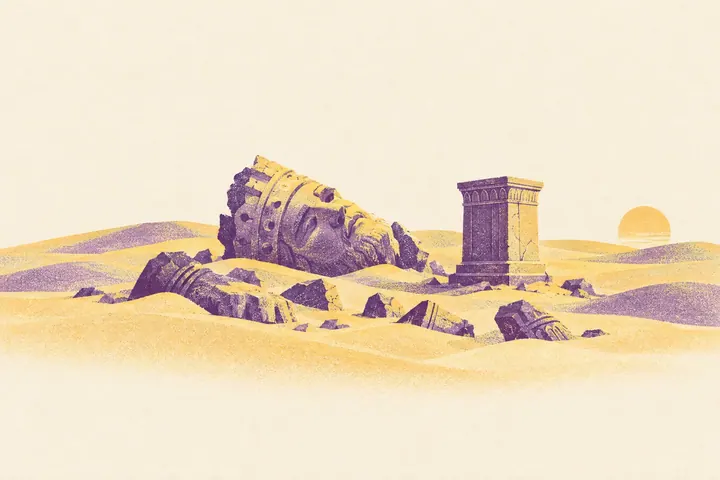
- Lines 2 to 5: two huge stone legs stand in the desert with no body above them. Nearby, half buried in sand, lies the statue’s broken face. Its frown and its “sneer of cold command” show a proud, cruel ruler.
- Lines 6 to 8: the sculptor understood the king’s feelings and copied them into the stone. Those feelings have outlived both the sculptor and the king.
- Lines 9 to 11: words carved on the pedestal (the base of the statue) give the king’s name. He calls himself “King of Kings” and tells other rulers to look at his works and despair.
- Lines 12 to 14: nothing else is left. Empty sand stretches as far as anyone can see.
The main ideas
Human power does not last. The king’s works have gone, and only a wreck is left in the sand.
Pride is made to look foolish. The words on the pedestal were meant to say: you will never match me. Now they say: your power will fall too. Shelley lets the king’s own words mock him.
Art outlasts power. The sculptor saw the king clearly and carved what he saw, so the king is remembered through an artist’s eyes, sneer and all.
Time and nature win. The desert has the last word.
How Shelley does it
A sonnet with a broken pattern
The poem is a sonnet: fourteen lines, mostly in iambic pentameter (ten syllables, with the beat on every second one). The rhyme scheme is ABABACDCEDEFEF. It does not follow the usual pattern of either main type of sonnet, the Italian or the English. You can link the broken pattern to the broken statue: even the form will not stay in order.
A story inside a story
The king’s words reach us at third hand: the speaker reports the traveller, who reports the words a sculptor carved. This is a frame narrative (a story told inside another story). The king wanted to speak to the whole world for ever. Instead his voice is boxed in by other people’s words, as his statue is half buried in sand.
Language: one word zoomed in each time
“sneer of cold command”. The hard c sounds in “cold command” are alliteration, and they make the phrase sound harsh. Zoom in on “cold”: this ruler felt nothing for the people he gave orders to.
“Look on my Works, ye Mighty, and despair!” The line is an imperative (an order) and ends with an exclamation mark, so we hear the king shouting. Zoom in on “despair”: he meant other rulers to despair because they could never be as great. The empty desert gives the word a new meaning.
“Nothing beside remains.” The full stop in the middle of line 12 is a caesura, a pause inside the line, and it cuts the king off. Zoom in on “Nothing”: it is the first word after he stops speaking, and it answers him.
“The lone and level sands stretch far away.” The repeated l and s sounds and the long vowels slow the last line down. Zoom in on “lone”: the king wanted crowds to look on his works, and now nobody does.
Context that matters
Shelley spent his short life attacking tyranny. In 1819 he wrote a sonnet, ‘England in 1819’, that begins by calling George III “An old, mad, blind, despised, and dying king”. It was not published until 1839, after Shelley’s death.
So when Shelley describes a dead king’s “sneer of cold command”, he is warning the rulers of his own time too: tyrants fall, however great they think they are. Use context like this in a sentence or two, where it explains why Shelley wrote as he did. Using context in your answers shows how.
Myths about Ozymandias
Myth Shelley chose a sonnet because sonnets are love poems, so the form shows that Ozymandias loves himself.
What the evidence says
AQA’s examiners met this idea in 2023 and said there “isn’t really anywhere to go with this idea once it has been stated”. Writing about the layers of voices, and the time they show passing, worked much better.
Source: AQA, Report on the examination, 8702/2, June 2023
Myth The more you know about the real pharaoh, the better your answer.
What the evidence says
The same report found that comments on Rameses II “were not particularly useful in terms of developing a response to the effects of power”. One sentence of context is enough. Spend your time on Shelley’s ideas and methods.
Source: AQA, Report on the examination, 8702/2, June 2023
Poems to compare it with
- My Last Duchess: two proud rulers, each seen through a work of art. Shelley’s king has lost everything, while Browning’s Duke still holds all his power.
- London: Blake and Shelley were both Romantic poets who hated tyranny. Blake shows the damage power does to ordinary people now. Shelley shows power falling in time.
- The Prelude: a proud boy and a proud king are both put in their place by something bigger. For Wordsworth it is a mountain, and for Shelley it is time and the desert.
- Storm on the Island and Exposure: nature is stronger than people, in a single night of weather as well as over three thousand years.
How to compare two poems shows how to turn a pair into an answer.
Lines to learn
- “I met a traveller from an antique land” (the speaker, line 1). The opening sets up the frame: everything after this is second-hand.
- “sneer of cold command” (the traveller, line 5). Alliteration makes the king sound harsh and unfeeling.
- “The hand that mocked them, and the heart that fed” (the traveller, line 8). The sculptor’s hand copied the king’s passions, and perhaps made fun of them too.
- “My name is Ozymandias, King of Kings” (Ozymandias, line 10). The king calls himself the greatest ruler of all.
- “Look on my Works, ye Mighty, and despair!” (Ozymandias, line 11). His order to other rulers, now spoken to an empty desert.
- “Nothing beside remains.” (the traveller, line 12). Three plain words that answer the king.
- “The lone and level sands stretch far away.” (the traveller, line 14). The last line is long, flat and empty, like the desert.
Test yourself
7 quotations from this page. For each one, choose who says it and where it comes from. Ten at a time, in a new order every round.
Who says it, and where? Open each quotation to check your answer.
“I met a traveller from an antique land”
The speaker, line 1
“sneer of cold command”
The traveller, line 5
“The hand that mocked them, and the heart that fed”
The traveller, line 8
“My name is Ozymandias, King of Kings”
Ozymandias, line 10
“Look on my Works, ye Mighty, and despair!”
Ozymandias, line 11
“Nothing beside remains.”
The traveller, line 12
“The lone and level sands stretch far away.”
The traveller, line 14
Frequently asked questions
What is the message of Ozymandias?
Human power does not last, however proud a ruler is. Ozymandias ordered other rulers to look on his works and despair, but only a broken statue is left in an empty desert. Shelley, who hated tyranny, makes the king’s own words mock him.
Is Ozymandias a sonnet?
Yes. It has fourteen lines, mostly in iambic pentameter. Its rhyme scheme, ABABACDCEDEFEF, does not follow either of the usual sonnet patterns, and you can link that broken pattern to the broken statue.
Who is speaking in Ozymandias?
The speaker says only the first line and a half. Then a traveller takes over and reports the words carved on the pedestal, so the king’s voice reaches us through two other people.
What poem goes well with Ozymandias in the exam?
‘My Last Duchess’ is the closest match: two proud rulers, each seen through a work of art. ‘London’ works for power and the people it harms, and ‘The Prelude’ or ‘Exposure’ work for the power of nature.
Sources
- Thomas Hutchinson (editor), The Complete Poetical Works of Percy Bysshe Shelley, Volume 2, Project Gutenberg (notes to ‘Ozymandias’, published in The Examiner, January 1818, and ‘England in 1819’, first published by Mary Shelley in 1839)
- Poetry Foundation, Percy Bysshe Shelley
- AQA, Report on the examination: Paper 2, June 2023 (sonnet form, Rameses II and the effects of power)
- AQA, GCSE English Literature 8702 specification (Paper 2, Section B)