Knowledge hub › For students › London
London by William Blake: GCSE poem guide
A walk through London where every face shows pain, and the poet knows who to blame. Here is the poem stanza by stanza, how Blake builds his attack and the lines worth learning.
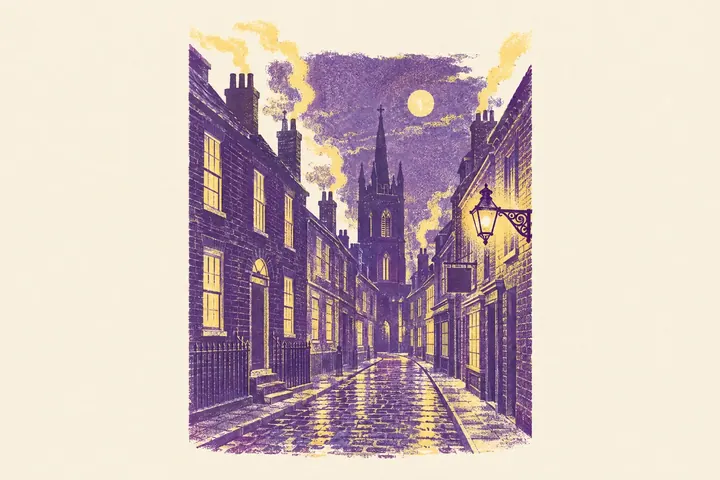
William Blake (1757 to 1827) was born in London and spent almost all his life there. He trained as an engraver, and he printed his own books of poems, with his own pictures, by hand. ‘London’ was published in 1794 in Songs of Experience, which Blake put together with his earlier Songs of Innocence.
The poem is sixteen lines long, in four stanzas. It is short enough to learn, and it gives you a lot to say about power: who has it, and what it does to the people who do not.
Read the transcript
This is ‘London’ by William Blake, from the Power and Conflict cluster of the AQA anthology. I’m Hannah, and I teach English. The question we’ll answer: How does every part of ‘London’ show the people in power causing suffering? We’ll go through the context, the poem section by section, one quotation explored closely, a model paragraph and the quotations to learn. First, the context.
An age of revolution. Blake was one of the Romantic poets. In 1789 the people of France rose up against their king, and many young English writers hoped ordinary people everywhere would win more freedom. Blake’s London. Blake lived and worked in London.
He saw poverty on every street, including children forced to work as chimney sweeps. Who Blake blamed. Blake blamed the people in charge: the church, the monarchy and the rich. ‘London’ was published in 1794 in Songs of Experience. Chains in the mind.
In the phrase “mind-forg’d manacles” Blake suggests that people are held down by fear and habit as well as by laws. Here’s the poem. Read it with me. I wander thro’ each charter’d street, Near where the charter’d Thames does flow. And mark in every face I meet Marks of weakness, marks of woe.
In every cry of every Man, In every Infants cry of fear, In every voice: in every ban, The mind-forg’d manacles I hear How the Chimney-sweepers cry Every blackning Church appalls, And the hapless Soldiers sigh Runs in blood down Palace walls But most thro’ midnight streets I hear How the youthful Harlots curse Blasts the new-born Infants tear And blights with plagues the Marriage hearse. Lines 1 to 4: The charter’d streets. “I wander thro’ each charter’d street”. The verb “wander” sounds free and aimless, but the adjective “charter’d” means owned and controlled. The speaker walks freely through a city that is not free.
“And mark in every face I meet”. The determiner “every” begins a pattern that runs through the poem. Nobody the speaker passes escapes the suffering. “Marks of weakness, marks of woe”. Repetition of “mark” as verb then noun: the speaker notices, and the people are marked.
Readers feel a whole city worn down. Lines 5 to 8: The sounds of fear. “In every cry of every Man”. Anaphora: four phrases begin “In every”. The poem moves from sight to sound, and the repeated cries build up like noise in a crowded street.
“In every Infants cry of fear”. Even babies cry in fear. The reader sees that suffering starts at birth, before anyone has done anything wrong. “in every ban”. A “ban” is a law or a public order.
Blake saw the people in charge controlling ordinary lives through rules. “The mind-forg’d manacles I hear”. A metaphor: “manacles” are chains, “forg’d” by the mind. Placing it at the end of the stanza makes the chains sound like the cause of every cry. And lines 13 to 16.
“But most thro’ midnight streets I hear”. The conjunction “But most” signals the worst sight is still to come. “midnight” moves the poem into darkness and the hidden life of the city. “How the youthful Harlots curse”. The adjective “youthful” shows a girl forced by poverty to sell sex.
Her curse sounds like anger at the life she has been pushed into. “Blasts the new-born Infants tear”. Often read as disease passed from mother to baby. Blake blamed the people in charge for the poverty that pushed young women into this life. “And blights with plagues the Marriage hearse”.
An oxymoron: “Marriage” means new life and joy, a “hearse” carries a coffin. The poem ends with love and family themselves infected by death. So, to sum it up in one sentence: Blake walks the reader through a city where every face and every cry shows suffering, and he blames the church, the monarchy and the rich for chaining people in poverty from birth to death. One quotation, explored closely: “mind-forg’d manacles”. Try it yourself first: method, zoom in, effect, and the context or purpose.
Method: A metaphor, with alliteration on the m sound. Zoom in: Forged means made by a blacksmith from hot metal. Here the chains are made by minds, so they are invisible. Effect: The reader sees that Londoners are trapped by fear and by the ideas they have been taught, as well as by laws. Context: Blake attacked the church, the monarchy and the rich.
He suggests that people accept their suffering because those in power taught them to. And here’s a model What–How–Why paragraph for the question: How does Blake present the suffering caused by those in power in ‘London’? Blake presents the suffering in London as the fault of the institutions that should protect the poor. In the third stanza he writes that “Every black’ning Church appalls”. The double-edged verb “appalls” means shocks, and also means to cover with a pall, the cloth placed over a coffin.
The Church is darkened by soot and by guilt. Then the soldier’s sigh “Runs in blood down Palace walls”. This metaphor puts the soldier’s blood on the monarchy’s own walls, as if the palace cannot wash itself clean. Blake attacked the church, the monarchy and the rich for the poverty around him. By linking each victim to a building of power, he makes his 1794 readers see who is to blame.
The quotations from ‘London’ worth learning by heart. “mind-forg’d manacles”. People are chained by fear and by ideas as well as by laws. “Runs in blood down Palace walls”. The soldier’s suffering stains the monarchy that sent him to fight.
Everything in this video comes from our Power and Conflict poetry scheme of learning for schools. If you’re a teacher, Lesson 3 of every scheme is free at btl.education. Thank you for watching.
What happens in the poem
- Stanza 1: the speaker walks through London’s streets and past the river Thames. In every face he meets he sees signs of weakness and sadness.
- Stanza 2: he hears misery in every voice: men, crying babies, and every law or ban. He hears “mind-forg’d manacles”, chains that people’s own minds have made.
- Stanza 3: he hears a chimney sweep’s cry and a soldier’s sigh. He links the sweep to the church and the soldier to the palace, where the king lives.
- Stanza 4: worst of all, at midnight he hears a young prostitute cursing. Her curse harms her newborn baby and turns marriage into a funeral.
The main ideas
Power causes suffering. The people at the top, the church, the king and the law, hold power over the poor. Blake shows the damage at street level, in faces and voices.
The people in charge are to blame. The church does nothing for the chimney sweep. The soldier’s pain marks the palace walls. Blake points at the institutions as well as at the suffering.
People are trapped in their own minds. The “mind-forg’d manacles” suggest that people accept their misery because of what they have been taught. The chains are inside them.
The suffering passes on. The poem ends with a newborn baby and a marriage, two new beginnings, and both are already spoiled.
How Blake does it
Form: a tight, regular pattern
Each stanza has four lines (a quatrain), with an ABAB rhyme scheme and mostly eight syllables a line. The pattern hardly changes. You can link that steady, marching form to the city itself: everything is controlled and nobody can step out of line.
Structure: from what he sees to what he hears
In stanza 1 the speaker sees. From stanza 2 he hears: cries, a ban, a sigh, a curse. The poem gets darker as it goes, moving through the day to “midnight streets”, and it ends on its harshest image.
Look at the first letters of the lines in stanza 3: How, Every, And, Runs. They spell HEAR. This is an acrostic, a word hidden in the first letters of the lines. It matches the speaker’s listening.
Language: one word zoomed in each time
“each charter’d street”. A charter was a legal paper that gave someone rights or ownership. Zoom in on “charter’d”: even the streets, and the river in the next line, are owned and controlled. Nothing in the city is free.
“Marks of weakness, marks of woe.” The speaker says he will “mark”, or notice, every face, then sees “Marks” on it. Repetition of “every” runs through the first two stanzas, so the suffering seems to be everywhere. Zoom in on “woe”: an old word for deep sadness, which sounds like a cry.
“The mind-forg’d manacles I hear”. Manacles are chains for the wrists. Zoom in on “forg’d”: chains are forged, or hammered, in a fire. Here people’s minds have made the chains themselves.
“Every blackning Church appalls”. Zoom in on “blackning”: the soot from the chimneys blackens the church walls, and the church’s name is blackened too, because it lets children do this work.
“Runs in blood down Palace walls”. A sigh cannot run in blood, so this is impossible on purpose. Zoom in on “blood”: the soldier suffers and dies for the king, and Blake puts the blood on the king’s own walls.
“the Marriage hearse”. A hearse is the car, or carriage, that carries a coffin. Putting marriage next to it is an oxymoron (two opposite ideas side by side). Zoom in on “hearse”: the poem’s last word is death.
Context that matters
Blake lived in a London with great wealth and great poverty side by side. Young children were sent up chimneys to sweep them, and Blake wrote two poems called ‘The Chimney-Sweeper’, one in Songs of Innocence and one in Songs of Experience. He was angry with the church, the king and the rich for the poverty around him.
The French Revolution began in 1789, five years before the poem was published, and people across Europe were asking why a king and a church should hold so much power. ‘London’ asks the same question.
AQA’s examiners in 2023 found that answers about the responsibilities and abuse of power did “much better” than answers that stayed with the details of poems such as ‘London’. So use the context to explain Blake’s anger about power, in a sentence or two. Using context in your answers shows how.
Poems to compare it with
- Ozymandias: Shelley and Blake were both Romantic poets who hated tyranny. Blake shows power harming people now. Shelley shows power falling in time.
- My Last Duchess: in 2023 the question named ‘My Last Duchess’, and ‘London’ and ‘Ozymandias’ were the most popular choices of second poem. Browning shows one powerful man harming one woman. Blake shows a whole system harming a whole city.
- Checking Out Me History: both poems show people in power shaping what others think. Blake’s “mind-forg’d manacles” sit well beside Agard’s speaker, who was taught a history that left him out.
- The Émigrée: two speakers and two cities. Blake’s city is full of misery, while Rumens’s speaker loves her city even though tyrants rule it.
- The Charge of the Light Brigade: two pictures of the soldier. Tennyson’s soldiers win glory, while Blake’s soldier only sighs.
How to compare two poems shows how to turn a pair into an answer.
Lines to learn
- “I wander thro’ each charter’d street” (the speaker, stanza 1). Even the streets are owned and controlled.
- “Marks of weakness, marks of woe.” (the speaker, stanza 1). Repetition and alliteration show suffering on every face.
- “In every Infants cry of fear” (the speaker, stanza 2). Even babies are afraid.
- “The mind-forg’d manacles I hear” (the speaker, stanza 2). People are chained by their own minds.
- “Every blackning Church appalls” (the speaker, stanza 3). The church is blackened by soot and by its own neglect.
- “Runs in blood down Palace walls” (the speaker, stanza 3). The soldier’s suffering is put on the king’s doorstep.
- “And blights with plagues the Marriage hearse.” (the speaker, stanza 4). The last line joins love and death in an oxymoron.
Test yourself
7 quotations from this page. For each one, choose who says it and where it comes from. Ten at a time, in a new order every round.
Where is it? Open each quotation to check your answer.
“I wander thro’ each charter’d street”
The speaker, stanza 1
“Marks of weakness, marks of woe.”
The speaker, stanza 1
“In every Infants cry of fear”
The speaker, stanza 2
“The mind-forg’d manacles I hear”
The speaker, stanza 2
“Every blackning Church appalls”
The speaker, stanza 3
“Runs in blood down Palace walls”
The speaker, stanza 3
“And blights with plagues the Marriage hearse.”
The speaker, stanza 4
Frequently asked questions
What is the message of London by William Blake?
The people in power, the church, the king and the law, cause the suffering of the poor, and the poor are trapped by it, even in their own minds. Blake shows that misery in every face and voice in the city.
What does mind-forged manacles mean?
Manacles are chains for the wrists, and forged means hammered out of metal. Blake says people’s own minds have made these chains: they accept their misery because of the ideas they have been taught.
What is the structure of London?
Four stanzas of four lines, with an ABAB rhyme scheme and a steady beat. The speaker moves from what he sees to what he hears, and the poem grows darker until it ends at midnight on the word “hearse”.
Which poems compare well with London?
‘Ozymandias’ is a strong choice, because both poets attack tyranny. ‘Checking Out Me History’ works for power over people’s minds, and ‘The Émigrée’ works for two very different cities.
Sources
- Project Gutenberg, William Blake, Songs of Innocence and of Experience (ebook 1934, including both poems called ‘The Chimney-Sweeper’)
- Poetry Foundation, William Blake
- AQA, Report on the examination: Paper 2, June 2023 (‘Ozymandias’ and ‘London’ as the most popular choices, and writing about the abuse of power)
- AQA, GCSE English Literature 8702 specification (Paper 2, Section B)