

Knowledge hub › For students › The Sign of Four: the story
The Sign of Four: the story, chapter by chapter
A young governess brings Sherlock Holmes a box of pearls and a strange letter, and the trail leads to a murder, a stolen treasure and a chase down the Thames. Each chapter is retold in plain English.
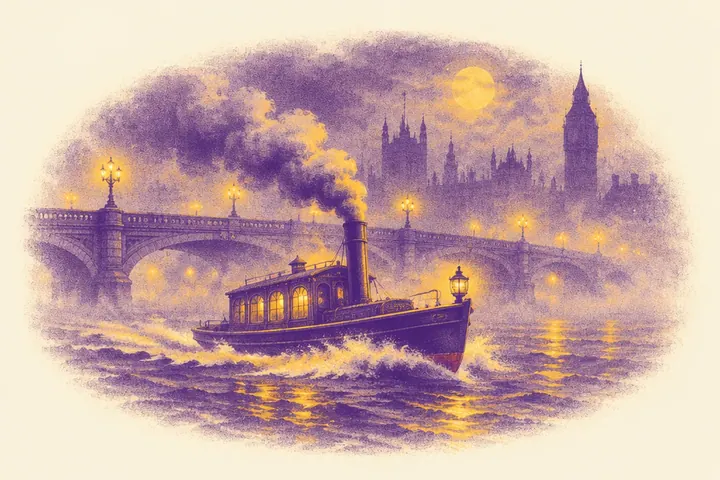
In Arthur Conan Doyle’s novel The Sign of Four (1890), Sherlock Holmes and Dr Watson help Mary Morstan find out what happened to her missing father. The trail leads to a murder in a locked room, a stolen Indian treasure and a chase down the Thames, and the treasure ends up at the bottom of the river. It is Section B of AQA GCSE English Literature Paper 1.
The Sign of Four is the second Sherlock Holmes novel. Conan Doyle was born in Edinburgh in 1859 and trained as a doctor. The story first appeared in Lippincott’s Monthly Magazine, an American magazine, in February 1890, and came out as a book later that year. It has 12 chapters, each with its own title.
- 12chapters in the novel, the last one told mostly by the convict Jonathan SmallStandard Ebooks text
- 1859the year Arthur Conan Doyle was born, in EdinburghEncyclopaedia Britannica
- 30marks for the question on the novel, with no marks for spelling, punctuation and grammarAQA specification
The whole story is told by Dr Watson, who shares rooms with Holmes at 221B Baker Street. He is solving a mystery and falling in love at the same time. The exam question prints an extract, then asks about the novel as a whole, so you need the whole story.
Chapter 1: The Science of Deduction
The novel opens with Holmes injecting himself with cocaine. He holds the needle with “his long, white, nervous fingers”, and his arm is covered in puncture marks. Watson has watched this three times a day for months. At last he warns Holmes that the drug could damage his great mind.
Holmes says he takes it because he is bored. He needs puzzles: “I abhor the dull routine of existence.”
Watson tests him with a watch that belonged to his older brother. From the scratches on it, Holmes works out that the brother was careless, often poor and fond of drink, and that he has died. Watson is hurt, but Holmes says “I never guess.” Then he stares out at the yellow fog, still bored, until a visitor arrives.
Chapter 2: The Statement of the Case
The visitor is Mary Morstan, a young governess. Watson sees in her face “a refined and sensitive nature”. Her father, Captain Morstan, was an officer in an Indian regiment. In 1878 he came home on leave, sent her a loving telegram from a London hotel and vanished. His only friend in London, Major Sholto, said he did not know Morstan was in England.
In 1882 an advertisement in The Times asked for Mary’s address. Since then, every year, she has been sent a large pearl. That morning a letter came. It tells her to stand by the third pillar outside the Lyceum Theatre at seven that evening, and to bring two friends but no police. She also shows them a paper from her father’s desk: a plan of a building, marked with four crosses and four names, the first of them Jonathan Small.
When she has gone, Watson praises her. Holmes says he did not notice: “A client is to me a mere unit” in a problem. Watson tells him there is something inhuman about him. Holmes has found out that Major Sholto died in April 1882, the year the pearls began.
Chapter 3: In Quest of a Solution
It is a foggy September evening, and “a dense drizzly fog lay low upon the great city”. At the Lyceum a coachman takes the three of them into a cab and drives fast through London. They cross the river and head south, past what Watson calls “the monster tentacles which the giant city was throwing out into the country”. The cab stops at a house in a new terrace, and an Indian servant opens the door.
Chapter 4: The Story of the Bald-Headed Man
Inside, the dull house hides a room full of rich Eastern carpets and lamps. Their host is Thaddeus Sholto, a small, nervous, bald man.
Thaddeus and his twin brother, Bartholomew, are Major Sholto’s sons. Their father came home from India rich, lived at Pondicherry Lodge in Upper Norwood and was terrified of men with wooden legs. On his deathbed in 1882 he told his sons the truth. Captain Morstan had come to claim his half of a treasure the two men had brought from India. They quarrelled, Morstan’s weak heart gave way and he fell dead, and Sholto hid the body. The dying man confessed that “The cursed greed which has been my besetting sin through life” had kept the treasure from Mary.
Before he could say where it was hidden, he saw at the window “a bearded, hairy face, with wild cruel eyes”, and died. Next morning the room had been searched, and a note on his body read the sign of the four.
Thaddeus sent Mary the pearls. Now Bartholomew has found the treasure hidden in the roof of Pondicherry Lodge, worth at least half a million pounds, and Thaddeus wants Mary to have her share. Watson realises she will be a great heiress, and admits that “selfishness took me by the soul”.
Chapter 5: The Tragedy of Pondicherry Lodge
They drive to Pondicherry Lodge, a big house behind a high wall. The porter, McMurdo, lets them in because he remembers boxing with Holmes. Bartholomew has been locked in his room all day. While they wait, Mary and Watson stand hand in hand in the garden like two scared children.
Holmes and Watson look through the keyhole. A face looks back, set in “a horrible smile, a fixed and unnatural grin”. They break the door down. Bartholomew is dead in his chair, with a dark thorn in the skin above his ear. On the table is a paper with the sign of the four. The treasure chest is gone.
Chapter 6: Sherlock Holmes Gives a Demonstration
The door was locked from inside, so the killer came through the window on a rope. There is the print of a boot and a wooden stump on the sill, and tiny bare footprints in the roof room above. Holmes works out that there were two people: a man with a wooden leg, and a small, agile companion who came in through the roof and let the rope down. The thorn is poisoned. The small companion has trodden in creosote, a strong-smelling tar, which will leave a trail.
Then Athelney Jones of Scotland Yard arrives. He is loud and sure of himself, and he decides that Thaddeus did it. He arrests Thaddeus, and later the servants too. Holmes gives him the name of one killer, Jonathan Small, but Jones takes no notice. Holmes sends Watson to take Mary home and to fetch a dog called Toby.
Chapter 7: The Episode of the Barrel
Watson takes Mary to the home of her employer, Mrs Cecil Forrester, in Camberwell. He longs to tell her he loves her but holds back. If she is to be rich, she might think he wants her money: “This Agra treasure intervened like an impassable barrier between us.”
Watson returns with Toby before dawn. Holmes finds a little woven pouch of poisoned thorns on the roof. Toby follows the smell of creosote across south London, but the trail ends at a timber yard, at a barrel of creosote. The dog has followed the wrong smell, and Holmes and Watson burst out laughing.
Chapter 8: The Baker Street Irregulars
They go back to where the trail split and follow the other line. It leads to the river and Smith’s Wharf. Mrs Smith tells them that her husband, Mordecai Smith, has gone off in his fast steam launch, the Aurora, with a man with a wooden leg. The killers have escaped by water.
At Baker Street, Holmes reads about the Andaman Islands in a reference book and calls in the Baker Street Irregulars, a gang of street boys led by Wiggins. He pays them to search both banks of the Thames for the Aurora.
Chapter 9: A Break in the Chain
No news comes. The newspaper praises Jones for arresting Thaddeus. Watson visits Mary to tell her the story. Before he goes, Holmes says “Women are never to be entirely trusted”, a view Watson calls atrocious.
Holmes grows restless, then goes out to search the river himself. While he is gone, Jones arrives, much less sure of himself. An old sailor comes asking for Holmes, then laughs in Holmes’s own voice. It was a disguise. Holmes has found the Aurora, and he tells Jones to have a fast police launch ready that evening.
Chapter 10: The End of the Islander
Holmes found the Aurora at the sixteenth boatyard he tried, Jacobson’s Yard, and left a boy to watch it. At dusk the boy waves a handkerchief, and the Aurora races out and away downstream.
The chase goes on for miles down the Thames. The engines of the police launch beat “like a great metallic heart”. Slowly they gain. In their lantern light they see a man with a wooden leg, cursing them, and beside him a tiny figure. Watson describes him in cruel, racist words as “this savage, distorted creature”. He raises a blowpipe, and Holmes and Watson fire together. He falls into the river and is lost. Later they find a poisoned dart stuck in the wood just behind where they stood.
The Aurora runs onto a mudbank. The wooden-legged man jumps out, but his stump sinks deep into the mud, and they haul him out with a rope. He is Jonathan Small. The iron treasure box is on board.
Chapter 11: The Great Agra Treasure
On the way back, Small says the little man was Tonga, his friend from the Andamans. Tonga killed Bartholomew with a dart. Small had no quarrel with Bartholomew, and he was so angry with Tonga that he could have half killed him.
Jones lets Watson take the box to Mary first. Watson forces it open with a poker. It is empty. Mary is not upset, and Watson is overjoyed, because “the golden barrier was gone from between us”. He tells her he loves her, and she agrees to marry him.
Chapter 12: The Strange Story of Jonathan Small
At Baker Street, Small laughs at the empty box. He threw the jewels into the Thames during the chase: “It is my treasure; and if I can’t have the loot I’ll take darned good care that no one else does”. Then he tells his story.
He grew up in Worcestershire and joined the army. In India, a crocodile took off his leg in the Ganges. In 1857 the rebellion against British rule broke out, and he took refuge in the fort at Agra. One night, guarding a gate with two Sikh soldiers, he joined their plot to kill a rich merchant, Achmet, who was bringing a treasure into the fort in secret. The four men hid the jewels, and Small drew four plans, each marked with the sign of the four. Then the body was found, and all four were sent to prison for life.
In the convict settlement on the Andaman Islands, Small met Major Sholto and Captain Morstan, who were officers there. Sholto had lost heavily at cards. Small offered both officers a share of the treasure if they would help the four escape. Sholto went to fetch it and never came back. Small says, “From that day I lived only for vengeance.”
Small nursed Tonga through an illness, and Tonga helped him escape. Years later they reached England. Small was the face at the window as Sholto died. When Bartholomew found the treasure, they came for it, hoping to find the room empty.
When Small has gone, Watson says he is to marry Mary. Holmes says he will never marry, in case it spoils his judgement. Watson points out that he gets a wife and Jones gets the credit. Holmes replies that “there still remains the cocaine-bottle”, and reaches up for it.
The main characters
- Sherlock Holmes: a private detective who reasons from small facts to big conclusions. He takes cocaine when he is bored and keeps feeling out of his work.
- Dr John Watson: the narrator, an army surgeon wounded in Afghanistan. He is loyal and warm, and he falls in love with Mary.
- Mary Morstan: a governess whose father vanished in 1878. She is calm, brave and kind.
- Thaddeus Sholto: Major Sholto’s nervous son, who sent Mary the pearls. Jones arrests him by mistake.
- Bartholomew Sholto: his twin, who finds the treasure and is killed the same night.
- Major John Sholto: the officer who took the treasure and kept it all.
- Captain Arthur Morstan: Mary’s father, who died while quarrelling with Sholto.
- Jonathan Small: the man with the wooden leg, a former soldier and convict who lives for the treasure and revenge.
- Tonga: an Andaman Islander who escaped with Small. Watson describes him in racist, animal terms.
- Athelney Jones: a Scotland Yard detective who arrests the wrong people and takes the credit.
The main ideas and context
Reason and emotion. Holmes trusts cold reason. Watson tells the story with feeling and falls in love. At the end Watson has a wife, and Holmes, with no case left, reaches for the cocaine. Conan Doyle said Holmes was partly based on Joseph Bell, one of his teachers at medical school, who could tell a great deal about a patient by looking closely.
Greed. The Agra treasure brings death or misery to everyone who wants it: Achmet, Morstan, both Sholtos, Small and Tonga. Major Sholto never spent it. He only wanted to own it, and Small would rather throw it in the river than let anyone else have it.
Justice. Scotland Yard arrests the wrong man, and only Holmes, working outside the police, finds the truth. Small asks whose treasure it really is, and the novel lets the reader judge.
The British Empire. The crime begins in India during the rebellion of 1857, which the British called the Indian Mutiny and many Indian historians call the First War of Independence. The British set up a prison settlement on the Andaman Islands in 1858. The novel’s descriptions of Tonga and the Islanders come from Victorian racial prejudice and are false, and a good answer says so.
Love and money. Watson cannot propose while Mary might be rich, because people would think he wanted her fortune. Before 1882 a married woman’s money passed to her husband. When the box is empty, he is free to speak.
Myths about The Sign of Four
Myth Holmes’s famous catchphrase, Elementary, my dear Watson, comes from this novel.
What the evidence says
The phrase does not appear anywhere in The Sign of Four. Instead Holmes explains his method at length, and in Chapter 1 he says “I never guess. It is a shocking habit”.
Source: Arthur Conan Doyle, The Sign of Four (1890), Chapter 1 (Standard Ebooks text)
Myth Mary ends up rich.
What the evidence says
The treasure box is empty when Watson opens it in Chapter 11. Small threw the jewels into the Thames during the chase. Watson is glad, because the money was keeping him and Mary apart.
Source: Arthur Conan Doyle, The Sign of Four (1890), Chapters 11 and 12 (Standard Ebooks text)
Myth The police solve the case.
What the evidence says
Athelney Jones arrests Thaddeus Sholto and the servants, who are all innocent. Holmes finds the real killers and plans the chase. Jones still takes the credit, as Watson points out at the end.
Source: Arthur Conan Doyle, The Sign of Four (1890), Chapters 6, 9 and 12 (Standard Ebooks text)
The Sign of Four in the exam
The Sign of Four is one of the 19th-century novels you can study for Section B of AQA’s Literature Paper 1. Paper 1 lasts 1 hour 45 minutes, and Section A is on your Shakespeare play.
You answer one question. It prints an extract from the novel, then asks you to write about the extract and about the novel as a whole. It is worth 30 marks. There are no marks for spelling, punctuation and grammar in this section. Spend about 50 minutes on it. The exam is closed book, so anything you say about the rest of the novel comes from memory.
In their report on the June 2024 paper, AQA’s examiners wrote: “With The Sign of Four, students readily grasped the differences between Holmes and Watson”. They added that students saw how the two friends complete each other.
What to do next
Learn the quotations on The Sign of Four: quotations to learn, and practise with How to answer the extract question. For ways to bring in the history of the empire, see Using context in your answers. You can read the whole novel free on Standard Ebooks.
Frequently asked questions
How many chapters are there in The Sign of Four?
There are 12. Chapters 1 to 11 follow Holmes and Watson through the case. In Chapter 12, Jonathan Small tells the story of the treasure from the beginning.
Who narrates The Sign of Four?
Dr Watson tells the whole story in the first person. We see Holmes through the eyes of a friend who admires him, and we follow Watson’s feelings for Mary as the case goes on.
What is the sign of the four?
It is a mark of four crosses that Jonathan Small drew on the plans of the hidden treasure. It stood for the oath between Small and his three partners in India. Small leaves it on Major Sholto’s body and in Bartholomew’s room.
What happens to the treasure at the end?
Small throws the jewels into the Thames during the chase, so the box is empty when Watson opens it. Mary never gets her share, and Watson is free to propose.
Is The Sign of Four on Paper 1 or Paper 2?
It is on AQA Literature Paper 1, Section B. You get one question on a printed extract and the whole novel, worth 30 marks.
Sources
- Standard Ebooks, Arthur Conan Doyle, The Sign of the Four
- Encyclopaedia Britannica, Arthur Conan Doyle
- AQA, GCSE English Literature 8702 specification
- AQA, Report on the examination: Paper 1, June 2024