

Teachers › Key Stage 3 › Year 8 › The Tempest
The Tempest
Key Stage 3 · Year 8 scheme of learning · Summer 1 in our Year 8 plan
A half-term scheme of learning for Year 8: 14 one-hour lessons across about six weeks, built around one big question: who should rule the island? Every lesson has slides, teacher notes and a student booklet with three levels of support.
William Shakespeare, about 1611. Every extract is printed in the booklets, so no class set of books is needed.
Three levels of support · a checkpoint in Lesson 7 with whole-class feedback · an end-of-unit assessment in Lesson 13, placed in five bands
Real pages from the scheme
Choose a page to see it larger. Lesson 6 is free: we email the full editable lesson.
 Teacher handbookCover
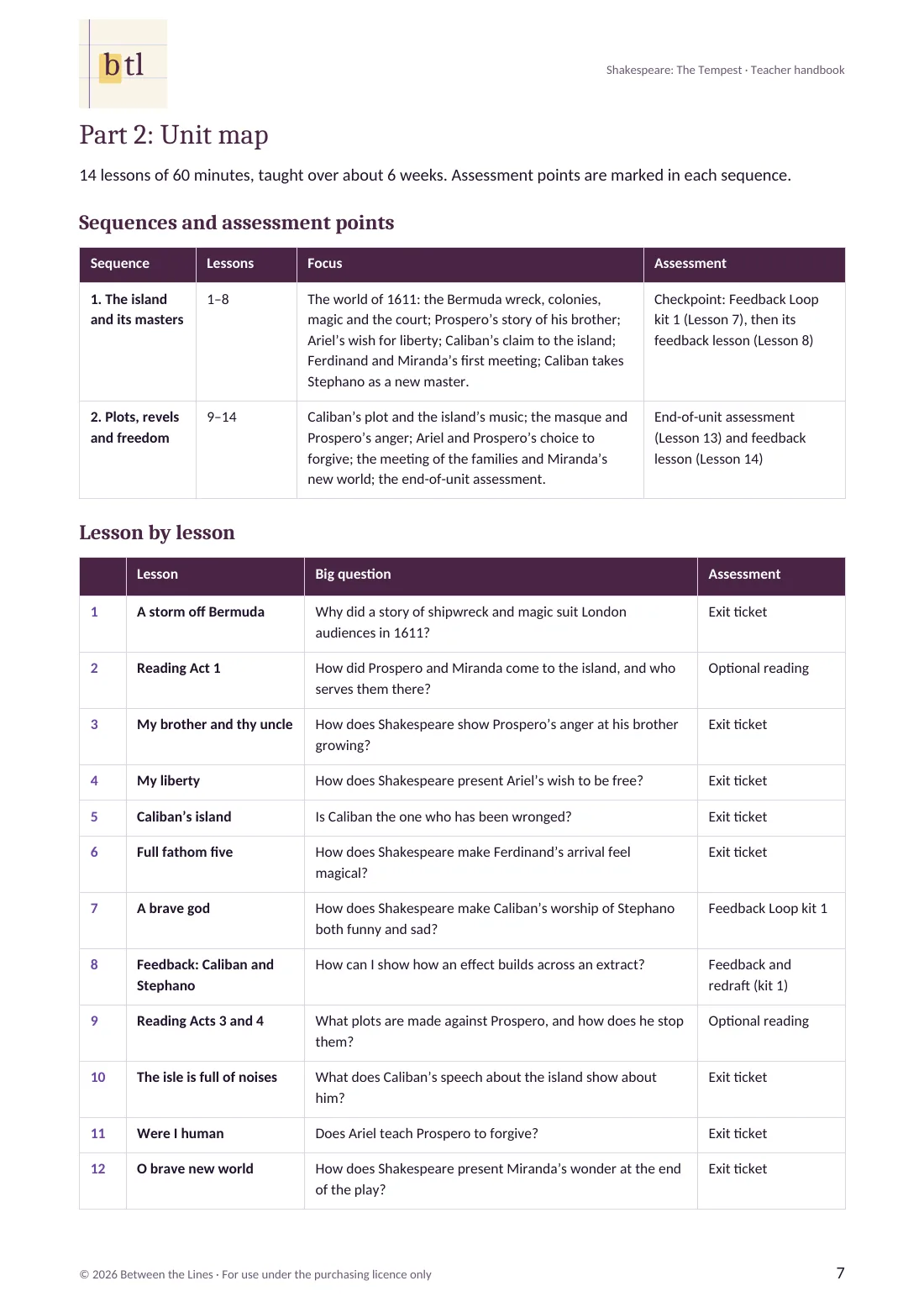 Lesson notesLesson 6 in the teacher handbook
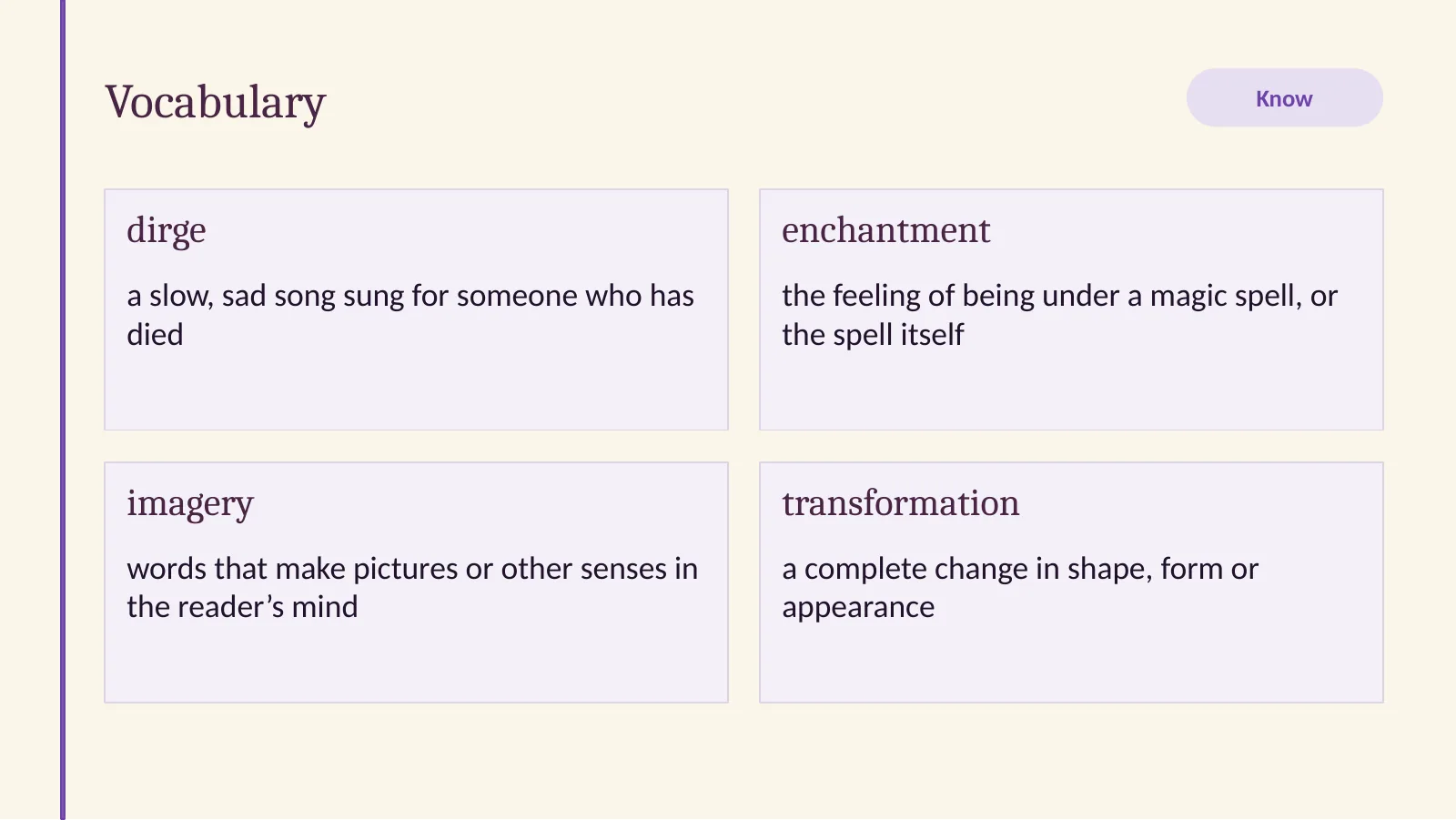 SlidesLesson 6: Full fathom five
 SecuringLesson 6 in the Securing student pack
 StrengtheningLesson 6 in the Strengthening student pack
 SoaringLesson 6 in the Soaring student pack
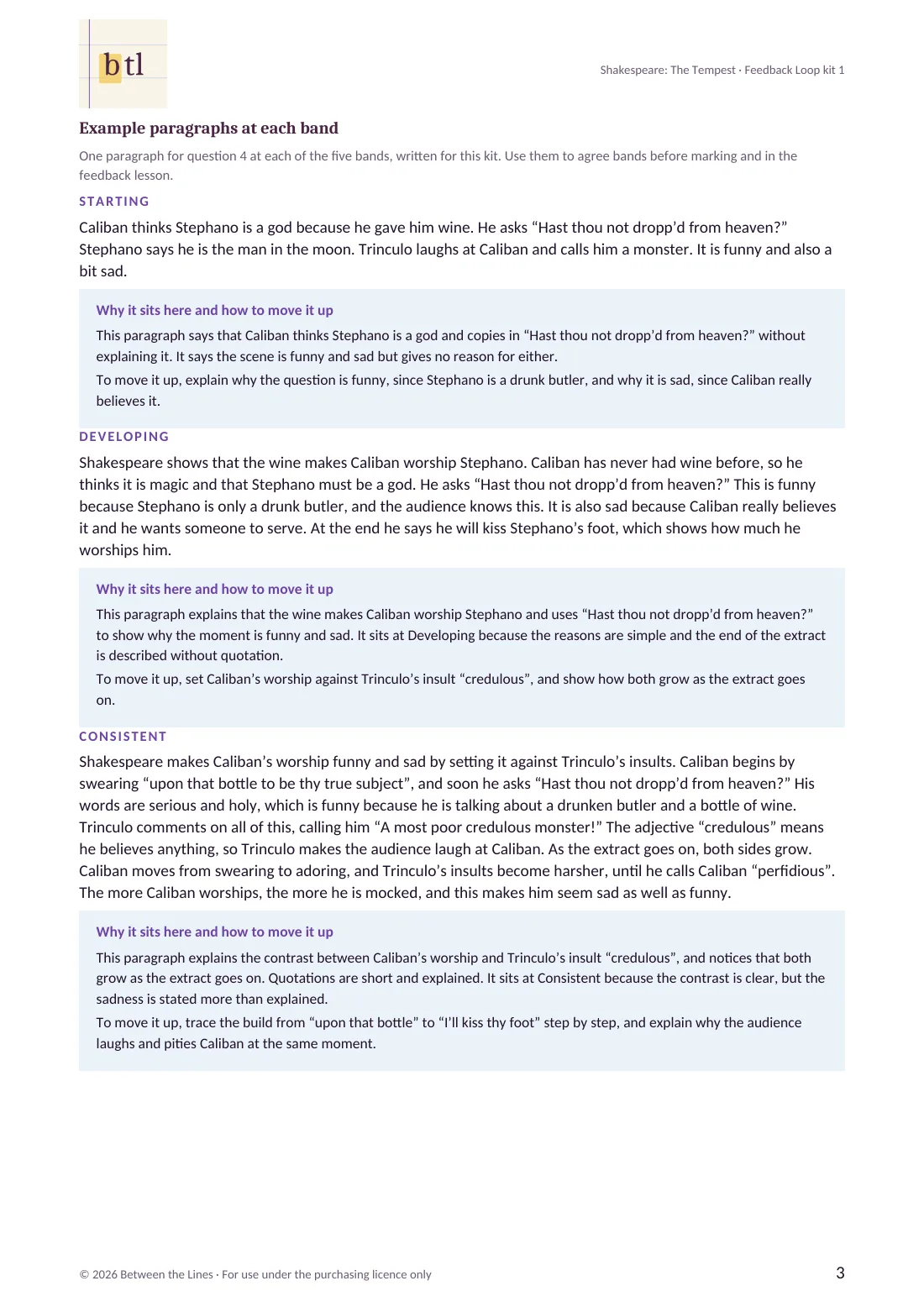 Feedback Loop kitThe checkpoint in Lesson 7
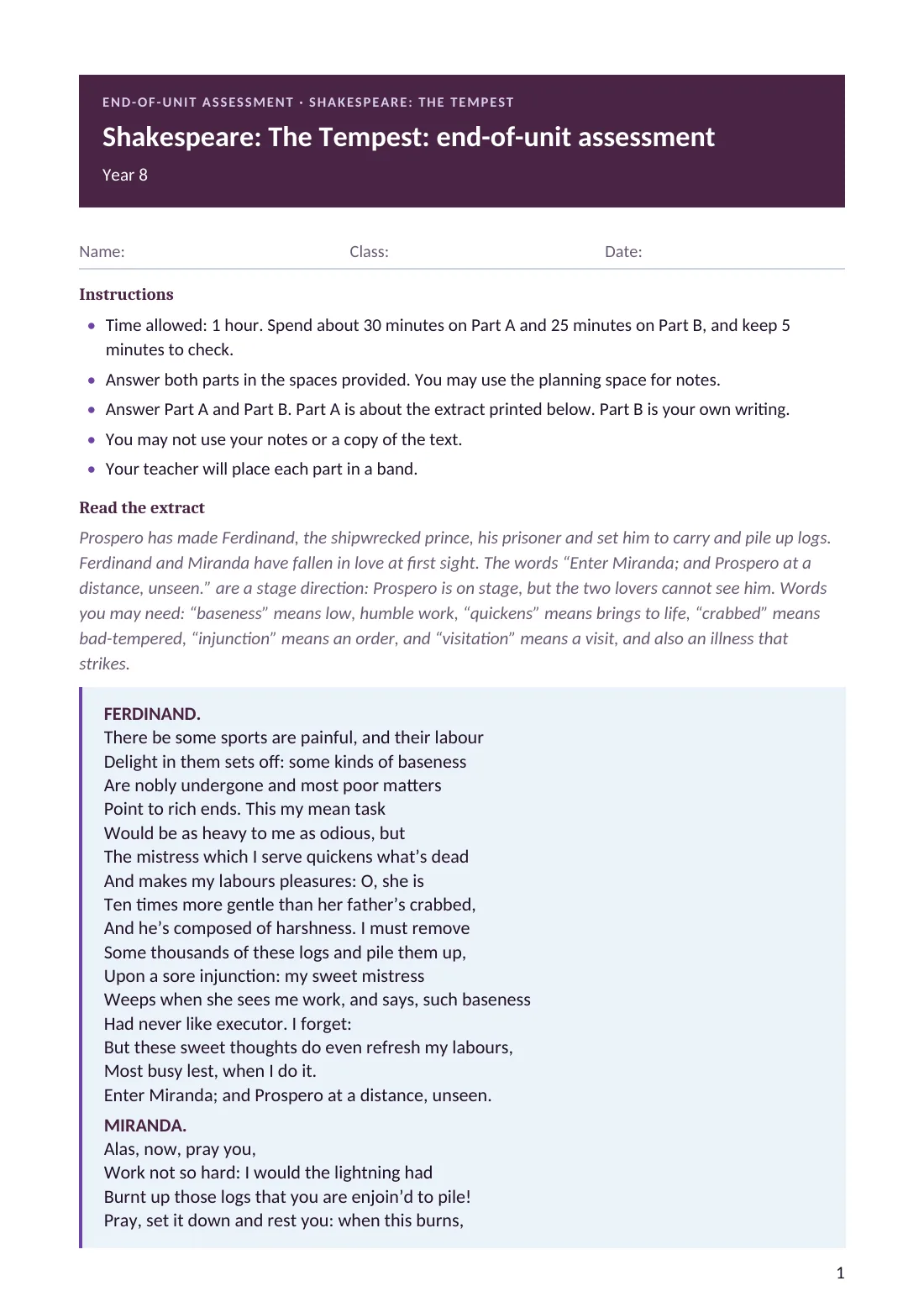 End-of-unit assessmentPart A reading, Part B writing
What students learn
Students read The Tempest, Shakespeare’s play about a duke who was thrown out of Milan and now rules an island by magic, and who brings his enemies to its shore in a storm. They learn what the first audiences of 1611 knew about shipwrecks, colonies and magic, then follow the play through its central scenes: Prospero’s story, Ariel’s wish for freedom, Caliban’s claim to the island, the first meeting of Ferdinand and Miranda, the drunken plot, the masque and Prospero’s choice to forgive. Close study asks how an effect builds across a passage and how far students agree with a reading of it, including the colonial reading of Caliban, with Caliban’s own voice taken seriously. They write What–How–Why paragraphs, a news report, a description and two monologues, and the unit ends with a reading response on an unseen extract and a monologue in prose for Caliban.
By the end of the unit, students can
- Explain what the first audiences of 1611 knew about shipwrecks, colonies, magic and the court
- Retell the plots of the play in order: Prospero’s revenge, the lovers, the lords’ plot and Caliban’s plot
- Analyse how Shakespeare builds an effect across an extract, with short quotations and accurate terms
- Evaluate a reading of a character or a scene and say how far they agree, with evidence
- Write a monologue in prose that gives a character a clear voice at a moment of change
Where it fits
Builds on: Year 7 study of A Midsummer Night’s Dream: a first whole Shakespeare play, read act by act; a magic servant (Puck) who carries out his master’s plans; comic working men who speak in prose while the lovers speak in verse; dramatic irony; and What–How–Why paragraphs that zoom in on a single word. Year 7 writing in role (letters, a diary, story openings) prepares students for the monologue in this unit.
Leads to: Shakespeare’s tragedies in Year 9 (Othello), where students follow a character across a whole play and weigh more than one reading; Shakespeare study in Years 10 and 11, where The Tempest may be read again in full; and writing in role for a character at a moment of change.
Two sequences, 14 lessons
The checkpoint, its feedback lesson and the end-of-unit assessment are planned into the sequence. Open a sequence to see its lessons. Lesson 6 is free.
The island and its mastersLessons 1 to 8
- 1A storm off BermudaWhy did a story of shipwreck and magic suit London audiences in 1611?
- 2Reading Act 1Reading lessonHow did Prospero and Miranda come to the island, and who serves them there?
- 3My brother and thy uncleHow does Shakespeare show Prospero’s anger at his brother growing?
- 4My libertyHow does Shakespeare present Ariel’s wish to be free?
- 5Caliban’s islandIs Caliban the one who has been wronged?
- 6Full fathom fiveFreeHow does Shakespeare make Ferdinand’s arrival feel magical?
- 7A brave godFeedback Loop kit 1How does Shakespeare make Caliban’s worship of Stephano both funny and sad?
- 8Feedback: Caliban and StephanoReview lessonHow can I show how an effect builds across an extract?
Plots, revels and freedomLessons 9 to 14
- 9Reading Acts 3 and 4Reading lessonWhat plots are made against Prospero, and how does he stop them?
- 10The isle is full of noisesWhat does Caliban’s speech about the island show about him?
- 11Were I humanDoes Ariel teach Prospero to forgive?
- 12O brave new worldHow does Shakespeare present Miranda’s wonder at the end of the play?
- 13End-of-unit assessmentEnd-of-unit assessmentOne reader said: ‘In this extract, love turns Ferdinand’s punishment into a pleasure.’ How far do you agree?
- 14Feedback and improvementFeedback lessonHow can I improve my reading and my writing?
Assessment without grades
End-of-unit assessment (Lesson 13): Part A, a reading response to a printed extract; Part B, a piece of the student’s own writing. One hour.
Each part is placed in one of five bands (Starting, Developing, Consistent, Confident, Assured) using the Year 8 reading and writing grids and our indicative content for the task. Nothing is scored or turned into a number. The checkpoint in Lesson 7 is one What–How–Why paragraph, placed in a band in the same way.
- Starting
- Developing
- Consistent
- Confident
- Assured
The bands describe the work, never the student. Key Stage 3 has no GCSE grades or marks in our schemes.
Buy the scheme
Both licences include every file in the scheme, as editable Word and PowerPoint files with a PDF copy of each.
One teacher
For your own classes
£40incl. VAT
- Print and adapt for your own students
- Put it on your school’s own secure learning platform
- Upgrade to a school licence for the difference before VAT
School
Every teacher and student at one school
£100+ VAT
- Print and adapt for every class in the school
- Put it on your school’s own secure learning platform
- Each further school in the same trust pays half
Planning the whole year? The Year 8 school bundle has all six schemes, the year plan and the end-of-year assessment for £480 + VAT.
Both licences include 10 folders: see what is in each
- 00Start here6 pages: how the scheme fits together
- 01Teacher handbook71 pages: intent, unit map, lesson notes and the assessment guide
- 02Slides14 PowerPoint decks with teacher notes, and a PDF copy of each
- 03Student bookletEvery lesson with the Securing, Strengthening and Soaring support side by side, 50 pages, plus one pack per level for set classes
- 04Independent practiceAll three levels in one booklet, 45 pages, plus one booklet per level
- 05Feedback Loop kitThe Lesson 7 checkpoint and its whole-class feedback lesson, 8 pages
- 06End-of-unit assessmentThe assessment paper and a teacher guide with the band grids
- 09Missed a lessonA catch-up sheet for every lesson
- 10InclusionNotes for students with SEND, students learning English and pupil premium students, and a key words list
- 11Talk routinesSixteen routines for spoken English in any lesson, with steps, sentence stems and a student sheet
To pay by invoice, to upgrade a teacher licence, or to license another school in your trust at half price, email hello@btl.education. Please don’t share the files outside your school or upload them to public websites. Licence terms
The Tempest is in the public domain. Every extract is copied exactly from a public-domain text of the play. Spellings, punctuation and a few speech headings differ in some school editions.
Teach Lesson 6 of The Tempest, free
One complete lesson from every Key Stage 3 scheme: the slides with teacher notes, and the teacher notes and student pages at Securing, Strengthening and Soaring. Choose a scheme and we email you the files straight away.
The rest of Year 8
- Gothic short stories Autumn 1
- Poetry of the First World War Autumn 2
- Detective fiction: Sherlock Holmes Spring 1
- Science fiction: The War of the Worlds Spring 2
- Voices of change Summer 2
Get our emails
About once a month: new free resources and the dates that matter for GCSE English.