
Macbeth: videos to go with the book
Free videos to go with the Between the Lines revision book for Macbeth. Watch one, then go back to the book and write: the exam is sat by hand.

Start here
Watch the complete revision guide before you start the book.
Read the transcript
This is the complete revision guide to Macbeth for AQA GCSE English Literature. I’m Hannah, and I teach English. In one video you’ll get the plot, the characters, the themes, the context, the terms to know, every quotation worth learning, and what the examiners reward. Paper 1 Section A: one question on an extract and the play as a whole. The question may call the extract a speech, a conversation or a moment in the play.
30 marks plus 4 for AO4, about 50 minutes. Answers are placed in a level by best fit. Let’s start with the plot, act by act. Act 1. The witches meet.
Macbeth wins the battle and is praised. The witches hail him as Thane of Cawdor and future king, and tell Banquo his descendants will be kings. Duncan makes Macbeth Thane of Cawdor but names Malcolm his heir. Lady Macbeth reads the letter and calls on spirits. Duncan arrives at Inverness; Macbeth doubts, and she persuades him.
Act 2. The dagger. Macbeth kills Duncan; Lady Macbeth returns the daggers and smears the grooms with blood. The Porter answers the knocking. Macduff finds the body, Macbeth kills the grooms, and Malcolm and Donalbain flee.
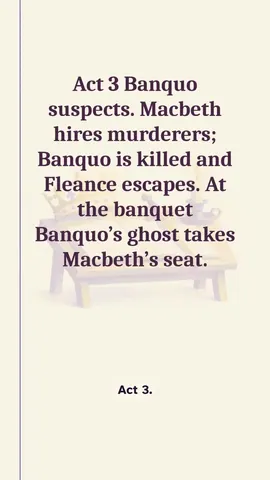
Nature turns unnatural, and Macbeth goes to be crowned. Act 3. Banquo suspects. Macbeth hires murderers; Banquo is killed and Fleance escapes. At the banquet Banquo’s ghost takes Macbeth’s seat.
Macbeth decides to visit the witches again. Macduff has gone to England. Act 4. The apparitions: beware Macduff; none of woman born can harm Macbeth; he is safe until Birnam Wood comes to Dunsinane. A line of kings descended from Banquo follows.
Macbeth has Macduff’s wife and children murdered. In England, Malcolm tests Macduff, and Macduff hears the news. Act 5. Lady Macbeth sleepwalks. The English army cuts branches from Birnam Wood.
Lady Macbeth dies. Macduff tells Macbeth he was “Untimely ripp’d” from his mother’s womb, and kills him. Malcolm becomes king. Now the characters. Macbeth.
A Scottish general, praised for his courage, who murders King Duncan to take the crown and becomes a tyrant destroyed by fear and guilt. Lady Macbeth. Macbeth’s wife, who drives him to the murder and then collapses under a guilt she cannot speak of. The witches. Three ‘weird sisters’ whose prophecies set Macbeth’s ambition loose.
They tell him truths that lead him to ruin. Banquo. Macbeth’s fellow general, who hears the same prophecies and does not act on them. Murdered on Macbeth’s orders; his ghost returns at the banquet. King Duncan.
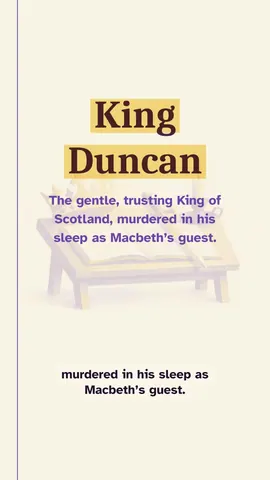
The gentle, trusting King of Scotland, murdered in his sleep as Macbeth’s guest. Macduff. The Thane of Fife, who discovers Duncan’s body, refuses to serve Macbeth and finally kills him after Macbeth has his family murdered. Malcolm. Duncan’s elder son and heir, who flees to England and returns with an army to take back the throne.
Fleance. Banquo’s son, who escapes the murderers, leaving the prophecy that Banquo’s line will be kings still alive. The Porter. The drunken gatekeeper whose comic speech about hell’s gate follows the murder. Lady Macduff and her son.
Murdered on Macbeth’s orders in Act 4, the clearest sign of how far he has fallen. The themes. For each one, here’s the idea in a sentence. That sentence is the start of a thesis. Ambition.
Ambition without a check destroys the ambitious and everyone near them. Kingship and order. A rightful king keeps the natural order; killing one breaks it, and nature itself rebels. Guilt. Guilt cannot be washed away; it comes back as hallucination, sleeplessness and madness.
The supernatural. The witches tell the truth in ways that mislead. They tempt, but the choice is Macbeth’s. Appearance and reality. Fair is foul: faces hide hearts, and what seems safe is deadly.
Gender and power. Characters tie courage and cruelty to manhood, and the play tests that idea to breaking point. The context. Use it where it explains a choice the writer made. One clause inside a point does more than a paragraph of history.
Macbeth was probably first performed in 1606, three years after James VI of Scotland became James I of England. James I believed in the divine right of kings: that a king was chosen by God and answerable only to God. To kill a king was a sin against heaven as well as a crime. The Great Chain of Being placed everything in a God-given order: God, angels, kings, nobles, ordinary people, animals, plants. Disturbing that order was thought to disturb nature itself.
In November 1605 the Gunpowder Plot to blow up the king and Parliament was discovered. The surviving plotters, including Guy Fawkes, were executed in January 1606, the year of the play. James I had written a book about witchcraft, Daemonologie (1597). Witchcraft was a crime punishable by death, and most of the audience believed witches were real. Shakespeare took the story from Holinshed’s Chronicles (1587) and changed it: the historical Macbeth reigned for seventeen years, and Banquo, claimed as James’s ancestor, was made innocent of the murder.
The terms to know. Name a method only when you can say what it does. Tragedy and tragic hero: A play in which a great man falls through a flaw of his own (hamartia). Macbeth moves from “brave Macbeth” in Act 1 to “this dead butcher” in Act 5. Soliloquy: A character alone on stage, speaking their thoughts.
Macbeth’s soliloquies track his conscience: Act 1 Scene 7, the dagger, “To be thus is nothing”, “Tomorrow, and tomorrow, and tomorrow”. Aside: A line the audience hears and the other characters do not. Macbeth’s asides in Act 1 Scenes 3 and 4 show the first thought of murder (Lesson 5). Dramatic irony: The audience knows what a character does not. Duncan arrives at Inverness saying “This castle hath a pleasant seat”.
Blank verse: Unrhymed iambic pentameter: lines of five beats, da-DUM, spoken by the nobles. Lines shared between two speakers show pressure and speed. The witches’ chant: Short rhyming lines with a falling beat (DUM-da), as in “Double, double, toil and trouble;”. They sound like a spell (Lesson 3). Prose: Lines with no metre: the Porter, Lady Macduff’s son, and Lady Macbeth sleepwalking.
Her loss of verse shows her loss of control (Lesson 25). Rhyming couplet: Two rhyming lines that close a scene or speech with force: “Hear it not, Duncan, for it is a knell / That summons thee to heaven or to hell.” Stichomythia: Quick, short lines traded between speakers. After the murder: “Did not you speak?” “When?” “Now.” (Lesson 12). Paradox and equivocation: A statement that seems to contradict itself (“Fair is foul, and foul is fair”), and speech with a double meaning. The Porter jokes about an “equivocator”; the apparitions equivocate with Macbeth.
Motif: An image that returns: blood, sleep, darkness, clothes that do not fit. Foil: A character who shows up another by contrast. Banquo hears the same prophecy and does not act on it. The quotations. These are the 16 I’d want every student to know by heart.
For each one: who says it, where, and why it matters. “Fair is foul, and foul is fair”. The witches, Act 1 Scene 1. Paradox: the play’s world turns values upside down from the first scene. “brave Macbeth”.
The Captain, Act 1 Scene 2. Macbeth’s reputation before we meet him: violence praised as loyalty. “Stars, hide your fires”. Macbeth, Act 1 Scene 4. Macbeth wants darkness to hide his desires, even from heaven.
“look like the innocent flower, But be the serpent under’t”. Lady Macbeth, Act 1 Scene 5. Appearance against reality; the serpent recalls Eden. “unsex me here”. Lady Macbeth, Act 1 Scene 5.
She asks the spirits to strip away what she sees as female weakness. “vaulting ambition”. Macbeth, Act 1 Scene 7. Ambition as a horse that leaps too far and falls. “When you durst do it, then you were a man”.
Lady Macbeth, Act 1 Scene 7. She ties manhood to murder to shame him into acting. “Is this a dagger which I see before me”. Macbeth, Act 2 Scene 1. The first hallucination: his mind is already divided.
“Will all great Neptune’s ocean wash this blood Clean from my hand”. Macbeth, Act 2 Scene 2. Hyperbole: guilt cannot be washed away. “A little water clears us of this deed”. Lady Macbeth, Act 2 Scene 2.
Her confidence here is undone in Act 5 Scene 1. “To be thus is nothing, But to be safely thus”. Macbeth, Act 3 Scene 1. The crown brings fear, not satisfaction. “O, full of scorpions is my mind, dear wife”.
Macbeth, Act 3 Scene 2. Guilt and fear as stinging creatures inside his head. “Blood will have blood”. Macbeth, Act 3 Scene 4. Murder breeds murder; he cannot stop.
“Out, damned spot! out, I say!”. Lady Macbeth, Act 5 Scene 1. The blood she said a little water would clear cannot be removed. “a tale Told by an idiot, full of sound and fury, Signifying nothing”.
Macbeth, Act 5 Scene 5. Life has lost all meaning for him. “this dead butcher, and his fiend-like queen”. Malcolm, Act 5 Scene 8. The official verdict on the Macbeths, which the audience may not fully share.
Finally, what the examiners reward. AO1, response. An argued answer to the question, set out in a thesis, with short references from the extract and other acts. Both bullets matter, in either order: students do not have to start with the extract. A how far question needs a judgement.
AO2, methods. How Shakespeare makes meaning for an audience: soliloquy, verse and prose, staging and structure as well as imagery and single words. Level 6 analysis is convincing, critical and exploratory. AO3, context. Context in AQA’s wide sense: the ideas in the question, the setting, tragedy as a genre, audiences then and now and the play’s universal ideas, as well as 1606.
Use it where it explains Shakespeare’s purpose. One clause inside a point does more than a paragraph of history; examiners reported in 2025 that information about James I and the Gunpowder Plot “added very little” to explanations of Macbeth’s ambition. AO4, accuracy. 4 marks for AO4: use a range of vocabulary and sentence structures for clarity, purpose and effect, with accurate spelling and punctuation. Check the spelling of the names.
And how answers lose marks: Retelling the plot; writing about the play as a novel with readers; staying in the extract; context bolted on at the end; pre-learned paragraphs that do not fit the question; theory or terms used to impress. That’s everything in one place. Watch it again in a week, and pause on any section you couldn’t have explained yourself. Everything in this video comes from our Macbeth scheme of learning for schools. If you’re a teacher, Lesson 3 of every scheme is free at btl.education.
Thank you for watching.
The play and its context
The story, the characters, the context and the words to know, a minute or two each.
Quotations to learn
Watch this alongside Part 5 of the book, Quotations to learn.
Read the transcript
These are the key quotations from Macbeth, one from every lesson in our scheme that studies a moment closely. I’m Hannah, and I teach English. For each one we’ll do what the exam rewards: name the method, zoom in on one word, say what effect it has, and explain the writer’s purpose. Method, zoom in, effect, purpose. Try each one yourself before I explain it.
Pause the video when the quotation appears, and fill in the four boxes in your head or on paper. “The Lord’s anointed temple”. The method: A metaphor. Macduff calls the murdered Duncan a temple, a holy building where God is worshipped. Zoom in: “anointed” means blessed with holy oil at a coronation.
The word makes Duncan God’s chosen king. The effect: The audience hears the murder as a sacrilege, like breaking into a church. It is worse than any ordinary killing. The context: James I believed God chose kings. Shakespeare wants the audience to feel that killing a king attacks heaven itself, which is what the divine right of kings taught.
“Fair is foul, and foul is fair”. The witches, Act 1 Scene 1. The method: A paradox, spoken by all three witches together, in a chant that rhymes. Zoom in: “foul” means dirty, evil and ugly. The witches say that good and evil have swapped places.
The effect: The audience is warned that nothing in this world can be trusted. What looks good may be deadly. The purpose: Shakespeare opens with witches because his audience believed in them and feared them. He sets up a play in which a brave man, a loving wife and a trusted thane all turn out to hide something foul. And why it matters for the exam: Paradox: the play’s world turns values upside down from the first scene.
“Like Valour’s minion, carv’d out his passage”. The method: Personification. Valour (courage) is made into a master and Macbeth is its favourite servant. Zoom in: “carv’d” is a word for cutting meat. Macbeth cuts his way through living men as if they were a joint on a table.
The effect: The audience admires Macbeth’s courage and is a little shocked by the ease of his killing. Both feelings arrive at once. The purpose: Shakespeare makes Macbeth a hero before he appears so that his fall will hurt. The violence he is praised for here is the same violence he turns on Duncan. “Let not light see my black and deep desires”.
The method: An aside in Act 1 Scene 4, after Duncan names Malcolm his heir. Macbeth has just told the stars to hide their fires, and now he commands the light itself. Zoom in: “black” and “deep” describe the desire to murder. Black is the colour of night and of sin; deep means hidden far down and hard to pull out. The effect: The audience sees a man who wants darkness so that even heaven cannot watch him.
He knows the wish is evil before he has done anything. The purpose: Shakespeare shows ambition as something Macbeth hides from God, and so from the natural order. In the Great Chain of Being the stars are part of heaven; asking them to look away is asking heaven to turn its back. “unsex me here”. Lady Macbeth, Act 1 Scene 5.
The method: An imperative in a soliloquy. Lady Macbeth commands the spirits as if she were casting a spell. Zoom in: “unsex” means to strip away her sex, her womanhood. She believes being a woman makes her too soft to kill. The effect: The audience is shocked.
A wife and hostess is asking to become something monstrous, with milk turned to “gall”. The purpose: Shakespeare ties cruelty to manhood, an idea the play will test to breaking point. In 1606, a woman calling on spirits sounded like witchcraft, which was a crime punishable by death, so the audience would fear her from the start. And why it matters for the exam: She asks the spirits to strip away what she sees as female weakness. “Vaulting ambition, which o’erleaps itself And falls on th’ other”.
Macbeth, Act 1 Scene 7. The method: A metaphor. Ambition is a horse or rider that jumps too hard and lands on the far side of the saddle. Zoom in: “Vaulting” means leaping high. The word sounds proud, yet the next verb is “falls”.
The leap already holds the fall. The effect: The audience sees Macbeth predict his own ruin. He is clever enough to know the murder will destroy him and still does it. The purpose: Shakespeare wants an audience ruled by James I to see that ambition against a God-chosen king carries its own punishment. Macbeth’s judgement here is the play’s judgement.
And why it matters for the exam: Ambition as a horse that leaps too far and falls. “When you durst do it, then you were a man”. Lady Macbeth, Act 1 Scene 7. The method: An attack on his manhood, built on a contrast between past and present: then he was a man, so now he is less than one. Zoom in: “durst” means dared.
For Lady Macbeth, daring to kill is the test of a man, and backing out is a failure of courage, never of conscience. The effect: The audience sees Macbeth’s own words turned against him. He said a man dares only what is fitting; she makes daring itself the whole of manhood. The purpose: Shakespeare shows how a false idea of manhood can push a good soldier into sin. The audience watches the argument that killed a God-chosen king, and it is about pride, never about right.
And why it matters for the exam: She ties manhood to murder to shame him into acting. “A dagger of the mind, a false creation”. The method: A metaphor inside a question. Macbeth asks whether the dagger is real or made by his own brain. Zoom in: “false” admits that the vision lies.
Macbeth can name the trick his mind is playing and still cannot stop seeing it. The effect: The audience watches a soldier who trusts his eyes in battle lose trust in them. His mind is already divided before the murder. The purpose: Shakespeare shows that the punishment for killing a king starts before the blow. Guilt arrives as a vision, and in 1606 an audience who believed in witchcraft would also ask what dark power sent it.
“Will all great Neptune’s ocean wash this blood Clean from my hand?”. Macbeth, Act 2 Scene 2. The method: Hyperbole in a rhetorical question. Macbeth sets the whole ocean against one hand and still expects the answer no. Zoom in: “all” makes the ocean as large as it can be.
If every drop of water in the world cannot clean him, nothing can. The effect: The audience hears guilt that has already grown bigger than the world. Lady Macbeth answers with “A little water”, so husband and wife now measure the same deed on opposite scales. The purpose: Shakespeare wants the audience to see that killing a God- chosen king stains the soul, not the skin. The blood becomes the play’s image of guilt, and Lady Macbeth will meet it again in Act 5.
And why it matters for the exam: Hyperbole: guilt cannot be washed away. “dark night strangles the travelling lamp”. The method: Personification: the night is given hands and the sun is made a lamp carried by a traveller. Zoom in: “strangles” is a murder word. The night kills the sun the way Macbeth killed Duncan in his sleep.
The effect: The audience feels that the whole sky has become a crime scene. Daylight itself has been murdered. The context: In the Great Chain of Being, the king is the sun of his country. Shakespeare shows a Jacobean audience that killing God’s anointed king makes nature itself go dark. “Upon my head they plac’d a fruitless crown”.
The method: Metaphor: the crown is a tree or plant that bears no fruit. Zoom in: “fruitless” means both useless and childless. The crown gives Macbeth no son to pass it to, so it gives him nothing. The effect: The audience sees that getting what he wanted has left Macbeth empty. The prize is already rotting in his hands.
The purpose: Shakespeare shows that ambition without a future is pointless. For an audience whose king claimed Banquo as his ancestor, the fruitless crown also promises that Macbeth’s line will end and Banquo’s will not. “O, full of scorpions is my mind, dear wife!”. Macbeth, Act 3 Scene 2. The method: Metaphor: Macbeth’s thoughts are stinging creatures living inside his head.
Zoom in: “full” means there is no room for anything else. Fear and guilt have crowded out every other thought. The effect: Scorpions sting and poison. The audience feels that Macbeth is being tortured from the inside, with no way to get the creatures out. The purpose: Shakespeare shows that the crown has brought Macbeth pain instead of peace.
He wants the audience to see that a mind which chooses murder cannot afterwards choose rest. And why it matters for the exam: Guilt and fear as stinging creatures inside his head. “Thou canst not say I did it”. The method: Dramatic irony: Macbeth speaks to a ghost only he can see, in front of a room full of lords who hear every word. Zoom in: “I did it” is a confession.
Nobody has accused him, yet the first thing he says is a denial of the murder. The effect: The audience holds its breath. The lords are still confused, and every word pushes Macbeth closer to giving himself away. The purpose: Shakespeare shows that guilt cannot be kept private. Macbeth could hide a dagger in Act 2; he cannot hide a ghost at his own feast.
“I am in blood Stepp’d in so far that, should I wade no more, Returning were as tedious as go o’er”. The method: Metaphor: Macbeth’s murders are a river of blood he is wading across. Zoom in: “tedious” is a cold, bored word for turning back from murder. He weighs guilt like a long walk. The effect: The audience hears a man who has stopped feeling.
In Act 2 he thought an ocean could not wash the blood away; now he simply walks through it. The purpose: Shakespeare shows how a tyrant is made: each crime makes the next one easier. He wants the audience to see that Macbeth is choosing to go on. “I’ll make assurance double sure, And take a bond of fate”. The method: A metaphor from the law: Macbeth treats fate as a contract he can sign and seal.
Zoom in: “double” echoes the witches’ chant “Double, double, toil and trouble”. Macbeth now talks like them without knowing it. The effect: The audience has just heard that “none of woman born Shall harm Macbeth”. He has been told he is safe, and his first thought is still murder. Fear has become a habit.
The purpose: Shakespeare shows a man who no longer trusts even good news. For an audience that believed the devil tempts through half-truths, the lesson is clear: trusting the witches is the road to damnation. “But I must also feel it as a man”. The method: An answer that corrects Malcolm’s command “Dispute it like a man”. The word “also” adds grief to revenge instead of replacing it.
Zoom in: “feel” is the plainest verb in the speech. Macduff claims feeling as part of being a man, where Lady Macbeth in Act 1 Scene 7 said a man proves himself by daring to kill. The effect: The audience hears a definition of manhood that includes love for a wife and children. Macduff is the first character in the play to say so out loud. The purpose: Shakespeare gives the play’s healthy answer to the question it has asked since Act 1: what is a man?
Macduff feels first and fights second, and this is the man who will kill Macbeth. “all the perfumes of Arabia will not sweeten this little hand”. The method: Hyperbole, and an echo. In Act 2 Scene 2 Macbeth feared that “all great Neptune’s ocean” could not wash his hand clean, and she mocked him. Now she says his line.
Zoom in: “little” is the word to stop on. The hand that said “A little water clears us of this deed” is now small and helpless, and the blood has become a smell no perfume can cover. The effect: The audience hears the woman who once seemed made of iron talk like a frightened child. Guilt has reached her through her senses, in sight and smell, where reason cannot argue it away. The purpose: Shakespeare shows that conscience cannot be commanded away.
For an audience that believed the soul answered to God, her sleepless mind is a judgement no doctor can lift: “More needs she the divine than the physician.” “Life’s but a walking shadow; a poor player”. The method: An extended metaphor: life is an actor who performs for an hour and is forgotten. On the Globe stage, an actor is saying this about actors. Zoom in: “shadow” is what Macbeth has become. In Act 1 Scene 4 he asked the stars to hide their fires so that darkness could cover his desires; now he is the dark.
The effect: The audience hears a king with no feeling left for his wife’s death. The flat “but” (only) and “poor” drain the words of any grandeur. The purpose: Shakespeare shows where ambition without conscience ends: in a man for whom nothing means anything. A Jacobean audience, who believed life had a God-given shape, would hear a soul that had cut itself off from meaning. “my soul is too much charg’d With blood of thine already”.
The method: A metaphor of weight. Macbeth’s soul is a vessel loaded with blood, and the blood is Macduff’s family’s. Zoom in: “soul” is the surprise. Macbeth has not spoken of his soul since the murder of Duncan, and here, with a sword in his hand, he admits he still has one and that it feels the weight. The effect: For a moment the audience sees the man under the tyrant.
“Of all men else I have avoided thee” is as close as Macbeth comes to shame, and it comes seconds before his death. The purpose: Shakespeare refuses to make the ending simple. Malcolm will call him a “dead butcher”, but the audience has just heard a butcher confess. A tragedy needs the audience to feel the waste of a man who could have been good. “the king-becoming graces, As justice, verity, temp’rance, stableness”.
The method: A list. Malcolm names twelve virtues in three lines, with no verbs to slow it down. Zoom in: “graces” are gifts from God. Shakespeare makes kingship a holy duty, so the list is a test that any king can be measured against. The effect: The audience checks Macbeth against every word.
He has no justice, no mercy, no patience. The list quietly becomes a charge sheet. The context: James I taught that a king was chosen by God. In 1606 this list told the audience what God expected of a king, and why a tyrant who lacked these graces could be removed. “The instruments of darkness tell us truths”.
The method: Paradox. Banquo puts “darkness” and “truths” in the same line, which should not fit together. Zoom in: “instruments” means tools. The witches are tools used by something darker, and they work by telling the truth, which is what makes them dangerous. The effect: The audience is warned before Macbeth acts.
When he later trusts the apparitions, we remember that he was told exactly how the witches work. The purpose: Shakespeare gives the warning to Banquo, who hears the same prophecy and does nothing. That contrast makes Macbeth’s fall a choice, which is what a 1606 audience, taught that the devil tempts but cannot force, would expect. “Vaulting ambition, which o’erleaps itself And falls on th’ other”. Macbeth, Act 1 Scene 7.
The method: A metaphor. Ambition is a rider who tries to vault into the saddle, jumps too hard and lands on the far side. Zoom in: “o’erleaps” is the word to zoom in on: the problem is too much, and Macbeth can see the fall before he jumps. The effect: The audience hears Macbeth predict his own ending in Act 1. Every later scene then plays out a fall he saw coming.
The purpose: Shakespeare gives Macbeth a clear conscience and a clear warning, so the murder is a choice. For a 1606 audience, a man who knows killing a king is a sin and does it anyway is a warning in himself. And why it matters for the exam: Ambition as a horse that leaps too far and falls. Pick the five you find hardest and write a What–How–Why paragraph on each this week: a point, the quotation with its method and one word zoomed in on, and the writer’s purpose. Every quotation and explanation here comes from our Macbeth scheme of learning for schools.
If you’re a teacher, Lesson 3 of every scheme is free at btl.education. If this helped, give the video a like and subscribe for more quotation videos and full revision guides. There’s another video on screen now to watch next. Thank you for watching.
Model answers explained
Write your own answer first, then watch.
Read the transcript
This is the end-of-unit essay from our Macbeth scheme, with three complete model answers: one at Level 3, one at Level 4 and one at Level 6. I’m Hannah. I’ll read each answer, then tell you why it sits in that level and what would move it up. The question is: Starting with this extract, explore how Shakespeare presents Macbeth as a man destroyed by his ambition. It’s worth 30 marks, plus 4 for AO4, spelling, punctuation and grammar, and you have 50 minutes.
In this extract, from Act 5 Scene 5, Macbeth is preparing his castle for the English army’s attack when Seyton brings him news of his wife’s death. Here it is. Macbeth. Hang out our banners on the outward walls; The cry is still, “They come!” Our castle’s strength Will laugh a siege to scorn: here let them lie Till famine and the ague eat them up. Were they not forc’d with those that should be ours, We might have met them dareful, beard to beard, And beat them backward home.
What is that noise? Seyton. It is the cry of women, my good lord. Macbeth. I have almost forgot the taste of fears.
The time has been, my senses would have cool’d To hear a night-shriek; and my fell of hair Would at a dismal treatise rouse and stir As life were in’t. I have supp’d full with horrors; Direness, familiar to my slaughterous thoughts, Cannot once start me. Wherefore was that cry? Seyton. The Queen, my lord, is dead.
Macbeth. She should have died hereafter. There would have been a time for such a word. Tomorrow, and tomorrow, and tomorrow, Creeps in this petty pace from day to day, To the last syllable of recorded time; And all our yesterdays have lighted fools The way to dusty death. Out, out, brief candle!
Life’s but a walking shadow; a poor player, That struts and frets his hour upon the stage, And then is heard no more: it is a tale Told by an idiot, full of sound and fury, Signifying nothing. Before the answers, here’s what a marker is looking for in this question. A marker looks for a clear thesis about how ambition destroys Macbeth and why Shakespeare shows it, then analysis that moves between the extract and the whole play. In the extract, strong answers explore the flat response to his wife’s death (“She should have died hereafter”), the repetition in “Tomorrow, and tomorrow, and tomorrow” that makes time crawl, the candle snuffed out in “Out, out, brief candle!” and the theatre metaphor of the “poor player” whose tale is “Signifying nothing”. Across the play, look for “Vaulting ambition” in Act 1 Scene 7, the “fruitless crown” of Act 3 Scene 1 and the “yellow leaf” of Act 5 Scene 3, so that the emptiness here is the end of a line.
The best answers treat structure as a method and link the divine right of kings to Shakespeare’s purpose. For AO4, check the spelling of names, sentence boundaries and the range of punctuation. And here’s how I’d plan it. Spend 2 minutes reading the extract twice. Underline three quotations that show what ambition has done to Macbeth and label the method in each.
Spend 2 minutes writing a one-sentence thesis: what has ambition destroyed in Macbeth, and what does Shakespeare want the audience to learn from it? Spend 5 minutes planning three or four points. You can start with the extract or elsewhere, but you must cover both the extract and the play as a whole. This extract comes from Act 5, near the end of the play, so starting earlier, for example with the “Vaulting ambition” soliloquy in Act 1, and reaching the extract later often works better. For each point, note one quotation or close reference.
Add context only where it explains Shakespeare’s choice, such as the belief that a king was chosen by God, and keep it to a clause. Keep 5 minutes at the end for AO4. Check the spelling of Macbeth, Banquo, Macduff, Duncan and Malcolm, make sure every sentence has a capital letter and a full stop, and look for one place to use a colon or semicolon accurately. The pitfalls to avoid. Spending most of the 50 minutes on the extract and leaving too little time for the play as a whole.
Retelling the story of Macbeth’s rise and fall instead of analysing how Shakespeare presents it. Adding a paragraph about James I or witchcraft at the end instead of linking context to Shakespeare’s purpose throughout. Misquoting from memory. A short, accurate quotation is better than a long, inaccurate one, and a close reference to the moment works when the exact words will not come. The first answer was written at Securing, the level of support for students aiming at a grade 4.
It sits in Level 3, explained, structured comments. In Macbeth, Shakespeare presents Macbeth as a man destroyed by his ambition. At the start he is a brave soldier, but by the end he has lost his wife, his friends and his hope. The extract shows how empty his life has become. In the extract, Macbeth hears that his wife is dead.
He says “She should have died hereafter.” This shows he does not feel much about it, because he says she would have died anyway at some point. Earlier in the extract he says “I have almost forgot the taste of fears”. The everyday noun “taste” makes fear sound like food, and he has had so much of it that he cannot feel it any more. This shows that his ambition has made him numb. Shakespeare uses a metaphor when Macbeth says “Out, out, brief candle!” The candle is his wife’s life, and maybe his own.
The sad adjective “brief” shows how short life seems to him now. He also says life is “a tale Told by an idiot, full of sound and fury, Signifying nothing.” This shows he thinks life has no meaning. He wanted to be king so badly, and now he has the crown it means nothing to him. In the play as a whole, Macbeth starts off as a hero. The Captain calls him “brave Macbeth” in Act 1 Scene 2.
When the witches tell him he will be king, he starts to have “black and deep desires”. This shows that his ambition starts early. In Act 1 Scene 7 he calls it “Vaulting ambition”, which is like a horse that jumps too far and falls. This is a warning about what will happen to him. After he kills Duncan, he feels guilty.
He says “Macbeth does murder sleep”, which shows he will never rest again. In Act 3 he says “O, full of scorpions is my mind”, which shows his thoughts hurt him. He has Banquo and then Macduff’s family killed because he is scared of losing the crown. At the end, Malcolm calls him a “dead butcher”. In Jacobean times people believed the king was chosen by God, so killing a king was a terrible sin.
Shakespeare wants the audience to see that ambition without limits destroys a person. Macbeth gets what he wanted, and it costs him everything. So why does it sit there, and what would move it up? This answer sits in Level 3 (Explained, structured comments): it stays on the question, uses quotations from the extract and three other acts, and explains what each one shows. Methods such as metaphor and repetition are named, and single words like “taste” and “brief” are picked out, though the effects are explained simply.
Context comes only in the last paragraph and is general, and the fifth paragraph slips into retelling the plot of Acts 2 and 3. To move up, it needs a clearer thesis about what ambition destroys, a closer look at one word in each quotation, and context tied to Shakespeare’s purpose inside each paragraph. The second answer was written at Strengthening, for students aiming at grades 5 and 6. It sits in Level 4, clear understanding. Shakespeare presents Macbeth as a man who gains everything he wanted and is destroyed by it.
The extract shows the end of that process: a king who cannot feel his wife’s death and sees life as meaningless. Across the play, Shakespeare shows how ambition takes Macbeth from brave soldier to tyrant, so that a Jacobean audience learns what happens when a man puts his own desire above God’s order. In the extract, Macbeth’s first reaction to the “cry of women” is to notice that he feels nothing. “I have almost forgot the taste of fears” uses the metaphor of taste to show that fear was once something he could sense sharply. Now he has “supp’d full with horrors”, as if he has eaten so much horror that he is sick of it.
The greedy verb “supp’d” links back to the banquet in Act 3, where Banquo’s ghost ruined his feast. Shakespeare shows that ambition has deadened him: he has done so much to keep the crown that nothing can “start” him any more. When Seyton tells him “The Queen, my lord, is dead”, Macbeth’s reply is cold. “She should have died hereafter” treats her death as badly timed. Then the soliloquy turns to time itself.
The repetition in “Tomorrow, and tomorrow, and tomorrow” makes the days drag, and the weary verb “Creeps” shows how slow and small life feels. This is the man who wanted to “jump the life to come” in Act 1 Scene 7; now the future he grabbed at is a “petty pace” towards “dusty death”. The extended metaphor of the theatre is the heart of the extract. Life is “a poor player, That struts and frets his hour upon the stage”. The restless verbs “struts and frets” make human effort look vain and anxious at once, which describes Macbeth’s own reign.
He calls life “a tale Told by an idiot, full of sound and fury, Signifying nothing”. For a Jacobean audience who believed the world was ordered by God, this is the voice of a man who has cut himself off from that order and found nothing in its place. In the play as a whole, Shakespeare makes the destruction gradual. In Act 1 Scene 2 the Captain praises “brave Macbeth”, a loyal soldier. The witches’ prophecy wakes his “black and deep desires”, and he knows the danger himself, calling it “Vaulting ambition, which o’erleaps itself And falls on th’ other”.
After Duncan’s murder he admits “Macbeth does murder sleep”, and in Act 3 he is “full of scorpions” and “in blood Stepp’d in so far” that going back feels as hard as going on. Each murder is meant to make him safe and makes him more afraid. By Act 5 Scene 3 he knows what ambition has cost. He lists what he should have had, “honour, love, obedience, troops of friends”, and what he has instead: “Curses, not loud but deep”. When Malcolm finally calls him a “dead butcher”, the audience has already watched the butcher judge himself.
Shakespeare, writing for an audience taught that a king was God’s deputy, shows that the man who kills a king destroys himself first. So why does it sit there, and what would move it up? This answer sits in Level 4 (Clear understanding), with Level 5 qualities in places: it has a clear thesis, explains well-chosen quotations from Acts 1, 2, 3 and 5, and keeps answering the question. Methods such as metaphor, repetition and the verb “Creeps” are explained clearly, and the link from “supp’d” back to the banquet shows the student thinking about the whole play. Context about the divine right of kings is accurate, brief and tied to purpose, though it is stated more than explored.
None of the models uses the Gunpowder Plot: the examiners at AQA report that it “added very little” to answers on Macbeth’s ambition (June 2025) and “made answers longer, but did not offer more insight” (June 2023). To secure Level 5, it needs a more developed idea about what kind of destruction Shakespeare shows, more on structure, and a weighing of how far the audience still pities Macbeth. The third answer was written at Soaring, for students aiming at grades 7 to 9. It sits in Level 6, convincing, critical analysis and exploration. Shakespeare presents Macbeth’s destruction as something that happens from the inside.
The armies at Dunsinane finish the work, yet by the time the extract begins ambition has already hollowed him out. In Act 5 Scene 5 Shakespeare shows a king who cannot feel, cannot grieve and cannot find a reason for anything he has done. Across the play, he traces how a loyal soldier talked himself, step by step, into this emptiness, for an audience whose king believed that to strike at a crown was to strike at God. The extract opens with a brave noise. “Hang out our banners on the outward walls” is the voice of the soldier from Act 1, and “Will laugh a siege to scorn” even sounds confident.
The “cry of women” prompts a confession: “I have almost forgot the taste of fears.” The metaphor of taste suggests fear was once vivid and bodily, something that made his “fell of hair” stir. Now, “supp’d full with horrors”, he is a man who has gorged on the very thing that once terrified him. The food imagery recalls the ruined banquet of Act 3 Scene 4: ambition promised a feast and has left him sick. His response to his wife’s death is the extract’s most chilling moment because it is so quiet. “She should have died hereafter” is a short, flat line, and its meaning is a matter of timing: she has died at an inconvenient moment.
The partner who feared he was “too full o’ th’ milk of human kindness” is dismissed in five words. In Act 1 Scene 5 she felt “The future in the instant”. Now the future is “Tomorrow, and tomorrow, and tomorrow”, and the polysyndeton drags the line out until the days blur into one. The sluggish verb “Creeps” gives the “petty pace” a reluctant, animal movement. Time, which Macbeth tried to seize when he would “jump the life to come”, has become his jailer.
The theatrical metaphor at the centre of the speech is where Shakespeare’s purpose is clearest. Life is “a poor player, That struts and frets his hour upon the stage”, and the audience, watching an actor say this on the Globe’s stage in daylight, is caught in the joke. The restless verbs “struts and frets” hold vanity and anxiety together, which is a fair summary of Macbeth’s reign. Then the sentence narrows to “Signifying nothing”. For a Jacobean audience who believed in a God-given order, the Great Chain of Being, this is a man who has broken his place in that order and found nothing beneath it.
In the play as a whole, the destruction is slow and self-inflicted. The Captain’s “brave Macbeth” who “unseam’d” a traitor is the kingdom’s defender; the same violence, turned on Duncan, makes him its disease. His own image of “Vaulting ambition, which o’erleaps itself And falls on th’ other” predicts his fall before he has acted, and after the murder he hears that “Macbeth does murder sleep”. In Act 3 the crown is “fruitless”, his mind is “full of scorpions”, and he reasons that, being “in blood Stepp’d in so far”, going back is as tedious as going on. That logic leads to the order to kill “His wife, his babes, and all unfortunate souls” in Act 4, when the ambitious man becomes the butcher.
By Act 5 Scene 3 Macbeth can list the account: “honour, love, obedience, troops of friends” exchanged for “Curses, not loud but deep”. The extract completes it. Malcolm’s final verdict, “this dead butcher”, restores the order a Jacobean audience expected, and “the time is free”. Shakespeare, though, has let the audience inside the butcher’s head, and what they find there is waste: a brave man who wanted one thing, got it, and found it “Signifying nothing”. That is the warning of the play, and its pity.
So why does it sit there, and what would move it up? This answer sits in Level 6 (Convincing, critical analysis and exploration): its thesis, that the destruction happens from the inside and is self-inflicted, shapes every paragraph. It zooms in on single words such as “supp’d”, “Creeps” and “struts and frets”, and treats structure as a method, reading the extract against Act 1 Scene 5 and Act 3 Scene 4. Context, from the Great Chain of Being to the daylight Globe stage, is part of the argument about Shakespeare’s purpose, and the quotations range across all five acts. To push it further, a student could weigh Malcolm’s verdict against the audience’s experience more fully, or consider how far the witches share the blame for a destruction the essay calls self-inflicted.
When classes sit this essay, the same three things come up in the feedback. Give the play as a whole as much space as the extract, and put the other acts in chronological order. Zoom in on one word in each quotation and explain its effect on the audience. Check the names before you hand in. Macbeth, Macduff, Banquo and Duncan were each misspelt in several essays, and AO4 is worth 4 marks.
And here’s the improvement task for each level. Find the one that matches your own answer, and redraft one paragraph in green pen. Levels 1 and 2: Pick one quotation from the extract, such as “Out, out, brief candle!”. Write three sentences: what it shows about Macbeth, which method Shakespeare uses, and how Macbeth was different in Act 1. Then check that every name has a capital letter and every sentence a full stop.
Levels 3 and 4: Redraft one paragraph so it moves from the extract to another act. Add a quotation from Act 1 Scene 7 or Act 3 Scene 1, zoom in on one word, and end with what Shakespeare wanted his audience to learn. Use at least one colon or semicolon correctly. Levels 5 and 6: Rewrite your introduction as a thesis about the kind of destruction Shakespeare presents. Then redraft one paragraph to analyse structure: how the “poor player” of Act 5 answers the “brave Macbeth” of Act 1, and why Shakespeare wants an audience under James I to notice.
This essay, the level guidance and all three models are part of our Macbeth scheme of learning for schools. If you’re a teacher, Lesson 3 of every scheme is free at btl.education. Thank you for watching.

The exam and writing your argument
How Paper 1 works, how to start an essay with a thesis, and a plan for the last twelve weeks.
AQA English Literature Paper 1 explained
4 minutes · captions available
The Shakespeare play and the 19th-century novel: the extract-to-whole question, timing, and what examiners reward.
Read the transcript
If there’s one sentence that changes a Literature essay, it’s the first one. I’m Hannah, and I teach English, and this video is about the thesis: how to write one for any GCSE English Literature question. A thesis is your answer to the essay question in one sentence. It goes at the start of your essay, and every paragraph after it gives evidence for it. A good thesis is an argument that someone could disagree with.
That’s the test. If nobody could disagree with it, it’s a fact, and a fact gives your essay nowhere to go. Here’s the formula. It has three steps, and each one matches one of our levels of support. Step one, Securing.
The writer presents, then the character or theme, as, then your idea. Make a clear claim that uses the words of the question. Step two, Strengthening. Add in order to, and the writer’s purpose: what did they want the audience or reader to think, feel or do? Step three, Soaring.
Add yet, and a complication or a change across the text, then in doing so, and what the writer achieves. Now your argument has somewhere to go. Let’s build one. The question: How does Dickens present Scrooge as an outsider in A Christmas Carol? Not yet a thesis: Scrooge is an outsider in A Christmas Carol.
That’s a fact. Nobody could disagree with it. Getting there: Dickens presents Scrooge as an outsider who shuts himself away from other people. A clear claim, but no purpose. Strong: Dickens presents Scrooge’s isolation as his own choice, in order to show readers that selfishness cuts people off from the warmth of other people.
Top level: Dickens presents Scrooge as an outsider by choice, yet hints that he can still be reached; in doing so, he warns wealthy readers and persuades them that change is possible. Listen to what changed. The top-level thesis has a claim, a complication and a purpose, and every paragraph of the essay now has a job: prove one part of that sentence. Here are three more, for other set texts. In Macbeth, Shakespeare presents Macbeth’s ambition as a force that destroys his conscience, in order to warn his audience that disrupting the natural order leads to chaos.
In An Inspector Calls, Priestley presents the Inspector as the voice of social responsibility, in order to persuade his post-war audience to reject the selfishness of the Birlings. In ‘Ozymandias’, from the Power and Conflict cluster, Shelley presents human power as temporary, in order to show that even the proudest ruler is humbled by time. Your turn. Here are five questions. Pause the video and write a thesis for each.
Start with the Securing frame if you need it, then try to add a purpose and a complication. One: How does Dickens present the importance of family in A Christmas Carol? Two: How does Dickens use the Ghost of Christmas Yet to Come to frighten Scrooge into changing? Three: How does Shakespeare present Lady Macbeth as a powerful woman? Four: How does Shakespeare present guilt in Macbeth?
Five: How does Priestley present Sheila as a character who changes? Then check each one. Does it answer the question that was asked? Does it use the words of the question? Does it make an argument someone could disagree with?
Does it name the writer’s purpose? And will every paragraph you plan support it? The Thesis Statement Builder is free to download and print at btl.education. Keep it next to you every time you plan an essay. Thank you for watching.
Read the transcript
Twelve weeks before your first English exam is the right moment to start a plan, and this is ours. It’s called the Year 11 countdown, it’s free to download and print, and in this video I’ll take you through it week by week. I’m Hannah, and I teach English. One focus a week. About thirty minutes a day, five days a week.
That’s all it asks. Every week runs the same way. Days 1 and 2: retrieve. Write down everything you remember about the focus, then check your notes and fill the gaps in a different colour. Test yourself on quotations.
Days 3 and 4: practise. Plan an answer to an exam-style question in ten minutes, then write two What–How–Why paragraphs from your plan. Day 5: time yourself. Write one full answer in exam time, then mark it against the level descriptors or ask your teacher for feedback. Retrieve first, because what you can remember without your notes is what you’ll have in the exam.
Then practise, then time yourself. The order matters. Here are the twelve weeks. The countdown uses Macbeth, A Christmas Carol and An Inspector Calls as its set texts; if you study different ones, swap yours in. Week 12: Macbeth: plot and characters.
Retell the play act by act from memory; one character profile a day. Week 11: Macbeth: themes, context and quotations. Learn ten quotations; link each one to a theme and to Jacobean context. Week 10: A Christmas Carol: plot, characters and context. Retell the five staves; revise the Poor Law, Malthus and Dickens’s purpose.
Week 9: A Christmas Carol: themes and quotations. Learn ten quotations; write one timed extract-to-whole essay. Week 8: An Inspector Calls: plot, characters and context. Retell the play; revise 1912 and 1945, class, age and gender. Week 7: An Inspector Calls: themes and quotations.
Learn ten quotations; write one timed essay. Week 6: Power and Conflict: the first eight poems. One poem a day: its context, three quotations and one method each. Week 5: Power and Conflict: the last seven poems and comparison. Finish the anthology; plan three comparisons that pair poems by theme.
Week 4: Unseen poetry. Practise the single-poem question and the comparison question on new poems. Week 3: Language Paper 1. Reading questions 1 to 4 on a fiction extract; one descriptive or narrative piece. Week 2: Language Paper 2.
Reading questions 1 to 4 on two non-fiction sources; one viewpoint piece. Week 1: Final week. Read through your notes and quotation lists, do short timed tasks only, and get plenty of sleep. In 2027 your four English papers are spread over four weeks: Literature Paper 1 on Wednesday 12 May, Literature Paper 2 on Wednesday 19 May, Language Paper 1 on Monday 24 May and Language Paper 2 on Tuesday 8 June. After each paper, spend about thirty minutes a day on the next one only.
From 12 to 18 May, Literature Paper 2: An Inspector Calls quotations, one Power and Conflict comparison plan a day, and one unseen poem in forty-five minutes. From 19 to 23 May, Language Paper 1: reread your Week 3 notes, practise Questions 2 to 4 on a new fiction extract, and plan one Question 5 a day. From 24 May to 7 June, Language Paper 2: practise Questions 1 to 4 on pairs of non-fiction sources, write one timed viewpoint piece a week, and do one full paper in an hour and forty-five minutes in the last week. And the night before an English exam. Read through your quotation lists once.
Leave new material alone. Pack at least two black pens in a see-through pencil case. You may highlight the question paper but not your answers. Watches aren’t allowed in the exam room, so plan to time yourself by the room clock. Remind yourself of the timings for each question on the paper.
There’s a table at the bottom of the countdown to write them in. And go to bed at your usual time. The Year 11 countdown is free at btl.education, along with a guide for parents and carers and the Thesis Statement Builder. Print it, stick it on the wall, and tick each week off. Good luck.
Thank you for watching.