Videos › Literature Paper 1 explained
AQA English Literature Paper 1 explained
4 minutes · captions available
The Shakespeare play and the 19th-century novel: the extract-to-whole question, timing, and what examiners reward.
Chapters
Transcript
Introduction
English Literature Paper 1 is Shakespeare and the nineteenth-century novel. It's an hour and forty-five minutes, it's closed book, and it's worth sixty-four marks, which is forty per cent of your Literature GCSE. In this video I'll show you how the two questions work, how to start each essay, and how to use the extract without getting stuck in it. Section A is your Shakespeare play, often Macbeth or Romeo and Juliet. It's worth thirty-four marks: thirty for your answer and four for spelling, punctuation and grammar. Section B is your nineteenth-century novel, such as A Christmas Carol or Jekyll and Hyde, worth thirty marks. You answer one question in each section, on the text you've studied. That's roughly fifty minutes an essay, with a few minutes to plan. The marks come from four assessment objectives. AO1 is your argument and how you use quotations to support it. AO2 is the writer's methods: language, form and structure. AO3 is context: the ideas and the time the text came from, linked to why the writer made their choices. And AO4 is spelling, punctuation and grammar, which only counts on the Shakespeare question. The best essays blend the first three in every paragraph. Both questions start with an extract and then ask about the play or novel as a whole. The wording is something like: starting with this extract, explore how Shakespeare presents ambition. So start in the extract, but don't stay there. Pick a short quotation, zoom in on a word or method, and make your point. Then follow the same idea to another moment in the text, earlier or later. That's how you show you know the whole thing. A good shape is two paragraphs from the extract and two or three from elsewhere. The first sentence of your essay should answer the question, so the examiner knows your argument straight away. 'Shakespeare presents Macbeth as ambitious' is a start. 'Shakespeare uses Macbeth to show how unchecked ambition destroys the man who feeds it' is an argument, and every paragraph after it has a job: to prove it. One habit holds a lot of essays back. Writing about Macbeth or Scrooge as if they're real people who live next door. They're constructs, built by a writer to make a point to an audience. So write 'Shakespeare presents', 'Dickens shows', 'Stevenson uses'. Ask what the writer wanted their audience to think, and why that mattered at the time. That one change of phrasing moves your whole essay towards AO2 and AO3. Context belongs next to the choice the writer made. Dickens shows Ignorance and Want as two children under the Ghost's robe because he wanted his readers to see what ignoring poor children would cost them. That's one sentence, and it's doing a job. A paragraph of facts about Victorian workhouses tacked onto the end of your essay isn't. It's closed book, so quotations have to be learned. Short ones work best. Two or three words you can fit inside your own sentence will do more than a whole speech you half remember. 'Fair is foul' does more work than ten lines. Write them on cards, test yourself, then test yourself again the next day. And for Shakespeare, remember the four marks for accuracy: spell the names right, and spell Shakespeare right. So: an argument in your first sentence, the extract first and then the whole text, writers not people, context tied to purpose, and short quotations learned by heart. Every AQA Literature question from 2017 to 2025 is in our free past questions booklets at btl.education.
More videos
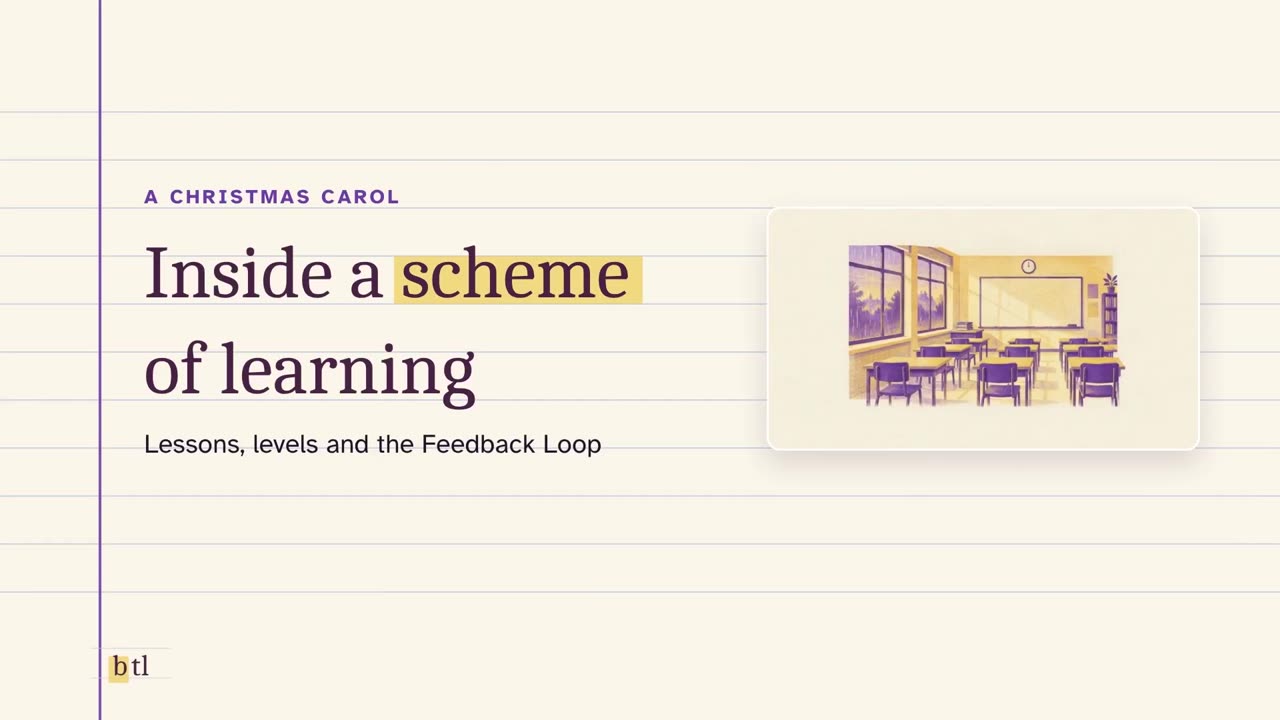
Every folder in the A Christmas Carol scheme: the teacher handbook, the slides, the student packs at three levels, the Feedback Loop kits, the end-of-unit essay, the stretch booklet and the catch-up and inclusion sheets.
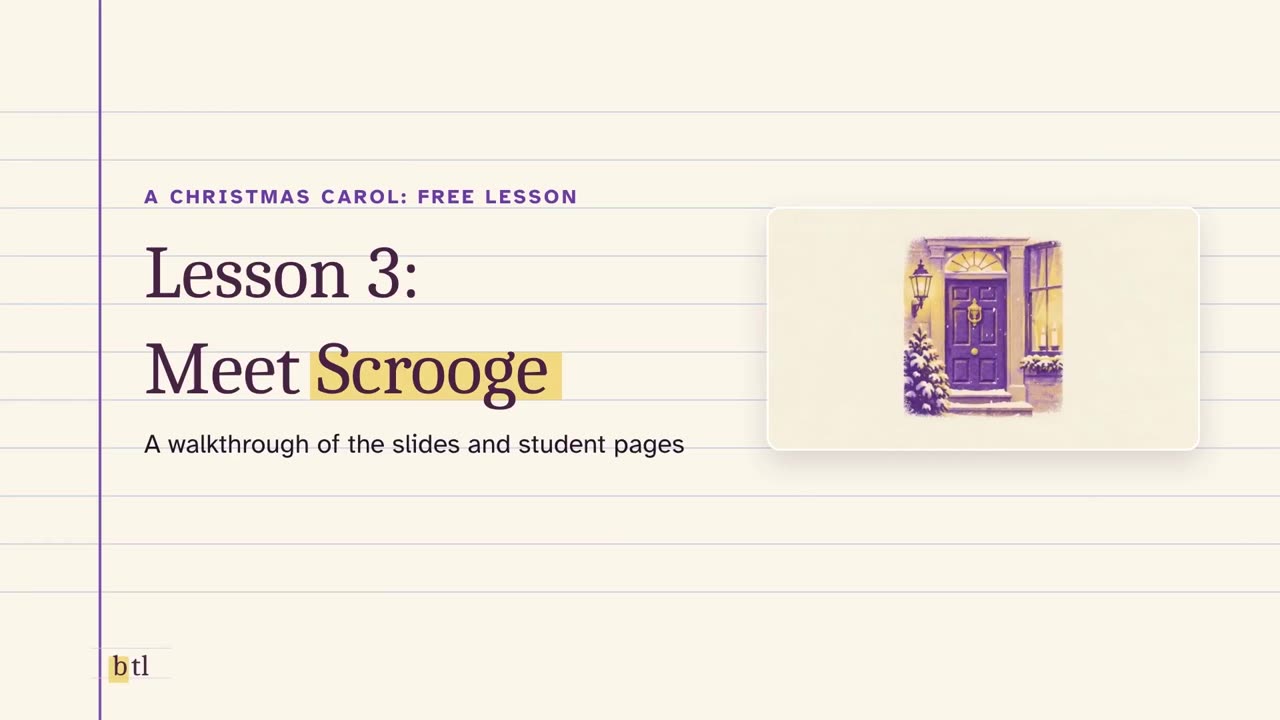
Hannah teaches through the free Lesson 3, Meet Scrooge: the Do Now, the four key words, exploding a quotation, the hinge question and the same task at Securing, Strengthening and Soaring.
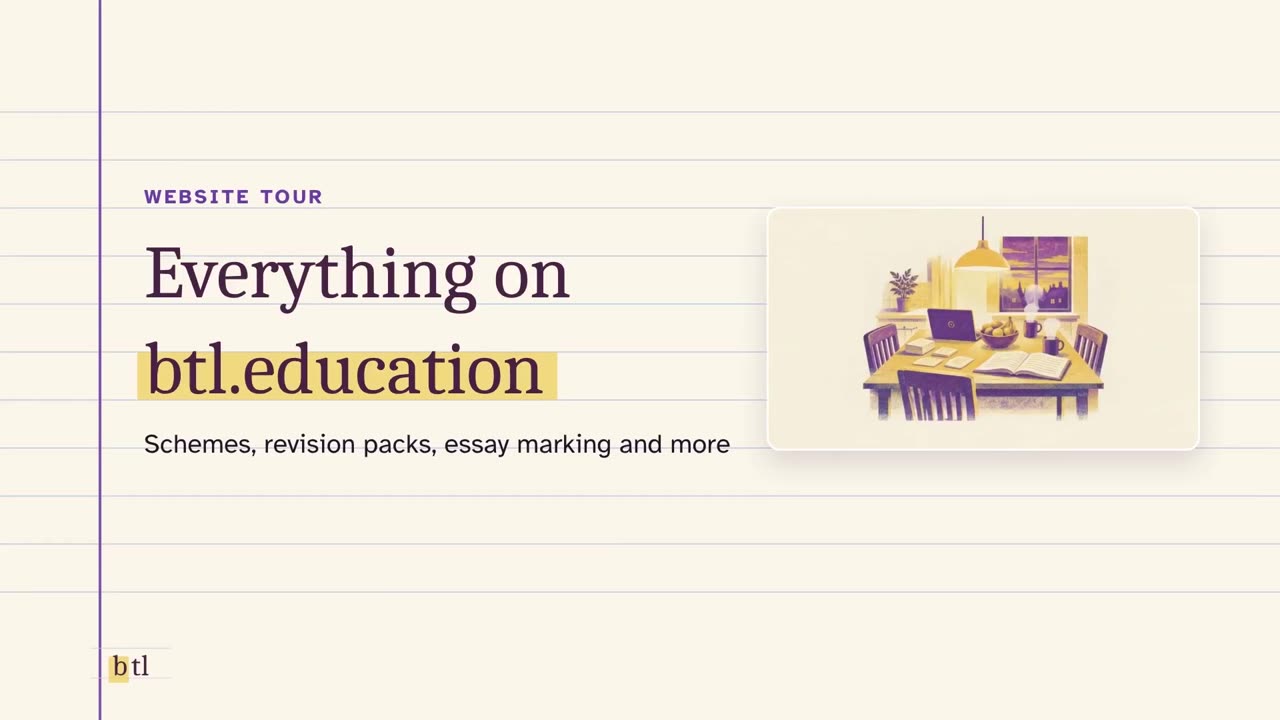
The schemes and licences, the free resources, revision packs for home, essay marking, the Knowledge hub and the display settings for reading on screen.
Long reads on the thinking behind the schemes, guides for teachers, students and parents and carers, education news and a glossary of 336 terms. Free to read, no sign-up.
The four English exams, how they are marked in levels, what the levels of support mean, and what helps at home. For parents and carers.
Every question on Paper 1: what it asks, how many marks it carries, how long to spend and what a strong answer does.
Every question on Paper 2: the two sources, summary, language, comparison and the viewpoint writing task.
The modern text, the poetry anthology and the unseen poems: the questions, the timing and how they are marked.
A 25-minute intervention session from start to finish: Do Now, extract, one quotation or skill, an exam question and a green-pen check.
How a Feedback Loop kit runs: the progress check, whole-class feedback in one lesson, and the improvement tasks at three levels.
A half-hour walkthrough of the An Inspector Calls scheme, made for departments using it: the handbook, one lesson in practice, the three levels, Feedback Loop kits, practice booklets, assessment, catch-up and inclusion.
A half-hour walkthrough of the Jekyll and Hyde scheme, made for departments using it: the handbook, one lesson in practice, the three levels, Feedback Loop kits, practice booklets, assessment, catch-up and inclusion.
A half-hour walkthrough of the Macbeth scheme, made for departments using it: the handbook, one lesson in practice, the three levels, Feedback Loop kits, practice booklets, assessment, catch-up and inclusion.
A half-hour walkthrough of the Romeo and Juliet scheme, made for departments using it: the handbook, one lesson in practice, the three levels, Feedback Loop kits, practice booklets, assessment, catch-up and inclusion.
A half-hour walkthrough of the Power and Conflict poetry scheme, made for departments using it: the handbook, one lesson in practice, the three levels, Feedback Loop kits, practice booklets, assessment, catch-up and inclusion.
A half-hour walkthrough of the Unseen poetry scheme, made for departments using it: the handbook, one lesson in practice, the three levels, Feedback Loop kits, practice booklets, assessment, catch-up and inclusion.
A half-hour walkthrough of the Language Paper 1 scheme, made for departments using it: the handbook, one lesson in practice, the three levels, Feedback Loop kits, practice booklets, assessment, catch-up and inclusion.
A half-hour walkthrough of the Language Paper 2 scheme, made for departments using it: the handbook, one lesson in practice, the three levels, Feedback Loop kits, practice booklets, assessment, catch-up and inclusion.
How the 30 drills in each Raising Achievement set work, how to choose them and how to run them with small groups or whole classes.
Get our emails
About once a month: new free resources and the dates that matter for GCSE English.