
Romeo and Juliet: videos to go with the book
Free videos to go with the Between the Lines revision book for Romeo and Juliet. Watch one, then go back to the book and write: the exam is sat by hand.

Start here
Watch the complete revision guide before you start the book.
Read the transcript
This is the complete revision guide to Romeo and Juliet for AQA GCSE English Literature. I’m Hannah, and I teach English. In one video you’ll get the plot, the characters, the themes, the context, the terms to know, every quotation worth learning, and what the examiners reward. Paper 1 Section A: one question on an extract and the play as a whole. The question may call the extract a speech, a conversation or a moment in the play.
30 marks plus 4 for AO4, about 50 minutes. Answers are placed in a level by best fit. Let’s start with the plot, act by act. Act 1. The Chorus tells us the lovers will die.
Servants of the two houses brawl and Tybalt joins in; the Prince threatens death for any further fighting. Romeo pines for Rosaline. Paris asks to marry Juliet, and Lady Capulet tells her of the match. Romeo goes masked to the Capulet feast, fearing what the stars hold. He and Juliet meet and kiss; Tybalt is held back by Capulet; each learns that the other is an enemy.
Act 2. Romeo climbs into the Capulet orchard. In the balcony scene the lovers exchange vows and Juliet asks him to arrange a marriage. Friar Lawrence agrees, hoping to end the feud. Mercutio mocks Romeo, and Tybalt sends a challenge.
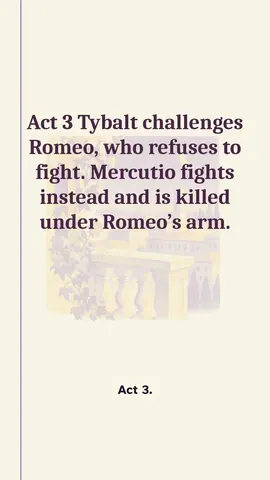
The Nurse carries messages, and the Friar marries the lovers in secret. Act 3. Tybalt challenges Romeo, who refuses to fight. Mercutio fights instead and is killed under Romeo’s arm. Romeo kills Tybalt and is banished.
Juliet hears the news from the Nurse; Romeo despairs in the Friar’s cell. Capulet fixes Juliet’s wedding to Paris for Thursday. The lovers spend one night together and part at dawn. Juliet refuses Paris, her father threatens to throw her out, and the Nurse advises her to marry him. Act 4.
At the Friar’s cell Juliet threatens to kill herself. The Friar gives her a potion that will make her seem dead for two and forty hours. She pretends to agree to the marriage, and Capulet moves it to Wednesday. Juliet drinks the potion; on the wedding morning the Nurse finds her, and the wedding becomes a funeral. Act 5.
Balthasar tells Romeo in Mantua that Juliet is dead, and Romeo buys poison. The Friar’s letter never reaches him. At the tomb Romeo kills Paris, drinks the poison and dies. Juliet wakes, refuses to leave with the Friar and stabs herself. The Friar explains everything, and the Prince tells the families “All are punish’d”.
Capulet and Montague make peace. Now the characters. Romeo. Montague’s only son, who moves from sighing over Rosaline to marrying Juliet in a day, kills Tybalt, and takes poison when he believes Juliet is dead. Juliet.
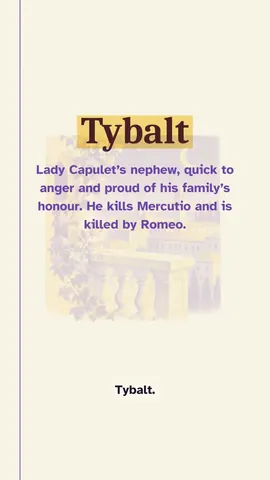
Capulet’s only daughter, not yet fourteen, who marries Romeo in secret, defies her father, and takes her own life in the tomb. Mercutio. The Prince’s kinsman and Romeo’s friend, a quick, mocking talker who fights Tybalt for Romeo and curses both houses as he dies. Tybalt. Lady Capulet’s nephew, quick to anger and proud of his family’s honour.
He kills Mercutio and is killed by Romeo. Friar Lawrence. Romeo’s confessor, who marries the lovers in the hope of ending the feud and plans Juliet’s false death. The Nurse. Juliet’s nurse since birth, bawdy and loving, who carries messages for the lovers and then advises Juliet to marry Paris.
Capulet. Juliet’s father and head of the Capulets, who seems patient with his daughter in Act 1 and threatens to throw her out in Act 3. Lady Capulet. Juliet’s mother, who urges the match with Paris and turns away from Juliet when she refuses. Benvolio.
Romeo’s cousin and friend, who tries to keep the peace and reports the fights to the Prince. Paris. A young nobleman, the Prince’s kinsman, who asks to marry Juliet and is killed by Romeo at her tomb. Prince Escalus. The ruler of Verona, who threatens death for further brawling, banishes Romeo and judges both families at the end.
The themes. For each one, here’s the idea in a sentence. That sentence is the start of a thesis. Love. Love comes in many forms in the play, from Romeo’s borrowed sighs for Rosaline to the sacred, sudden love that costs the lovers their lives.
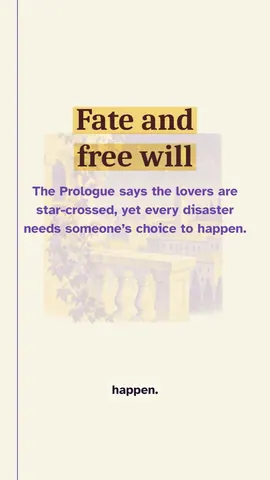
Conflict and violence. The feud turns quarrels into killings, and its violence reaches the people who want no part in it. Fate and free will. The Prologue says the lovers are star-crossed, yet every disaster needs someone’s choice to happen. Family and authority.
Fathers rule their households, and a daughter who refuses a match risks losing her home. Honour and masculinity. Young men are expected to answer an insult with a sword; Romeo’s gentleness is called submission. Time and haste. The story takes about four days, and almost everyone acts too quickly, from the lovers to Capulet.
The context. Use it where it explains a choice the writer made. One clause inside a point does more than a paragraph of history. Romeo and Juliet was probably written in about 1595 and was first printed in 1597, while Elizabeth I was queen. Shakespeare took the story from Arthur Brooke’s poem The Tragicall Historye of Romeus and Juliet (1562), which came from an Italian tale.
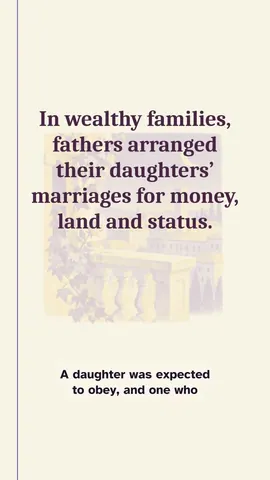
He squeezed months of action into about four days and made Juliet younger: she is not yet fourteen. Many Elizabethans believed that the stars could shape a person’s life. “Star-cross’d” means thwarted by the stars, so the Prologue tells the audience that fate is against the lovers. In wealthy families, fathers arranged their daughters’ marriages for money, land and status. A daughter was expected to obey, and one who refused could be disowned.
Young men of good family carried swords, and an insult to a man’s name or family was expected to be answered. The play is set in Verona, where the Prince has banned street fighting on pain of death. Love poetry in the 1590s was full of sonnets in the style of Petrarch, the Italian poet who wrote of a lady he could never have. Romeo’s speeches about Rosaline use the same sighs and oxymorons, and the Prologue and the lovers’ first conversation are sonnets. The terms to know.
Name a method only when you can say what it does. Tragedy and tragic hero: A play that ends in the deaths of its central characters. Romeo’s haste is often read as his fatal flaw (hamartia), and the Prologue tells us the ending before it begins. Prologue and sonnet: The Chorus speaks a fourteen-line sonnet that ends in a rhyming couplet. The lovers’ first conversation in Act 1 Scene 5 is also a sonnet, shared between them (Lesson 9).
Petrarchan lover: A lover who sighs over a lady he cannot have, in the style of the poet Petrarch. Romeo over Rosaline: “Feather of lead, bright smoke, cold fire, sick health!” (Lessons 5 and 6). Oxymoron: Two opposite words placed together. Romeo’s “O brawling love! O loving hate!” and Juliet’s “Beautiful tyrant, fiend angelical” show love and hate joined.
Soliloquy: A character alone on stage, speaking their thoughts. Juliet’s “Gallop apace” in Act 3 Scene 2 and the potion speech in Act 4 Scene 3 (Lesson 22). Dramatic irony: The audience knows what a character does not. Capulet mourns Juliet in Act 4 Scene 5 while the audience knows she has taken a potion (Lesson 23). Foreshadowing: Hints of what is to come: Juliet’s “My grave is like to be my wedding bed” and the Friar’s “These violent delights have violent ends”.
Blank verse and rhyme: Unrhymed iambic pentameter for most of the nobles’ speech. The lovers often slip into rhyme, which marks their love as special. Prose: Lines with no metre, used by the servants, the Nurse and Mercutio when he jokes. Mercutio’s dying lines are prose (Lesson 16). Light and dark imagery: Juliet is “the sun” and teaches “the torches to burn bright”; the lovers meet at night and are parted by the dawn.
Religious imagery: Pilgrims, saints and prayer in the shared sonnet make the lovers’ first kiss sound holy (Lesson 9). Foil: A character who shows up another by contrast. Benvolio keeps the peace while Tybalt hates the word; the Nurse’s earthy talk sets off Juliet’s devotion. The quotations. These are the 31 I’d want every student to know by heart.
For each one: who says it, where, and why it matters. “A pair of star-cross’d lovers take their life”. The Chorus, The Prologue. The stars are against the lovers before the play begins; the audience knows the ending. “Where civil blood makes civil hands unclean”.
The Chorus, The Prologue. Citizens kill citizens: the feud stains the whole city. “Do you bite your thumb at us, sir?”. Abram, Act 1 Scene 1. A rude gesture starts a street fight: the feud runs down to the servants.
“I hate the word As I hate hell, all Montagues, and thee”. Tybalt, Act 1 Scene 1. Tybalt hates peace itself; hatred is his whole identity. “O brawling love! O loving hate!”.
Romeo, Act 1 Scene 1. Oxymoron: Romeo’s love for Rosaline is borrowed from Petrarch’s sonnets, and love and hate are already joined. “My child is yet a stranger in the world”. Capulet, Act 1 Scene 2. Capulet seems protective of his young daughter, which makes his later rage more shocking.
“It is an honour that I dream not of”. Juliet, Act 1 Scene 3. A polite, obedient answer to her mother about marriage. “Some consequence yet hanging in the stars”. Romeo, Act 1 Scene 4.
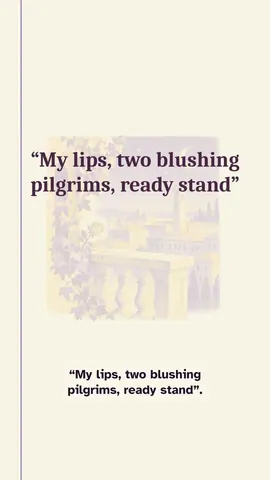
A premonition that the feast will lead to his death. “O, she doth teach the torches to burn bright!”. Romeo, Act 1 Scene 5. Light imagery: Juliet outshines the torches and puts Rosaline out of his mind. “My lips, two blushing pilgrims, ready stand”.
Romeo, Act 1 Scene 5. The shared sonnet: religious imagery makes their love sound sacred. “My only love sprung from my only hate!”. Juliet, Act 1 Scene 5. Antithesis: love and hate are tied together the moment she learns his name.
“It is the east, and Juliet is the sun!”. Romeo, Act 2 Scene 2. Metaphor: Juliet is the centre of his world and his source of light. “What’s in a name? That which we call a rose By any other name would smell as sweet”.
Juliet, Act 2 Scene 2. Juliet wants to separate the man from the family name. “It is too rash, too unadvis’d, too sudden”. Juliet, Act 2 Scene 2. Juliet sees the danger of their speed, even as she gives her love.
“Not truly in their hearts, but in their eyes”. Friar Lawrence, Act 2 Scene 3. The Friar doubts young men’s love, since Rosaline was forgotten so quickly. “These violent delights have violent ends”. Friar Lawrence, Act 2 Scene 6.
Foreshadowing: love this intense will burn out like gunpowder. “O calm, dishonourable, vile submission!”. Mercutio, Act 3 Scene 1. Mercutio sees Romeo’s peace with Tybalt as shameful, so he fights for him. “A plague o’ both your houses”.
Mercutio, Act 3 Scene 1. Repeated as he dies: a curse on both families, which the play then carries out. “Thy beauty hath made me effeminate”. Romeo, Act 3 Scene 1. Romeo blames love for making him less of a man, and turns to violence.
“O, I am fortune’s fool!”. Romeo, Act 3 Scene 1. Romeo blames fortune for the killing he has just done. “O serpent heart, hid with a flowering face!”. Juliet, Act 3 Scene 2.
Oxymoron and Eden imagery: Juliet’s shock that Romeo has killed her cousin. “There is no world without Verona walls”. Romeo, Act 3 Scene 3. Banishment feels like death to him. “Hang thee young baggage, disobedient wretch!”.
Capulet, Act 3 Scene 5. Capulet’s rage when Juliet refuses Paris: a father’s power over a daughter. “I think it best you married with the County”. The Nurse, Act 3 Scene 5. The Nurse’s practical advice leaves Juliet alone.
“If all else fail, myself have power to die”. Juliet, Act 3 Scene 5. Juliet’s first talk of suicide: death is the one choice she still has. “My dismal scene I needs must act alone”. Juliet, Act 4 Scene 3.
Juliet alone with the potion: a theatre metaphor for her isolation. “Death lies on her like an untimely frost”. Capulet, Act 4 Scene 5. Simile: dramatic irony, because the audience knows she is not dead. “Then I defy you, stars!”.
Romeo, Act 5 Scene 1. Romeo defies fate and in doing so fulfils it. “Thus with a kiss I die”. Romeo, Act 5 Scene 3. His last line ends with the kiss that began their love in Act 1 Scene 5.
“See what a scourge is laid upon your hate”. The Prince, Act 5 Scene 3. The Prince names the feud as the cause, and heaven as the punisher. “For never was a story of more woe Than this of Juliet and her Romeo”. The Prince, Act 5 Scene 3.
A rhyming couplet closes the tragedy, as the Prologue opened it. Finally, what the examiners reward. AO1, response. An argued answer to the question, set out in a thesis, with short references from the extract and other acts. Both bullets matter, in either order: students do not have to start with the extract.
A how far question needs a judgement. AO2, methods. How Shakespeare makes meaning for an audience: sonnet and rhyme, soliloquy, dramatic irony, structure and timing as well as imagery and single words. Level 6 analysis is convincing, critical and exploratory. AO3, context.
Context in AQA’s wide sense: the ideas in the question, the setting in Verona, tragedy as a genre, audiences then and now and the play’s universal ideas, as well as the 1590s: fathers and daughters, honour and the sword, belief in the stars, the sonnet tradition. Use it where it explains Shakespeare’s purpose. One clause inside a point does more than a paragraph of history. AO4, accuracy. 4 marks for a range of vocabulary and sentence structures for clarity, purpose and effect, with accurate spelling and punctuation.
Check the spelling of the names: Mercutio, Tybalt, Benvolio, Capulet, Montague. And how answers lose marks: Retelling the plot; writing about the play as a novel with readers; staying in the extract; treating it as a simple love story and leaving out the feud; context bolted on at the end; pre-learned paragraphs that do not fit the question; theory or terms used to impress. That’s everything in one place. Watch it again in a week, and pause on any section you couldn’t have explained yourself. Everything in this video comes from our Romeo and Juliet scheme of learning for schools.
If you’re a teacher, Lesson 3 of every scheme is free at btl.education. Thank you for watching.
The play and its context
The story, the characters, the themes and the context, a minute or two each.
Quotations to learn
Watch this alongside Part 5 of the book, Quotations to learn.
Model answers explained
Write your own answer first, then watch.
Read the transcript
This is the end-of-unit essay from our Romeo and Juliet scheme, with three complete model answers: one at Level 3, one at Level 4 and one at Level 6. I’m Hannah. I’ll read each answer, then tell you why it sits in that level and what would move it up. The question is: Starting with this conversation, explore how Shakespeare presents conflict in Romeo and Juliet. It’s worth 30 marks, plus 4 for AO4, spelling, punctuation and grammar, and you have 50 minutes.
In this extract, from Act 3 Scene 1, Mercutio and Benvolio are in the streets of Verona on a hot afternoon when Tybalt arrives, looking for Romeo. Romeo has just married Juliet in secret, so Tybalt is now his kinsman. Nobody else on stage knows. Here it is. Tybalt.
Mercutio, thou consortest with Romeo. Mercutio. Consort? What, dost thou make us minstrels? And thou make minstrels of us, look to hear nothing but discords.
Here’s my fiddlestick, here’s that shall make you dance. Zounds, consort! Benvolio. We talk here in the public haunt of men. Either withdraw unto some private place, And reason coldly of your grievances, Or else depart; here all eyes gaze on us.
Mercutio. Men’s eyes were made to look, and let them gaze. I will not budge for no man’s pleasure, I. Tybalt. Well, peace be with you, sir, here comes my man.
Mercutio. But I’ll be hanged, sir, if he wear your livery. Marry, go before to field, he’ll be your follower; Your worship in that sense may call him man. Tybalt. Romeo, the love I bear thee can afford No better term than this: Thou art a villain.
Romeo. Tybalt, the reason that I have to love thee Doth much excuse the appertaining rage To such a greeting. Villain am I none; Therefore farewell; I see thou know’st me not. Tybalt. Boy, this shall not excuse the injuries That thou hast done me, therefore turn and draw.
Romeo. I do protest I never injur’d thee, But love thee better than thou canst devise Till thou shalt know the reason of my love. And so good Capulet, which name I tender As dearly as mine own, be satisfied. Mercutio. O calm, dishonourable, vile submission!
Alla stoccata carries it away. Tybalt, you rat-catcher, will you walk? Tybalt. What wouldst thou have with me? Mercutio.
Good King of Cats, nothing but one of your nine lives; that I mean to make bold withal, and, as you shall use me hereafter, dry-beat the rest of the eight. Will you pluck your sword out of his pilcher by the ears? Make haste, lest mine be about your ears ere it be out. Tybalt. I am for you.
Romeo. Gentle Mercutio, put thy rapier up. Mercutio. Come, sir, your passado. Before the answers, here’s what a marker is looking for in this question.
A marker looks for a clear thesis about how Shakespeare presents conflict and why, then analysis that moves between the extract and the whole play. In the extract, strong answers explore Mercutio’s quarrelsome puns on “consort”, Benvolio’s attempt to move the quarrel out of “the public haunt of men”, the dramatic irony of Romeo’s refusal to fight a man who is now his kinsman (“Villain am I none”), and Mercutio’s scorn for “calm, dishonourable, vile submission!” Across the play, look for the Prologue’s “ancient grudge”, the brawl and Tybalt’s “I hate the word” in Act 1 Scene 1, Capulet holding Tybalt back at the feast, Capulet’s rage at Juliet in Act 3 Scene 5 and the Prince’s “See what a scourge is laid upon your hate”. The best answers treat conflict broadly (the houses, honour, parents and children, love and hate inside Juliet) and link honour and masculinity to Shakespeare’s purpose. The source text reads “the love I bear thee” in Tybalt’s insult, where some editions print hate: credit either reading, since the sarcasm works both ways. For AO4, check the spelling of names, sentence boundaries and the range of punctuation.
And here’s how I’d plan it. Spend 2 minutes reading the extract twice. Underline three quotations that show conflict and label the method in each. Spend 2 minutes writing a one-sentence thesis: what kind of conflict does Shakespeare present, and what does he want the audience to learn from it? Spend 5 minutes planning three or four points.
You can start with the extract or elsewhere, but you must cover both the extract and the play as a whole. This extract comes from Act 3 Scene 1, the centre of the play, so you could start with the brawl in Act 1 Scene 1 and reach the extract second, then go on to Capulet’s rage at Juliet in Act 3 Scene 5. For each point, note one quotation or close reference. Add context only where it explains Shakespeare’s choice, such as the code of honour that made an insult a challenge to fight, and keep it to a clause. Keep 5 minutes at the end for AO4.
Check the spelling of Romeo, Juliet, Mercutio, Tybalt, Benvolio, Capulet and Montague, make sure every sentence has a capital letter and a full stop, and look for one place to use a colon or semicolon accurately. The pitfalls to avoid. Spending most of the 50 minutes on the extract and leaving too little time for the play as a whole. Retelling the fight instead of analysing how Shakespeare presents conflict, and what for. Writing about street fights alone.
Conflict in the play also comes between fathers and daughters, and inside Juliet herself. Misquoting from memory. A short, accurate quotation is better than a long, inaccurate one, and a close reference to the moment works when the exact words will not come. The first answer was written at Securing, the level of support for students aiming at a grade 4. It sits in Level 3, explained, structured comments.
In Romeo and Juliet, Shakespeare presents conflict as something that starts with words and ends in death. In the extract, Tybalt wants to fight Romeo, and Mercutio is ready to fight anyone. In the extract, Tybalt says to Romeo “Thou art a villain.” This is an insult, and he wants Romeo to fight him. Romeo does not want to fight because he has just married Juliet, who is Tybalt’s cousin. He says “Villain am I none”.
This shows that Romeo is trying to keep the peace. Tybalt does not know about the marriage, so he cannot understand why. Mercutio is angry that Romeo will not fight. He calls it “calm, dishonourable, vile submission!” The harsh adjective “dishonourable” shows that Mercutio thinks Romeo has lost his honour. In those days young men had to defend their honour, so Mercutio fights Tybalt instead.
This shows that conflict happens because of pride. Shakespeare also uses Mercutio’s jokes. He calls Tybalt “rat-catcher” and “King of Cats”. These insults make Tybalt angrier. The audience knows that this will end badly because of the Prologue.
In the play as a whole, conflict starts in Act 1 Scene 1, when the servants fight in the street. Tybalt says “I hate the word As I hate hell, all Montagues, and thee”. This shows that Tybalt hates the Montagues more than anything. The Prince says that if they fight again they will be put to death. There is also conflict between Juliet and her father.
In Act 3 Scene 5, Capulet calls her a “disobedient wretch!” because she will not marry Paris. This shows that there is conflict inside the family as well as between the families. At the end, Romeo and Juliet are both dead. The Prince says “All are punish’d.” Shakespeare wants the audience to see that hate and fighting destroy everyone, even the young people who did nothing wrong. So why does it sit there, and what would move it up?
This answer sits in Level 3 (Explained, structured comments): it stays on the question, uses accurate quotations from the extract and three other scenes, and explains what each one shows. Methods such as insults and the adjective “dishonourable” are named, though the effects are explained simply. Context about honour is mentioned once and stays general, and the paragraph on Act 1 Scene 1 slips towards retelling. To move up, it needs a thesis that says what kind of conflict Shakespeare presents and why, a closer look at one word in each quotation, and context used only where it explains Shakespeare’s purpose. The second answer was written at Strengthening, for students aiming at grades 5 and 6.
It sits in Level 4, clear understanding. Shakespeare presents conflict in Romeo and Juliet as something that spreads: it starts as a quarrel between two families and reaches into every part of Verona, including the lovers’ own homes. The extract shows how quickly words become weapons, and how one young man’s sense of honour can turn another man’s peace into a fight. Across the play, Shakespeare shows that the feud destroys the young people who had no part in starting it, so that his audience sees the cost of hate. At the start of the extract, Tybalt is looking for a fight.
He tells Mercutio “thou consortest with Romeo”, and Mercutio twists the sneering verb into a joke: “Consort? What, dost thou make us minstrels?” His sword becomes a fiddlestick, and he warns that he will “make you dance”. The pun shows that Mercutio treats conflict as a game of words. Benvolio tries to move the quarrel to “some private place”, reminding them that “here all eyes gaze on us”. He is the peacemaker, as he was in Act 1 Scene 1, and once again nobody listens.
When Romeo arrives, the conflict changes. Tybalt says “Thou art a villain”, the worst insult he can find. Romeo’s answer is calm: “Villain am I none”. The audience knows what Tybalt does not: an hour ago Romeo married Juliet, so Tybalt is now his kinsman. The dramatic irony makes Romeo’s “I see thou know’st me not” true in a way Tybalt cannot understand.
Romeo even says that he values the name of “good Capulet” “As dearly as mine own”. For a moment, love has beaten the feud. Mercutio cannot bear it. He calls Romeo’s peace “calm, dishonourable, vile submission!” The list of three adjectives builds his disgust, and the scornful adjective “dishonourable” shows what matters to him: in Verona a young man who will not fight has lost his honour. He calls Tybalt “rat-catcher” and “Good King of Cats”, and the fight begins.
Shakespeare shows that the feud is kept alive by men who think fighting is the only way to be a man. Mercutio is neither a Montague nor a Capulet, yet he dies for the quarrel. In the play as a whole, Shakespeare presents conflict from the first lines. The Prologue speaks of an “ancient grudge” in which “civil blood makes civil hands unclean”, so the audience knows that the feud stains the whole city. In Act 1 Scene 1 the servants start a brawl with a rude gesture (“Do you bite your thumb at us, sir?”), and Tybalt arrives saying “I hate the word As I hate hell, all Montagues, and thee”.
The repeated verb “hate” shows that hatred is the whole of who he is. The Prince warns that if they fight again, “Your lives shall pay the forfeit of the peace”, which is why the fight in the extract has such serious results. Conflict also comes inside families. In Act 3 Scene 5, Capulet turns on Juliet when she refuses to marry Paris, calling her a “disobedient wretch!” and telling her she can “hang, beg, starve, die in the streets”. The conflict between the families has become a conflict between a father and his daughter, because Juliet cannot tell him the truth about her marriage.
At the end, the Prince tells the fathers to “See what a scourge is laid upon your hate”. The deaths of Romeo and Juliet end the feud, and Capulet calls them “Poor sacrifices of our enmity”. Shakespeare wants his audience to see that conflict, once started, is very hard to stop, and that it is the young who pay for the quarrels of the old. So why does it sit there, and what would move it up? This answer sits in Level 4 (Clear understanding), with Level 5 qualities in places: it has a clear thesis, explains well-chosen quotations from the Prologue and Acts 1, 3 and 5, and keeps answering the question.
Methods such as Mercutio’s pun, dramatic irony and the list of three adjectives are explained clearly, and the link back to Benvolio in Act 1 Scene 1 shows the student thinking about the whole play. Context about honour and the Prince’s law is accurate and tied to purpose, though it is stated more than explored. To secure Level 5, it needs a more developed idea about the kinds of conflict Shakespeare presents, closer analysis of single words, and more on structure, such as where the extract falls in the play. The third answer was written at Soaring, for students aiming at grades 7 to 9. It sits in Level 6, convincing, critical analysis and exploration.
Shakespeare presents conflict in Romeo and Juliet as a disease of honour: it passes from fathers to servants to sons, and it is most dangerous at the moment someone tries to stop it. The extract, near the centre of the play, is where that disease meets the lovers’ secret. Romeo, newly married, refuses to fight, and his refusal does more harm than any blow. Across the play, Shakespeare shows that conflict in Verona is a habit its young men have learned, and that it ends only when it has taken the children of both houses. The extract opens with conflict as play.
Tybalt’s “thou consortest with Romeo” is meant as a sneer, yet Mercutio seizes the sly verb and turns it into a joke about musicians: “Consort? What, dost thou make us minstrels?” His sword becomes a “fiddlestick” that will “make you dance”. The puns are funny, and they are also a refusal to let words stay peaceful; Mercutio would rather fence with language than let a quarrel cool. Benvolio’s plea to “reason coldly” in “some private place” sets the temperature of the scene, because everyone else is hot. Shakespeare opened the scene with Benvolio’s warning that “these hot days, is the mad blood stirring”, and the heat of Verona’s afternoon is the heat of its young men’s tempers.
Tybalt’s “Thou art a villain” should end the conversation, since it is an insult a gentleman must answer. Romeo’s reply is the most surprising speech in the scene. “Villain am I none” is short and calm, and its inverted word order puts the insult first and the denial last, as if he has heard it and set it aside. The dramatic irony is painful: the audience knows that an hour ago Romeo married Tybalt’s cousin, so “the reason that I have to love thee” is literally true. When he calls the Capulet name one he will “tender As dearly as mine own”, the two houses are joined, briefly, in a single sentence.
Love has entered the feud’s own language, and nobody on stage can hear it. Mercutio’s “O calm, dishonourable, vile submission!” is where Shakespeare shows what conflict feeds on. The adjectives grow harsher as they go, and the humiliating abstract noun “submission” is the one that matters: to Mercutio, a man who will not fight has made himself a servant. The code of honour, which an Elizabethan audience knew from the fashion for rapier fencing among its own young gentlemen, leaves no room for a peace that cannot explain itself. Mercutio, who is neither Capulet nor Montague, draws his sword for a quarrel that is not his, and dies of it.
His dying curse, “A plague o’ both your houses”, turns the whole conflict back on the families. This moment is the hinge of the play’s structure. Before it, conflict and love run side by side; after it, love is swallowed by conflict. Within the same scene Romeo decides that Juliet’s “beauty hath made me effeminate” and calls on “fire-ey’d fury” to guide him. The peacemaker becomes a killer in minutes, and his “O, I am fortune’s fool!” tries to hand the blame to the stars for a choice he has just made.
Shakespeare makes the audience watch the code of honour win. In the play as a whole, the extract repeats a pattern Shakespeare set up in the first scene. The Prologue’s “ancient grudge” breaks out in “civil blood”, and in Act 1 Scene 1 the quarrel begins with servants and a rude gesture: “Do you bite your thumb at us, sir?” The Prince’s “Three civil brawls, bred of an airy word” shows how little it takes, and the feud is kept alive by men like Tybalt, whose “I hate the word As I hate hell, all Montagues, and thee” makes hatred an identity. At the feast, Tybalt’s “To strike him dead I hold it not a sin” shows how close violence always is. Capulet holds him back then; by Act 3 nobody does.
Shakespeare also moves conflict indoors. In Act 3 Scene 5 Capulet’s rage at Juliet is the feud by other means: a father’s authority, defied, turns to insults (“disobedient wretch!”) and the threat that she can “hang, beg, starve, die in the streets”. Juliet cannot explain herself, because the feud has made her marriage a secret, so the conflict between the houses becomes a conflict between a daughter and her father. In Act 3 Scene 2 the same conflict is inside her, in oxymorons such as “Beautiful tyrant, fiend angelical”. The ending answers the Prologue.
The Prince’s “See what a scourge is laid upon your hate” names the cause, and “All are punish’d” includes the Prince himself. The fathers’ peace is real, yet Capulet’s “Poor sacrifices of our enmity” admits what it cost, and the promise of golden statues sounds like the old rivalry carried on in wealth. Shakespeare presents conflict as something a society chooses and keeps choosing, and the tragedy is that it takes two children’s deaths to make the choice clear. So why does it sit there, and what would move it up? This answer sits in Level 6 (Convincing, critical analysis and exploration): its thesis, that conflict is a disease of honour that is most dangerous when someone tries to stop it, shapes every paragraph.
It zooms in on single words such as “submission” and “consortest”, and treats structure as a method, reading the extract as the hinge of the play and the ending as an answer to the Prologue. Context, from the fashion for rapier fencing to a father’s authority, is part of the argument about Shakespeare’s purpose, and the quotations range across the Prologue and Acts 1, 3 and 5. To push it further, a student could weigh the ending more fully, for example whether the Prince’s own “winking” at the feud makes the state as guilty as the families. When classes sit this essay, the same three things come up in the feedback. Give the play as a whole as much space as the extract, and put the other acts in chronological order.
Zoom in on one word in each quotation, name its word class with an adjective, and explain its effect on the audience. Check the names before you hand in. Mercutio, Tybalt, Benvolio and Capulet were each misspelt in several essays, and AO4 is worth 4 marks. And here’s the improvement task for each level. Find the one that matches your own answer, and redraft one paragraph in green pen.
Levels 1 and 2: Pick one quotation from the extract, such as “Thou art a villain”. Write three sentences: what it shows about Tybalt, which method Shakespeare uses, and how the conflict in Act 1 Scene 1 was similar. Then check that every name has a capital letter and every sentence a full stop. Levels 3 and 4: Redraft one paragraph so it moves from the extract to another act. Add a quotation from Act 1 Scene 1 or Act 3 Scene 5, zoom in on one word, and end with what Shakespeare wanted his audience to learn.
Use at least one colon or semicolon correctly. Levels 5 and 6: Rewrite your introduction as a thesis about the kind of conflict Shakespeare presents. Then redraft one paragraph to analyse structure: how Romeo’s peace in the extract turns to “fire- ey’d fury” within the same scene, and why Shakespeare wants his audience to watch the change. This essay, the level guidance and all three models are part of our Romeo and Juliet scheme of learning for schools. If you’re a teacher, Lesson 3 of every scheme is free at btl.education.
Thank you for watching.
The exam and writing your argument
How Paper 1 works, how to start an essay with a thesis, and a plan for the last twelve weeks.
AQA English Literature Paper 1 explained
4 minutes · captions available
The Shakespeare play and the 19th-century novel: the extract-to-whole question, timing, and what examiners reward.
Read the transcript
If there’s one sentence that changes a Literature essay, it’s the first one. I’m Hannah, and I teach English, and this video is about the thesis: how to write one for any GCSE English Literature question. A thesis is your answer to the essay question in one sentence. It goes at the start of your essay, and every paragraph after it gives evidence for it. A good thesis is an argument that someone could disagree with.
That’s the test. If nobody could disagree with it, it’s a fact, and a fact gives your essay nowhere to go. Here’s the formula. It has three steps, and each one matches one of our levels of support. Step one, Securing.
The writer presents, then the character or theme, as, then your idea. Make a clear claim that uses the words of the question. Step two, Strengthening. Add in order to, and the writer’s purpose: what did they want the audience or reader to think, feel or do? Step three, Soaring.
Add yet, and a complication or a change across the text, then in doing so, and what the writer achieves. Now your argument has somewhere to go. Let’s build one. The question: How does Dickens present Scrooge as an outsider in A Christmas Carol? Not yet a thesis: Scrooge is an outsider in A Christmas Carol.
That’s a fact. Nobody could disagree with it. Getting there: Dickens presents Scrooge as an outsider who shuts himself away from other people. A clear claim, but no purpose. Strong: Dickens presents Scrooge’s isolation as his own choice, in order to show readers that selfishness cuts people off from the warmth of other people.
Top level: Dickens presents Scrooge as an outsider by choice, yet hints that he can still be reached; in doing so, he warns wealthy readers and persuades them that change is possible. Listen to what changed. The top-level thesis has a claim, a complication and a purpose, and every paragraph of the essay now has a job: prove one part of that sentence. Here are three more, for other set texts. In Macbeth, Shakespeare presents Macbeth’s ambition as a force that destroys his conscience, in order to warn his audience that disrupting the natural order leads to chaos.
In An Inspector Calls, Priestley presents the Inspector as the voice of social responsibility, in order to persuade his post-war audience to reject the selfishness of the Birlings. In ‘Ozymandias’, from the Power and Conflict cluster, Shelley presents human power as temporary, in order to show that even the proudest ruler is humbled by time. Your turn. Here are five questions. Pause the video and write a thesis for each.
Start with the Securing frame if you need it, then try to add a purpose and a complication. One: How does Dickens present the importance of family in A Christmas Carol? Two: How does Dickens use the Ghost of Christmas Yet to Come to frighten Scrooge into changing? Three: How does Shakespeare present Lady Macbeth as a powerful woman? Four: How does Shakespeare present guilt in Macbeth?
Five: How does Priestley present Sheila as a character who changes? Then check each one. Does it answer the question that was asked? Does it use the words of the question? Does it make an argument someone could disagree with?
Does it name the writer’s purpose? And will every paragraph you plan support it? The Thesis Statement Builder is free to download and print at btl.education. Keep it next to you every time you plan an essay. Thank you for watching.
Read the transcript
Twelve weeks before your first English exam is the right moment to start a plan, and this is ours. It’s called the Year 11 countdown, it’s free to download and print, and in this video I’ll take you through it week by week. I’m Hannah, and I teach English. One focus a week. About thirty minutes a day, five days a week.
That’s all it asks. Every week runs the same way. Days 1 and 2: retrieve. Write down everything you remember about the focus, then check your notes and fill the gaps in a different colour. Test yourself on quotations.
Days 3 and 4: practise. Plan an answer to an exam-style question in ten minutes, then write two What–How–Why paragraphs from your plan. Day 5: time yourself. Write one full answer in exam time, then mark it against the level descriptors or ask your teacher for feedback. Retrieve first, because what you can remember without your notes is what you’ll have in the exam.
Then practise, then time yourself. The order matters. Here are the twelve weeks. The countdown uses Macbeth, A Christmas Carol and An Inspector Calls as its set texts; if you study different ones, swap yours in. Week 12: Macbeth: plot and characters.
Retell the play act by act from memory; one character profile a day. Week 11: Macbeth: themes, context and quotations. Learn ten quotations; link each one to a theme and to Jacobean context. Week 10: A Christmas Carol: plot, characters and context. Retell the five staves; revise the Poor Law, Malthus and Dickens’s purpose.
Week 9: A Christmas Carol: themes and quotations. Learn ten quotations; write one timed extract-to-whole essay. Week 8: An Inspector Calls: plot, characters and context. Retell the play; revise 1912 and 1945, class, age and gender. Week 7: An Inspector Calls: themes and quotations.
Learn ten quotations; write one timed essay. Week 6: Power and Conflict: the first eight poems. One poem a day: its context, three quotations and one method each. Week 5: Power and Conflict: the last seven poems and comparison. Finish the anthology; plan three comparisons that pair poems by theme.
Week 4: Unseen poetry. Practise the single-poem question and the comparison question on new poems. Week 3: Language Paper 1. Reading questions 1 to 4 on a fiction extract; one descriptive or narrative piece. Week 2: Language Paper 2.
Reading questions 1 to 4 on two non-fiction sources; one viewpoint piece. Week 1: Final week. Read through your notes and quotation lists, do short timed tasks only, and get plenty of sleep. In 2027 your four English papers are spread over four weeks: Literature Paper 1 on Wednesday 12 May, Literature Paper 2 on Wednesday 19 May, Language Paper 1 on Monday 24 May and Language Paper 2 on Tuesday 8 June. After each paper, spend about thirty minutes a day on the next one only.
From 12 to 18 May, Literature Paper 2: An Inspector Calls quotations, one Power and Conflict comparison plan a day, and one unseen poem in forty-five minutes. From 19 to 23 May, Language Paper 1: reread your Week 3 notes, practise Questions 2 to 4 on a new fiction extract, and plan one Question 5 a day. From 24 May to 7 June, Language Paper 2: practise Questions 1 to 4 on pairs of non-fiction sources, write one timed viewpoint piece a week, and do one full paper in an hour and forty-five minutes in the last week. And the night before an English exam. Read through your quotation lists once.
Leave new material alone. Pack at least two black pens in a see-through pencil case. You may highlight the question paper but not your answers. Watches aren’t allowed in the exam room, so plan to time yourself by the room clock. Remind yourself of the timings for each question on the paper.
There’s a table at the bottom of the countdown to write them in. And go to bed at your usual time. The Year 11 countdown is free at btl.education, along with a guide for parents and carers and the Thesis Statement Builder. Print it, stick it on the wall, and tick each week off. Good luck.
Thank you for watching.