

Teachers › Key Stage 3 › Year 9 › Othello
Othello
Key Stage 3 · Year 9 scheme of learning · Spring 2 in our Year 9 plan
A half-term scheme of learning for Year 9: 14 one-hour lessons across about six weeks, built around one big question: who is to blame for Othello’s fall? Every lesson has slides, teacher notes and a student booklet with three levels of support.
William Shakespeare, 1604. Every extract is printed in the booklets, so no class set of books is needed.
Three levels of support · a checkpoint in Lesson 7 with whole-class feedback · an end-of-unit assessment in Lesson 13, placed in five bands
Real pages from the scheme
Choose a page to see it larger. Lesson 3 is free: we email the full editable lesson.
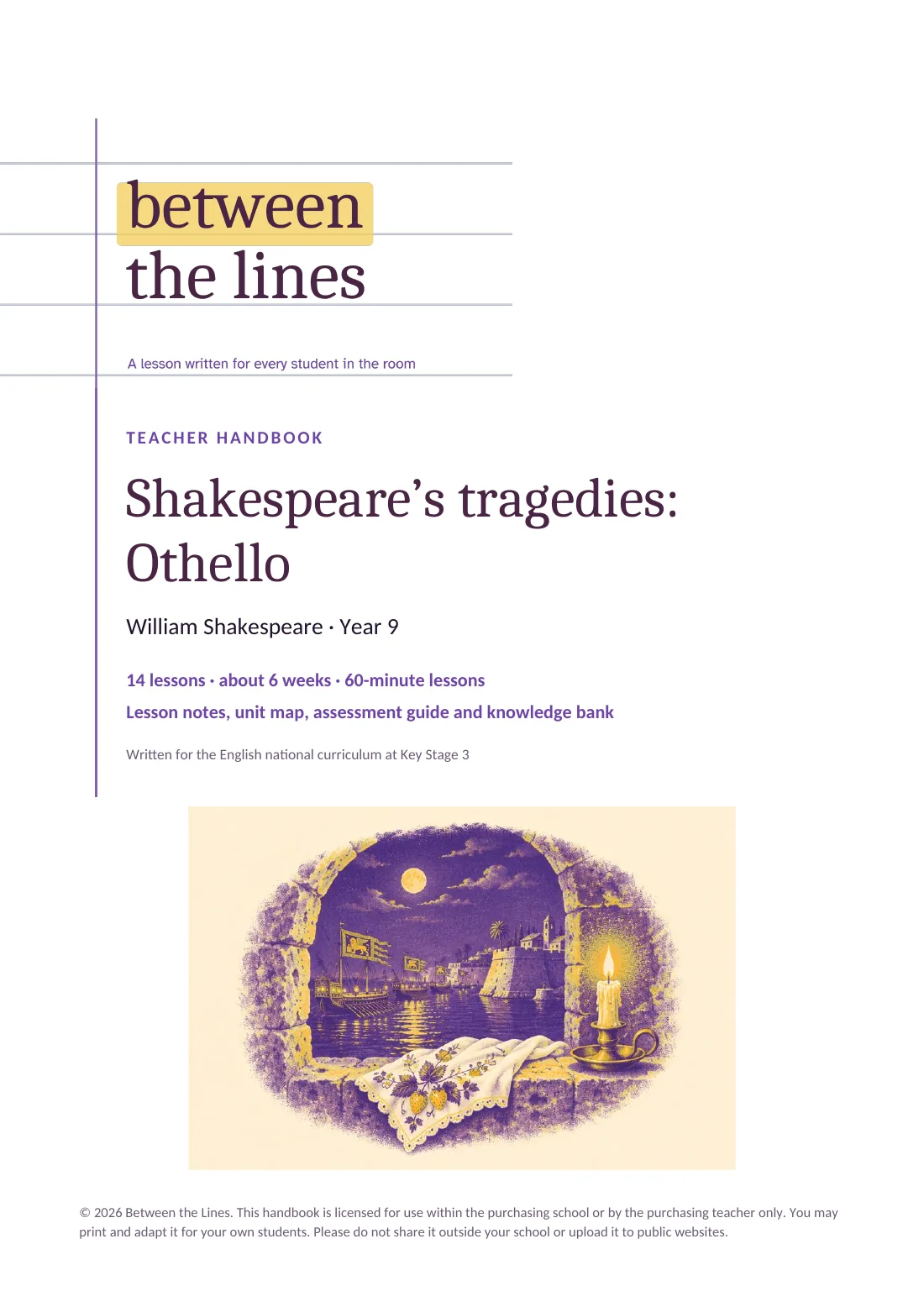 Teacher handbookCover
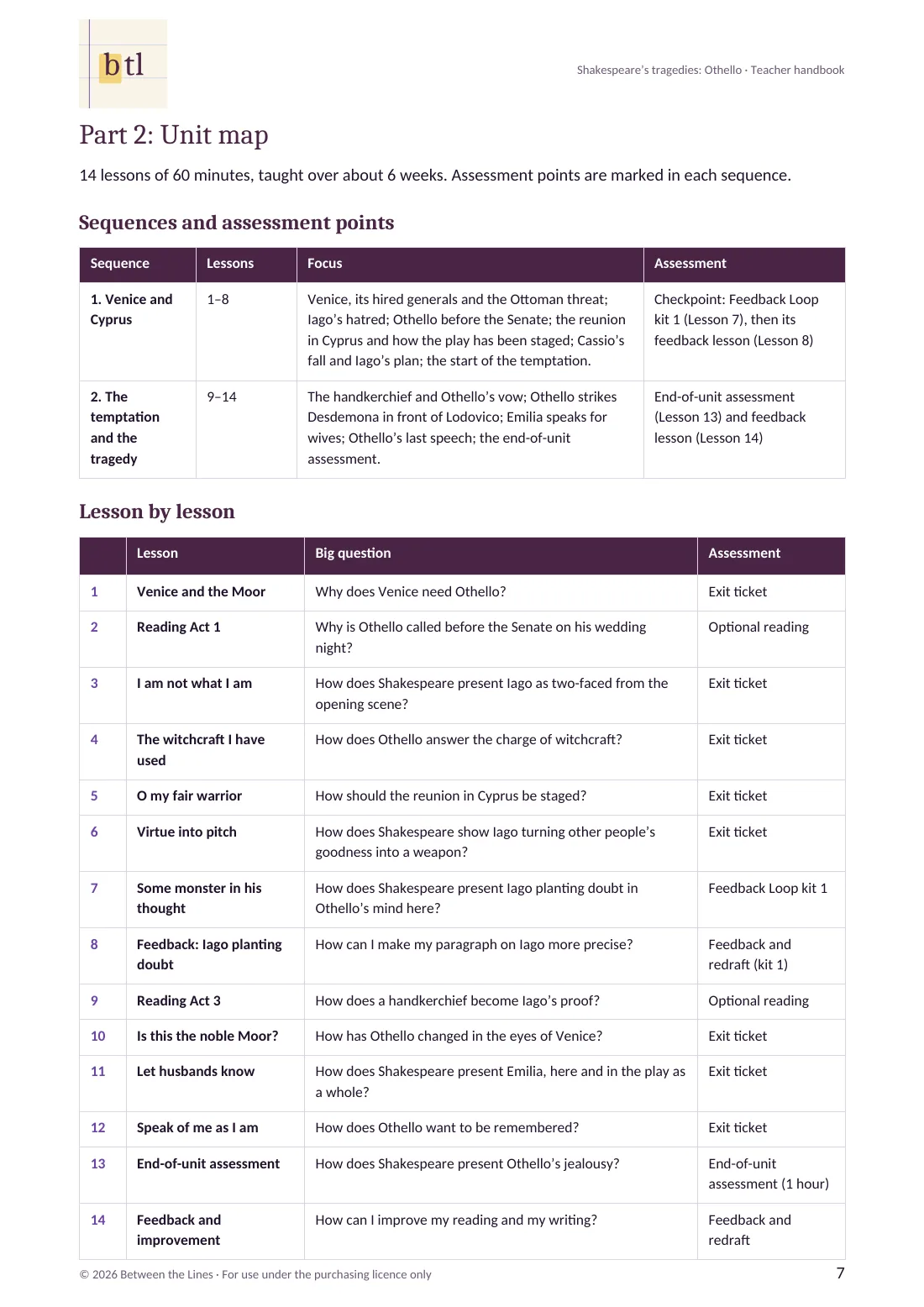 Lesson notesLesson 3 in the teacher handbook
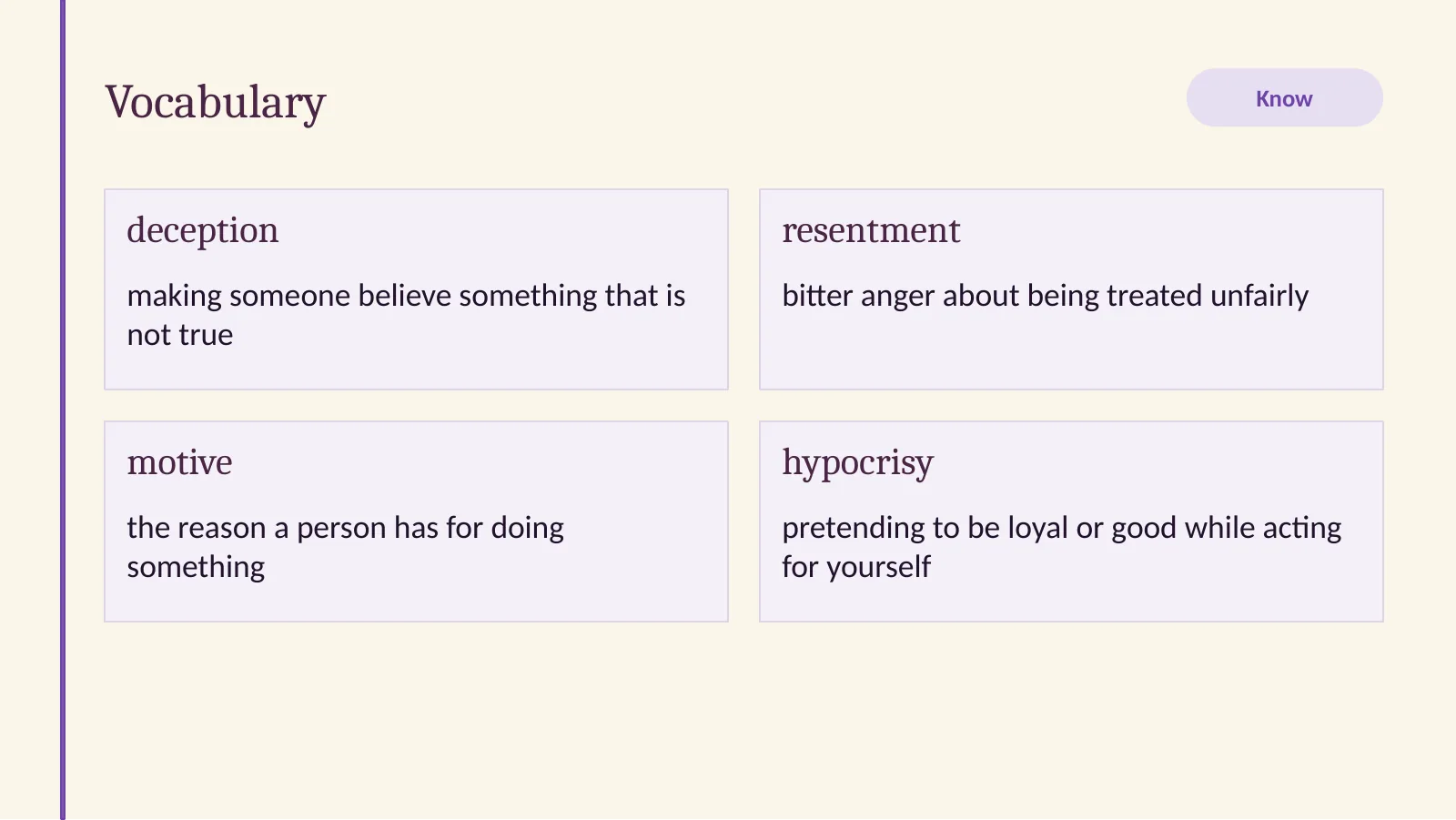 SlidesLesson 3: I am not what I am
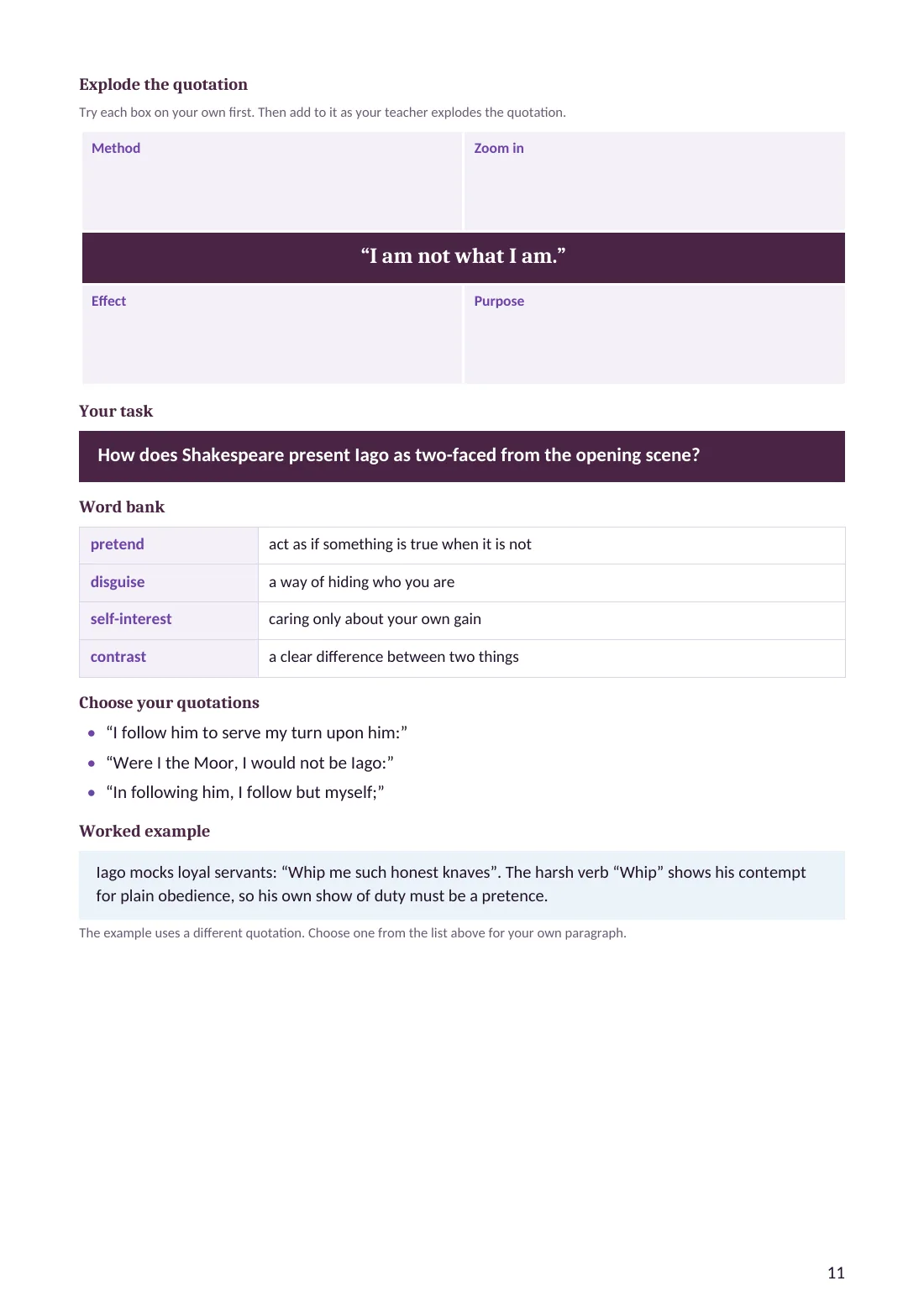 SecuringLesson 3 in the Securing student pack
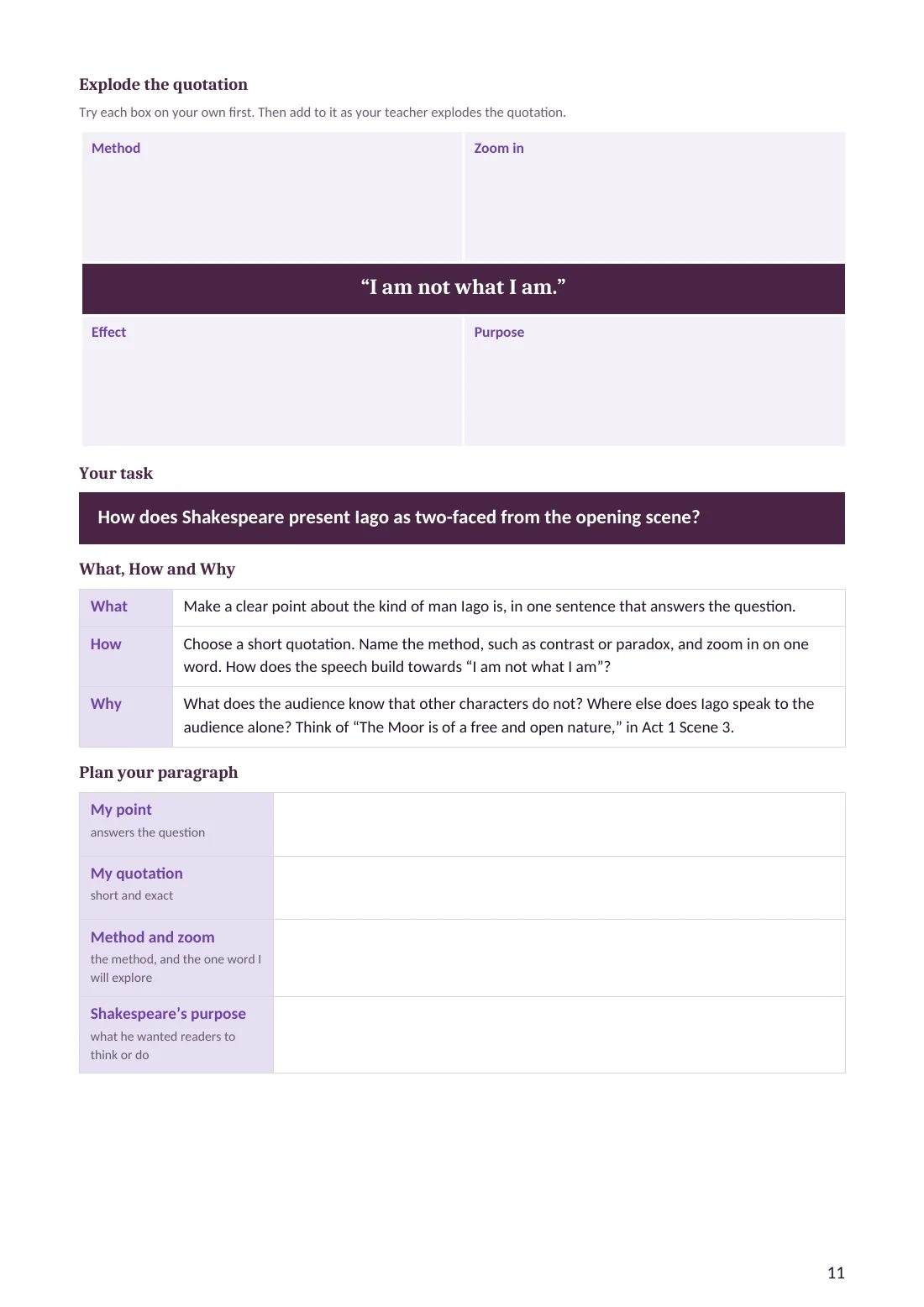 StrengtheningLesson 3 in the Strengthening student pack
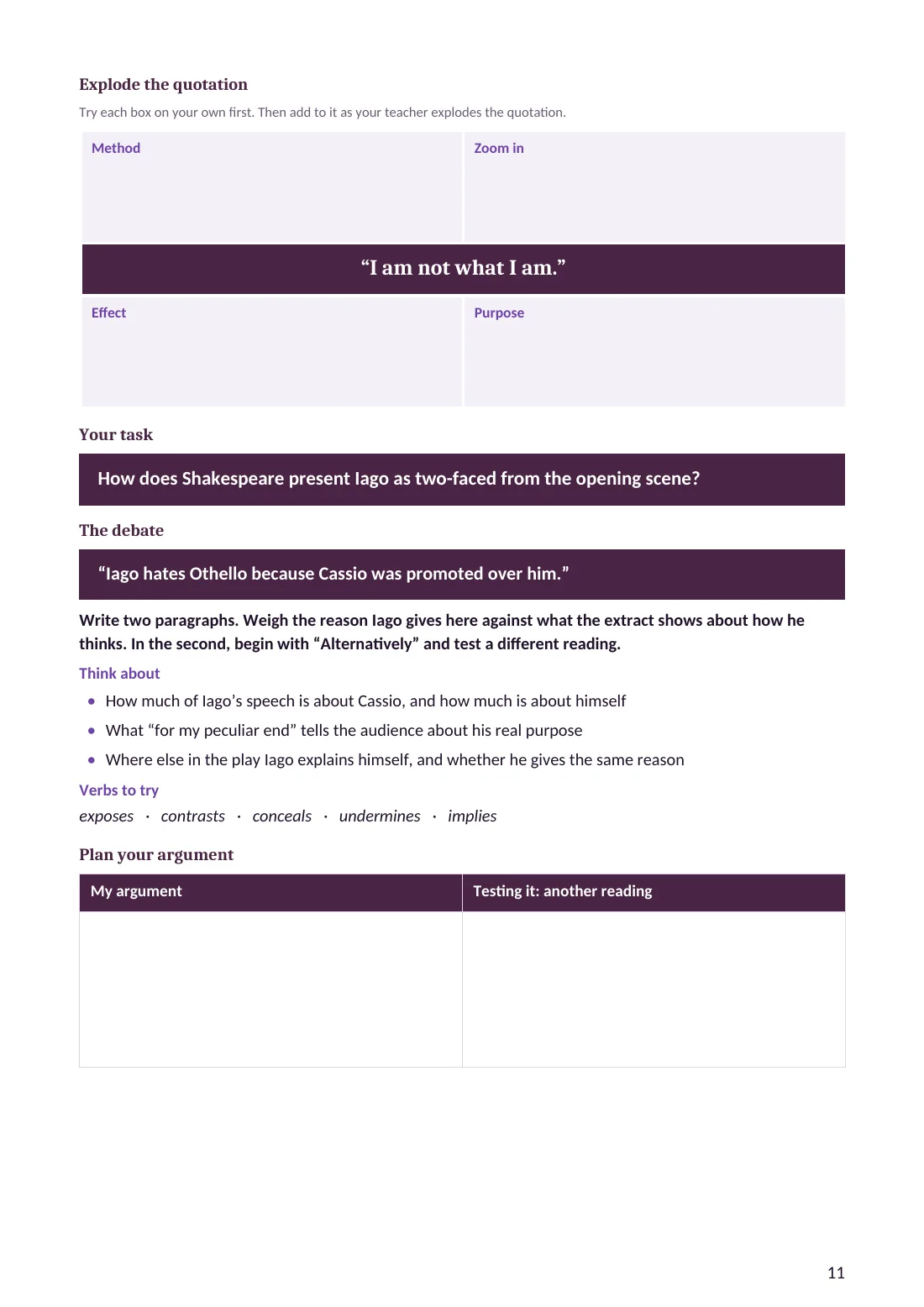 SoaringLesson 3 in the Soaring student pack
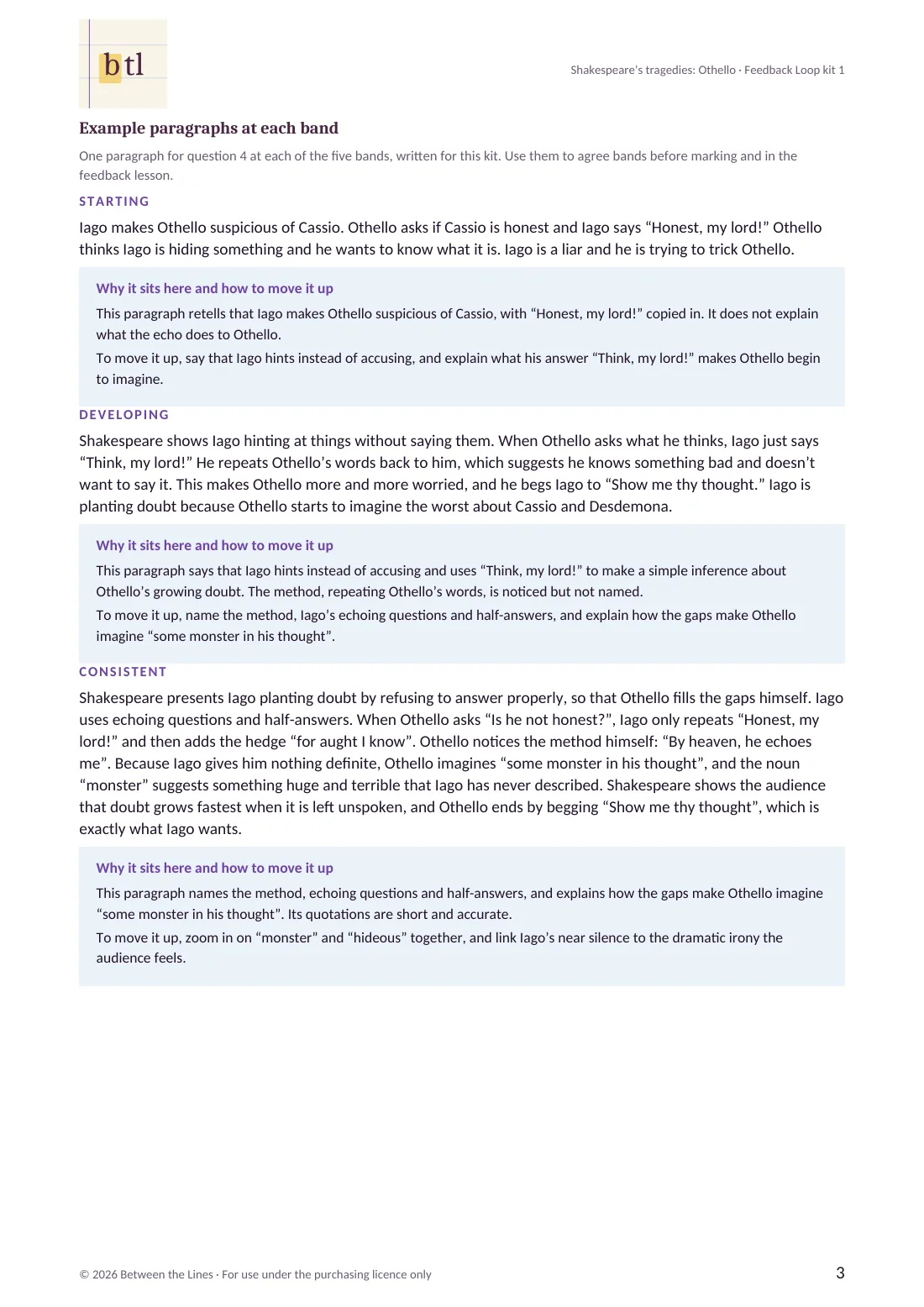 Feedback Loop kitThe checkpoint in Lesson 7
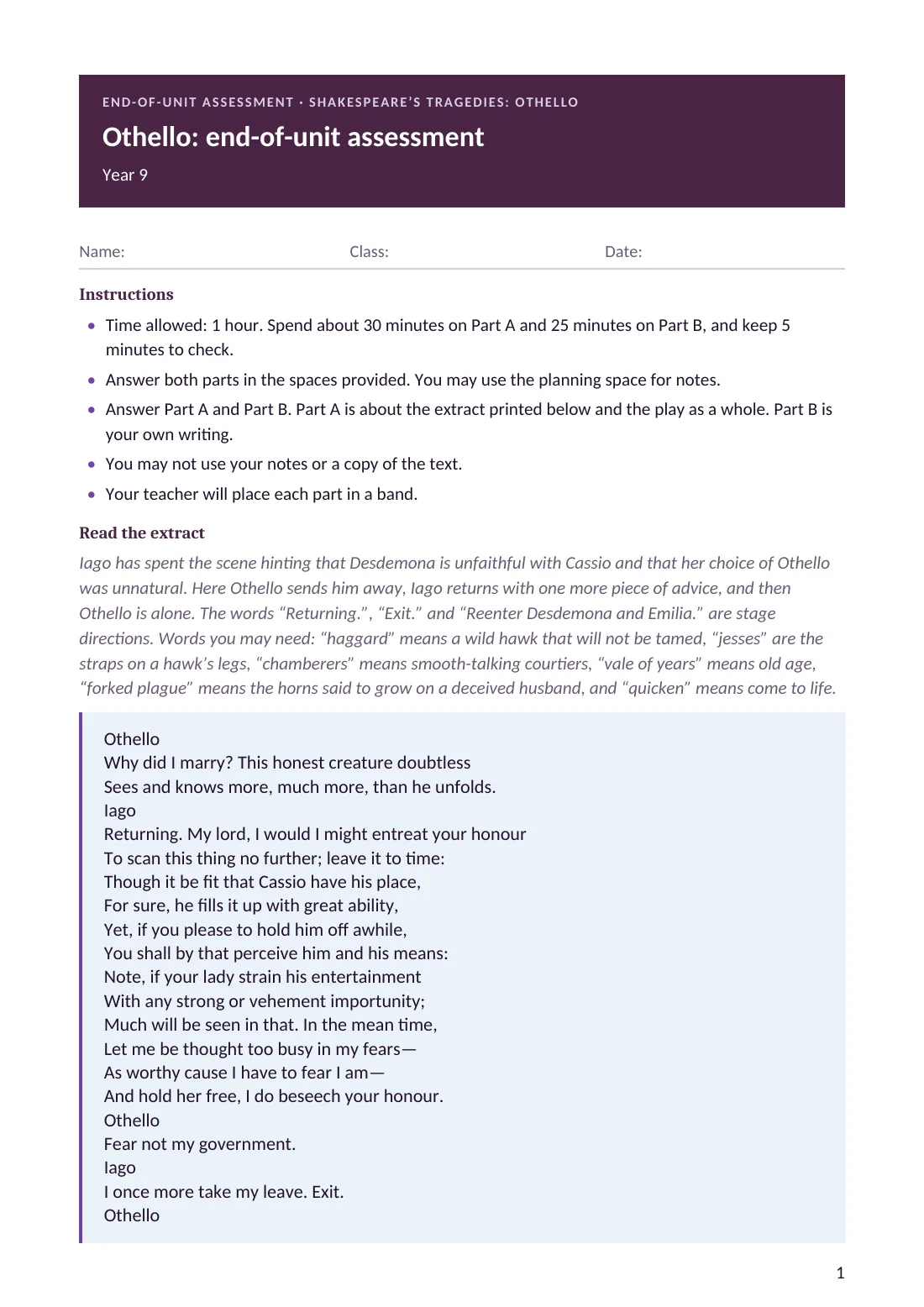 End-of-unit assessmentPart A reading, Part B writing
What students learn
Students read their first Shakespeare tragedy: a Black general at the height of his success in Venice, a marriage that his wife’s father calls witchcraft, and an officer who hates him and destroys him with lies. They learn about the world of the play (Venice, Cyprus and the war with the Ottoman Turks), about Black Africans in Shakespeare’s England and about how the part of Othello has been played on stage. Racism is taught openly as Iago’s weapon, and Othello’s dignity and eloquence are taken seriously. Close study follows Iago’s deceptions, Othello’s fall and Emilia’s challenge, and students write concept-led What–How–Why paragraphs that move from an extract to the whole play. They also write in role: a speech, a monologue, a programme note and a witness’s letter. The unit ends with a reading response on an unseen extract and the play as a whole, and a monologue of their own.
By the end of the unit, students can
- Explain the world of the play: Venice, Cyprus, the Ottoman threat and Black Africans in Shakespeare’s England
- Trace how Iago turns Othello against Desdemona, scene by scene
- Analyse how Shakespeare presents Othello, Iago, Desdemona and Emilia, using short quotations and subject terms
- Write concept-led What–How–Why paragraphs that move from an extract to the play as a whole
- Write a monologue in role that uses the play’s events, language and viewpoint
Where it fits
Builds on: Year 8 study of The Tempest: reading a whole Shakespeare play through its main scenes, soliloquy and the difference between verse and prose, a ruler with magic and the outsider he controls, and a monologue written in role. From Year 7, A Midsummer Night’s Dream: Shakespeare’s theatre, dramatic irony and What–How–Why paragraphs that zoom in on single words. Othello is most students’ first tragedy.
Leads to: Shakespeare in Years 10 and 11, where a tragedy such as Macbeth or Romeo and Juliet is studied in depth: the tragic hero, a villain who speaks to the audience, essays that move from an extract to the play as a whole, and context woven into an argument. The monologue in role prepares students for writing a narrative from one viewpoint.
Two sequences, 14 lessons
The checkpoint, its feedback lesson and the end-of-unit assessment are planned into the sequence. Open a sequence to see its lessons. Lesson 3 is free.
Venice and CyprusLessons 1 to 8
- 1Venice and the MoorWhy does Venice need Othello?
- 2Reading Act 1Reading lessonWhy is Othello called before the Senate on his wedding night?
- 3I am not what I amFreeHow does Shakespeare present Iago as two-faced from the opening scene?
- 4The witchcraft I have usedHow does Othello answer the charge of witchcraft?
- 5O my fair warriorHow should the reunion in Cyprus be staged?
- 6Virtue into pitchHow does Shakespeare show Iago turning other people’s goodness into a weapon?
- 7Some monster in his thoughtFeedback Loop kit 1How does Shakespeare present Iago planting doubt in Othello’s mind here?
- 8Feedback: Iago planting doubtReview lessonHow can I make my paragraph on Iago more precise?
The temptation and the tragedyLessons 9 to 14
- 9Reading Act 3Reading lessonHow does a handkerchief become Iago’s proof?
- 10Is this the noble Moor?How has Othello changed in the eyes of Venice?
- 11Let husbands knowHow does Shakespeare present Emilia, here and in the play as a whole?
- 12Speak of me as I amHow does Othello want to be remembered?
- 13End-of-unit assessmentEnd-of-unit assessmentHow does Shakespeare present Othello’s jealousy?
- 14Feedback and improvementFeedback lessonHow can I improve my reading and my writing?
Assessment without grades
End-of-unit assessment (Lesson 13): Part A, a reading response to a printed extract and the play as a whole; Part B, a piece of the student’s own writing. One hour.
Each part is placed in one of five bands (Starting, Developing, Consistent, Confident, Assured) using the Year 9 reading and writing grids and our indicative content for the task. Nothing is scored or turned into a number. The checkpoint in Lesson 7 is one What–How–Why paragraph, placed in a band in the same way.
- Starting
- Developing
- Consistent
- Confident
- Assured
The bands describe the work, never the student. Key Stage 3 has no GCSE grades or marks in our schemes.
Buy the scheme
Both licences include every file in the scheme, as editable Word and PowerPoint files with a PDF copy of each.
One teacher
For your own classes
£40incl. VAT
- Print and adapt for your own students
- Put it on your school’s own secure learning platform
- Upgrade to a school licence for the difference before VAT
School
Every teacher and student at one school
£100+ VAT
- Print and adapt for every class in the school
- Put it on your school’s own secure learning platform
- Each further school in the same trust pays half
Planning the whole year? The Year 9 school bundle has all six schemes, the year plan and the end-of-year assessment for £480 + VAT.
Both licences include 10 folders: see what is in each
- 00Start here6 pages: how the scheme fits together
- 01Teacher handbook72 pages: intent, unit map, lesson notes and the assessment guide
- 02Slides14 PowerPoint decks with teacher notes, and a PDF copy of each
- 03Student bookletEvery lesson with the Securing, Strengthening and Soaring support side by side, 50 pages, plus one pack per level for set classes
- 04Independent practiceAll three levels in one booklet, 45 pages, plus one booklet per level
- 05Feedback Loop kitThe Lesson 7 checkpoint and its whole-class feedback lesson, 8 pages
- 06End-of-unit assessmentThe assessment paper and a teacher guide with the band grids
- 09Missed a lessonA catch-up sheet for every lesson
- 10InclusionNotes for students with SEND, students learning English and pupil premium students, and a key words list
- 11Talk routinesSixteen routines for spoken English in any lesson, with steps, sentence stems and a student sheet
To pay by invoice, to upgrade a teacher licence, or to license another school in your trust at half price, email hello@btl.education. Please don’t share the files outside your school or upload them to public websites. Licence terms
Othello is in the public domain. Every extract is copied exactly from a public-domain text of the play.
Teach Lesson 3 of Othello, free
One complete lesson from every Key Stage 3 scheme: the slides with teacher notes, and the teacher notes and student pages at Securing, Strengthening and Soaring. Choose a scheme and we email you the files straight away.
The rest of Year 9
- Gothic novel: Dracula Autumn 1
- Poetry of power and protest Autumn 2
- Victorian voices Spring 1
- Visions of the future: The Time Machine Summer 1
- Writing to describe and narrate Summer 2
Get our emails
About once a month: new free resources and the dates that matter for GCSE English.