

Teachers › Key Stage 3 › Year 9 › Poetry of power and protest
Poetry of power and protest
Key Stage 3 · Year 9 scheme of learning · Autumn 2 in our Year 9 plan
A half-term scheme of learning for Year 9: 14 one-hour lessons across about six weeks, built around one big question: how can a poem stand up to power? Every lesson has slides, teacher notes and a student booklet with three levels of support.
Blake, Shelley, Barrett Browning, Dunbar and McKay, 1794 to 1921. Every extract is printed in the booklets, so no class set of books is needed.
Three levels of support · a checkpoint in Lesson 7 with whole-class feedback · an end-of-unit assessment in Lesson 13, placed in five bands
Real pages from the scheme
Choose a page to see it larger. Lesson 5 is free: we email the full editable lesson.
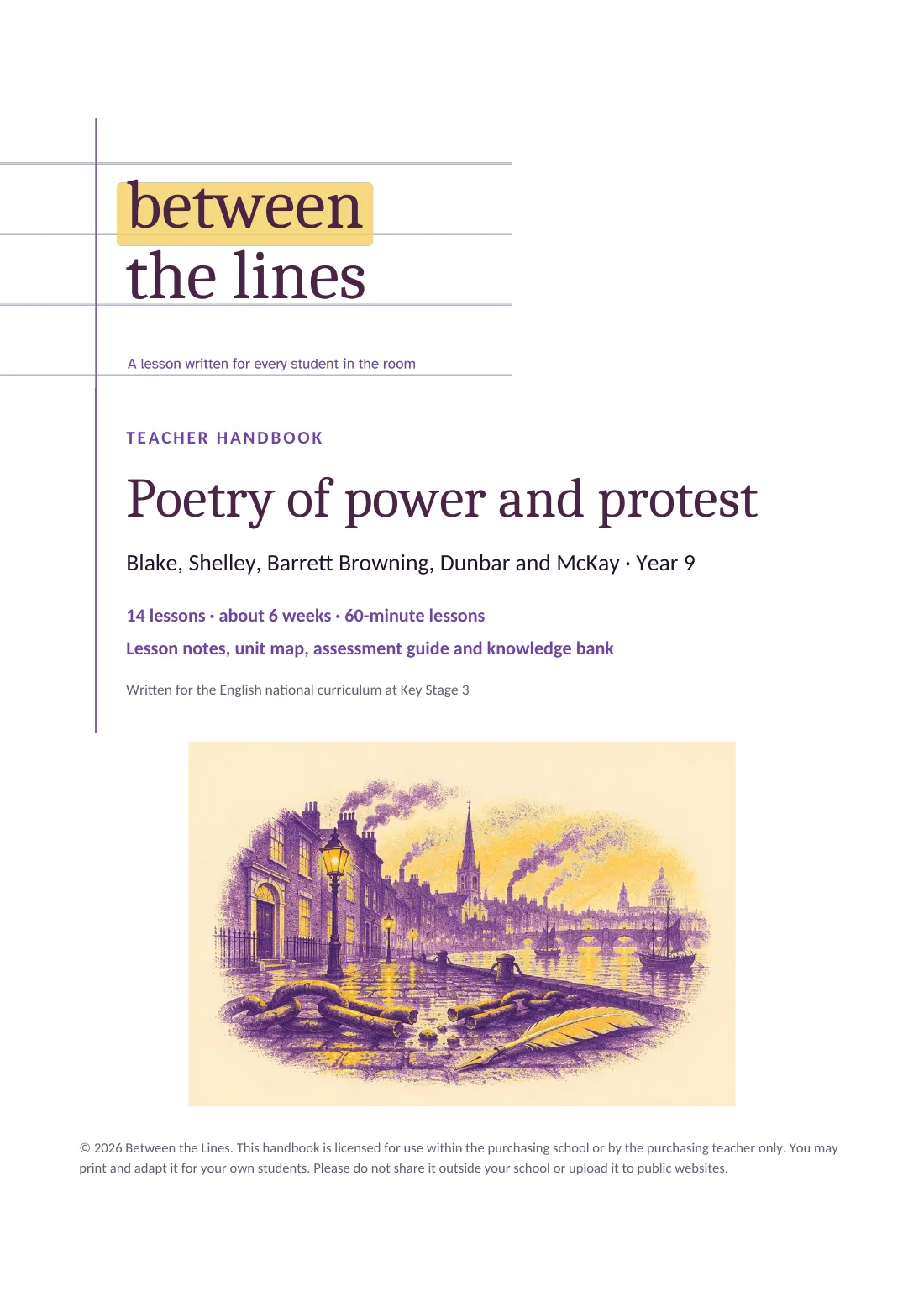 Teacher handbookCover
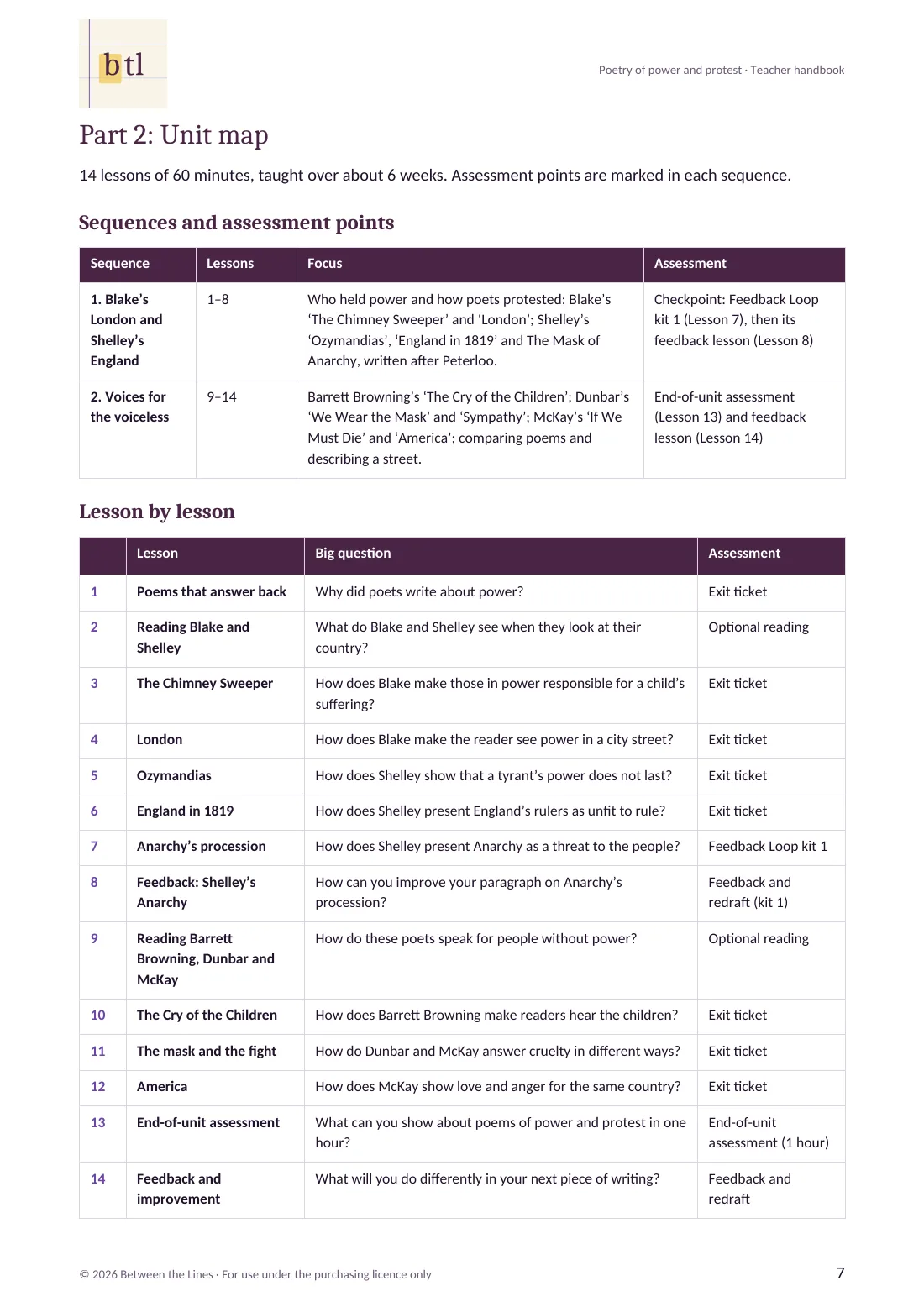 Lesson notesLesson 5 in the teacher handbook
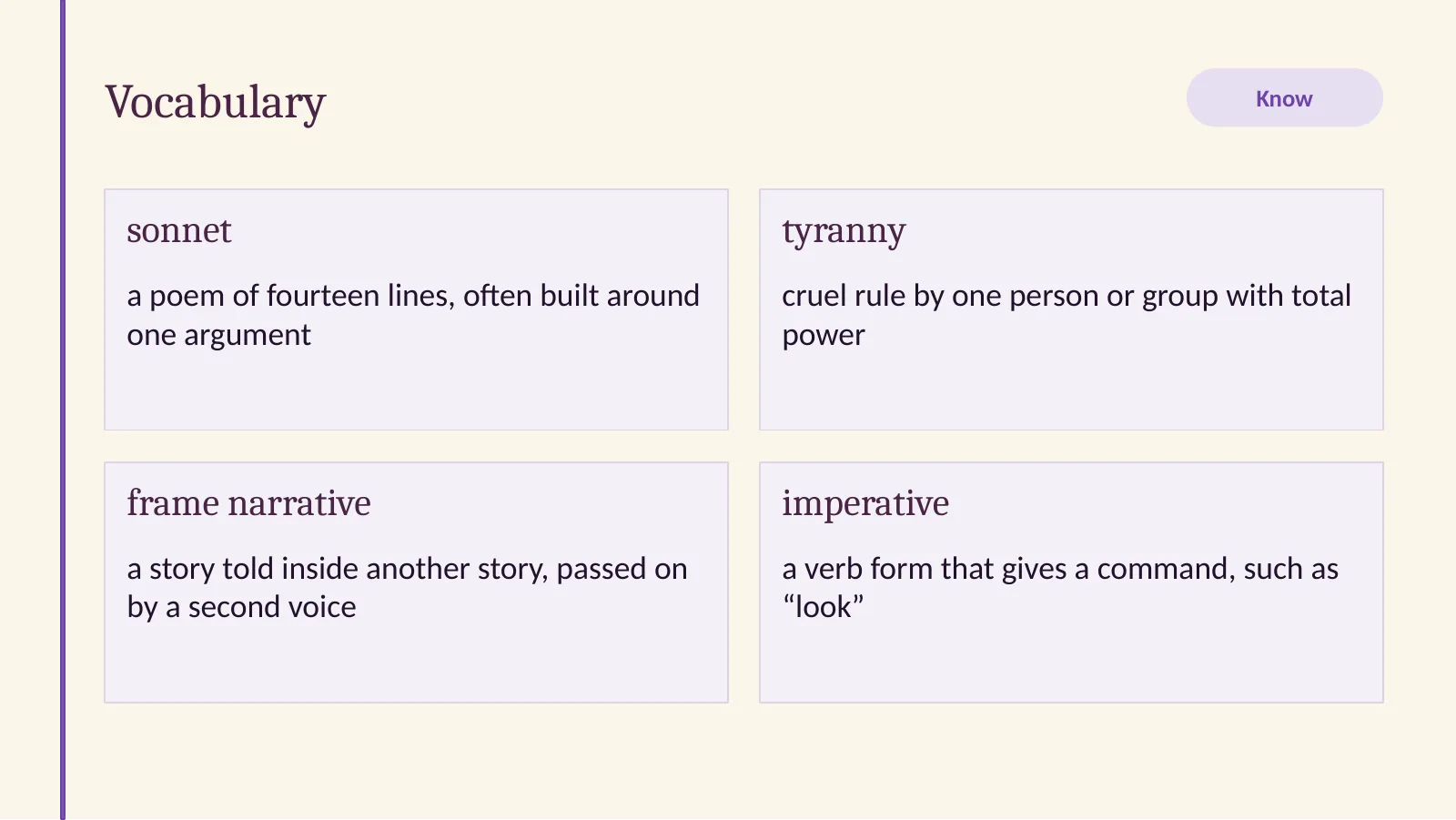 SlidesLesson 5: Ozymandias
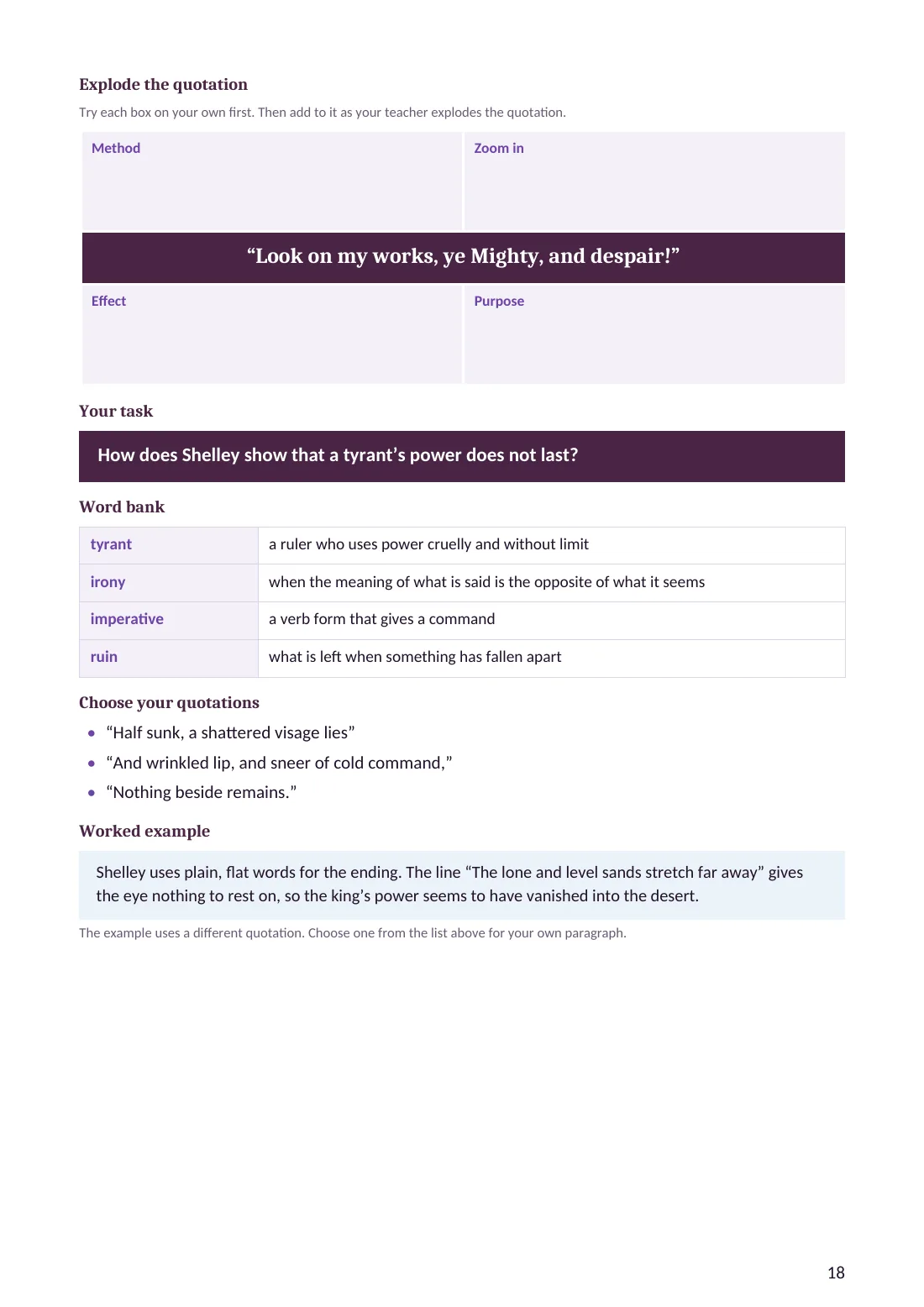 SecuringLesson 5 in the Securing student pack
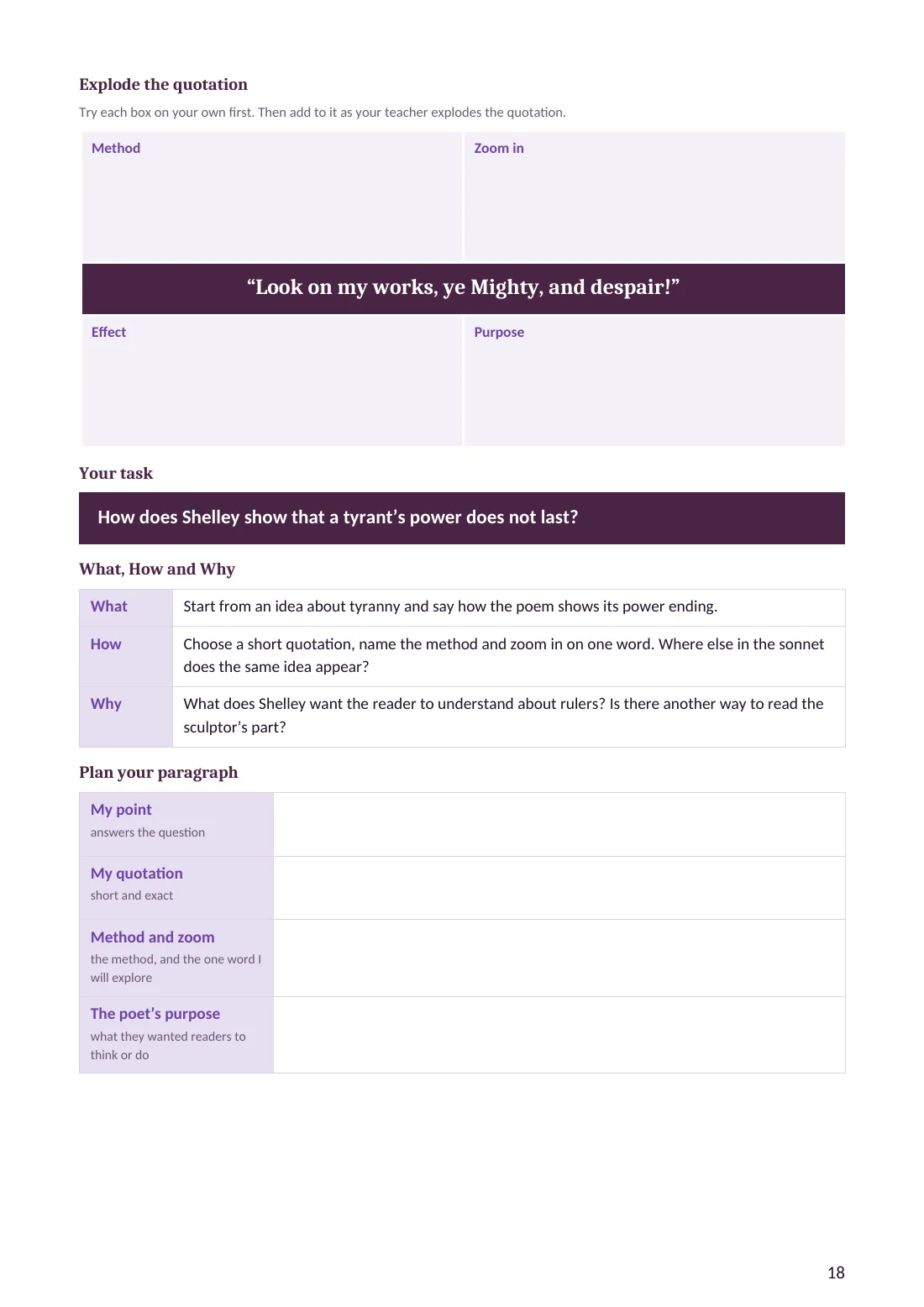 StrengtheningLesson 5 in the Strengthening student pack
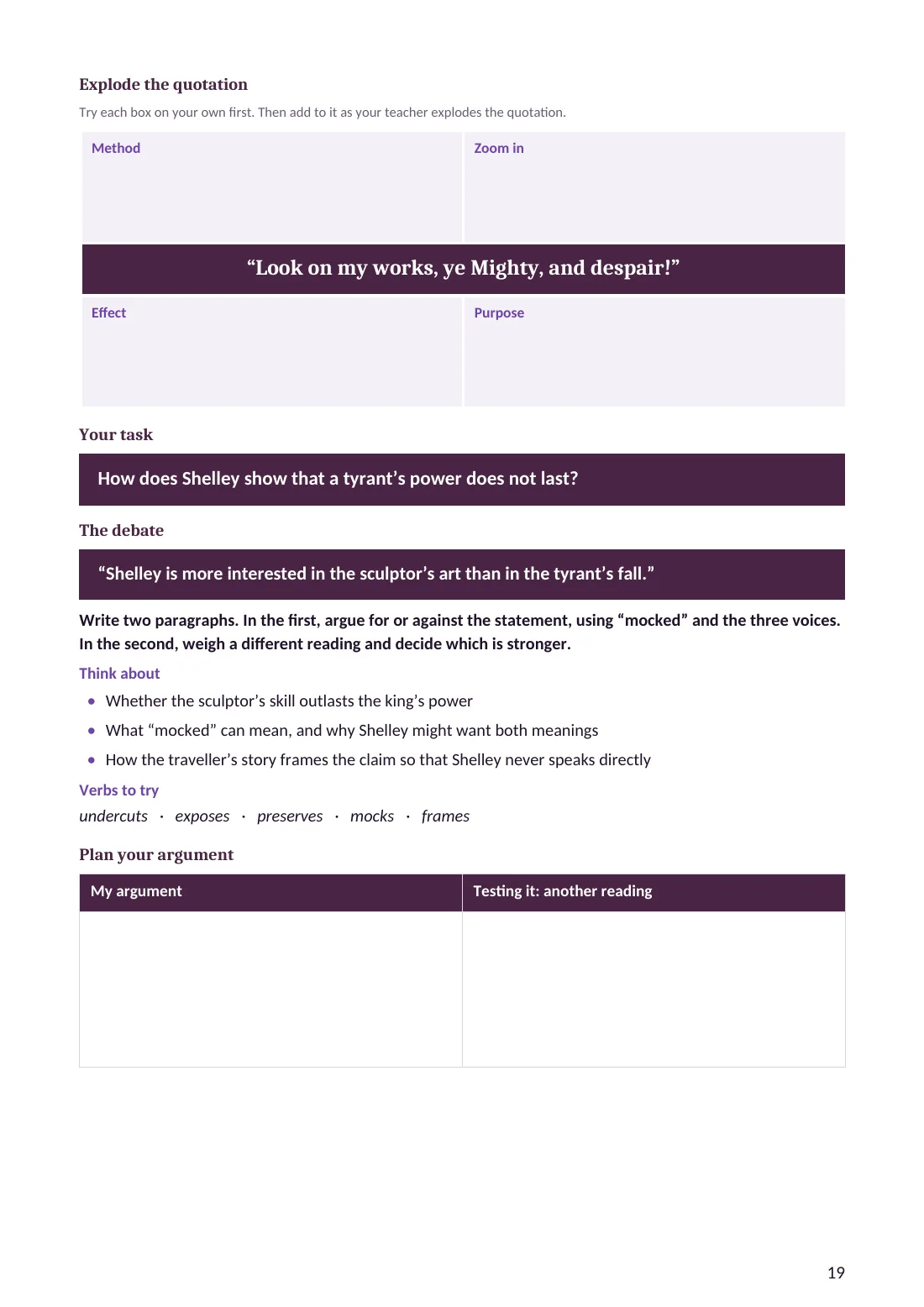 SoaringLesson 5 in the Soaring student pack
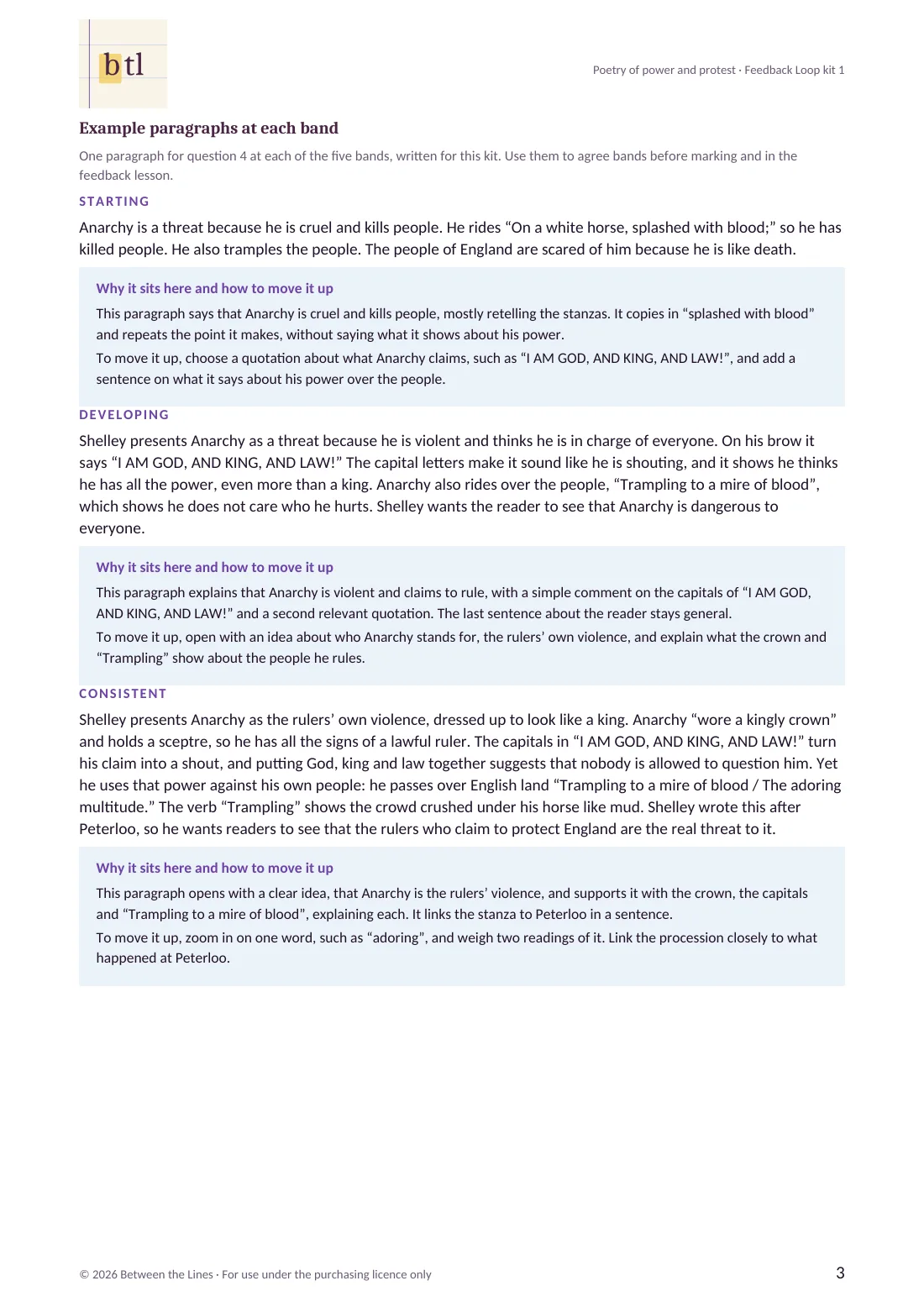 Feedback Loop kitThe checkpoint in Lesson 7
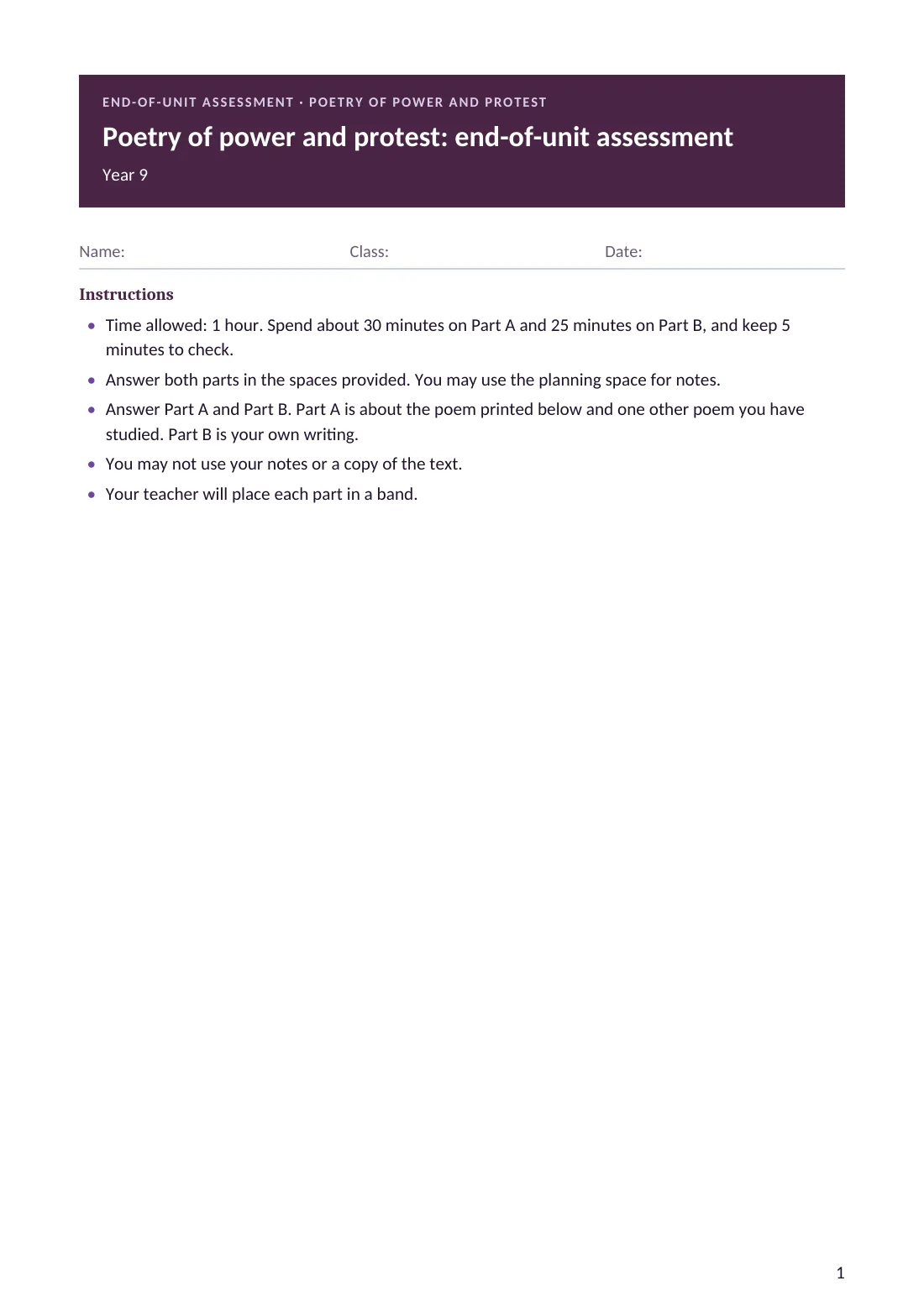 End-of-unit assessmentPart A reading, Part B writing
What students learn
Students read twelve poems written between 1794 and 1921 by poets who looked hard at who held power and who paid for it: Blake walking the streets of London, Shelley answering the Peterloo massacre from Italy, Barrett Browning giving voice to children in mines and mills, and Dunbar and McKay writing as Black Americans in a country that denied them equal rights. Each close-study lesson asks a concept-led question about how a poet presents power, and students build arguments in What–How–Why paragraphs, weighing more than one reading. Comparison runs through the second half of the unit and is assessed in Part A, where students compare an unseen poem by Shelley with a unit poem of their choice. The unit ends with students writing a description of a city street that makes the reader notice who holds power.
By the end of the unit, students can
- Explain the moments that lie behind the poems, from Blake’s London and Peterloo to the United States after Reconstruction and the summer of 1919
- Analyse how poets present power, and the people who suffer under it, through voice, imagery, form and sound
- Compare two poems in every paragraph, linking their methods, their ideas and their contexts
- Write concept-led What–How–Why paragraphs that weigh more than one reading of a poem
- Write a description of a city street that makes a reader notice who holds power there
Where it fits
Builds on: Year 8 study of First World War poetry, where students read poems in the order they were written, compared two poems in lessons and linked a poem’s purpose to its moment, and of Voices of change, where they heard Douglass, Truth, Stanton and Pankhurst speak for people without power and saw how a speaker persuades. Year 9 students bring What–How–Why paragraphs that start from an idea, and some practice in comparison.
Leads to: Poetry in Years 10 and 11: a poetry anthology studied by theme, where poems are compared in every paragraph, and unseen poems read and compared under time. Students may meet ‘London’ and ‘Ozymandias’ again there.
Two sequences, 14 lessons
The checkpoint, its feedback lesson and the end-of-unit assessment are planned into the sequence. Open a sequence to see its lessons. Lesson 5 is free.
Blake’s London and Shelley’s EnglandLessons 1 to 8
- 1Poems that answer backWhy did poets write about power?
- 2Reading Blake and ShelleyReading lessonWhat do Blake and Shelley see when they look at their country?
- 3The Chimney SweeperHow does Blake make those in power responsible for a child’s suffering?
- 4LondonHow does Blake make the reader see power in a city street?
- 5OzymandiasFreeHow does Shelley show that a tyrant’s power does not last?
- 6England in 1819How does Shelley present England’s rulers as unfit to rule?
- 7Anarchy’s processionFeedback Loop kit 1How does Shelley present Anarchy as a threat to the people?
- 8Feedback: Shelley’s AnarchyReview lessonHow can you improve your paragraph on Anarchy’s procession?
Voices for the voicelessLessons 9 to 14
- 9Reading Barrett Browning, Dunbar and McKayReading lessonHow do these poets speak for people without power?
- 10The Cry of the ChildrenHow does Barrett Browning make readers hear the children?
- 11The mask and the fightHow do Dunbar and McKay answer cruelty in different ways?
- 12AmericaHow does McKay show love and anger for the same country?
- 13End-of-unit assessmentEnd-of-unit assessmentWhat can you show about poems of power and protest in one hour?
- 14Feedback and improvementFeedback lessonWhat will you do differently in your next piece of writing?
Assessment without grades
End-of-unit assessment (Lesson 13): Part A, a comparison of a printed poem with one other poem from the unit; Part B, a piece of the student’s own writing. One hour.
Each part is placed in one of five bands (Starting, Developing, Consistent, Confident, Assured) using the Year 9 reading and writing grids and our indicative content for the task. Bands describe the work, never the student, and nothing is scored. The checkpoint in Lesson 7 is one What–How–Why paragraph, placed in a band in the same way.
- Starting
- Developing
- Consistent
- Confident
- Assured
The bands describe the work, never the student. Key Stage 3 has no GCSE grades or marks in our schemes.
Buy the scheme
Both licences include every file in the scheme, as editable Word and PowerPoint files with a PDF copy of each.
One teacher
For your own classes
£40incl. VAT
- Print and adapt for your own students
- Put it on your school’s own secure learning platform
- Upgrade to a school licence for the difference before VAT
School
Every teacher and student at one school
£100+ VAT
- Print and adapt for every class in the school
- Put it on your school’s own secure learning platform
- Each further school in the same trust pays half
Planning the whole year? The Year 9 school bundle has all six schemes, the year plan and the end-of-year assessment for £480 + VAT.
Both licences include 10 folders: see what is in each
- 00Start here6 pages: how the scheme fits together
- 01Teacher handbook68 pages: intent, unit map, lesson notes and the assessment guide
- 02Slides14 PowerPoint decks with teacher notes, and a PDF copy of each
- 03Student bookletEvery lesson with the Securing, Strengthening and Soaring support side by side, 50 pages, plus one pack per level for set classes
- 04Independent practiceAll three levels in one booklet, 46 pages, plus one booklet per level
- 05Feedback Loop kitThe Lesson 7 checkpoint and its whole-class feedback lesson, 8 pages
- 06End-of-unit assessmentThe assessment paper and a teacher guide with the band grids
- 09Missed a lessonA catch-up sheet for every lesson
- 10InclusionNotes for students with SEND, students learning English and pupil premium students, and a key words list
- 11Talk routinesSixteen routines for spoken English in any lesson, with steps, sentence stems and a student sheet
To pay by invoice, to upgrade a teacher licence, or to license another school in your trust at half price, email hello@btl.education. Please don’t share the files outside your school or upload them to public websites. Licence terms
Every poem in these resources is in the public domain. Poems and extracts are printed exactly from public-domain texts, with the poet and the date.
Teach Lesson 5 of Poetry of power and protest, free
One complete lesson from every Key Stage 3 scheme: the slides with teacher notes, and the teacher notes and student pages at Securing, Strengthening and Soaring. Choose a scheme and we email you the files straight away.
The rest of Year 9
- Gothic novel: Dracula Autumn 1
- Victorian voices Spring 1
- Othello Spring 2
- Visions of the future: The Time Machine Summer 1
- Writing to describe and narrate Summer 2
Get our emails
About once a month: new free resources and the dates that matter for GCSE English.