Videos › The free Lesson 3, slide by slide
Free lesson walkthrough: A Christmas Carol, Lesson 3
8 minutes · captions available
Hannah teaches through the free Lesson 3, Meet Scrooge: the Do Now, the four key words, exploding a quotation, the hinge question and the same task at Securing, Strengthening and Soaring.
Chapters
Transcript
Introduction
This is Between the Lines, and I'm here today to talk you through one of our lessons that's available to download for free at btl.education. Lesson 3 of A Christmas Carol.
The big question: How does Dickens make us dislike Scrooge?
Now, every lesson starts exactly the same way, with a big question. Here, it's, How does Dickens make us dislike Scrooge, and why does he want us to? We've got three clear bullet points at the start of every lesson, which tell us what students are going to have mastered by the end of this lesson. Here, we can explain the methods that Dickens uses to introduce Scrooge. We can link Scrooge's coldness to Dickens' purpose, and then we're going to master through writing a What-How-Why paragraph on the opening of Stave 1.
Know: Do Now: five questions from memory
We've then got our Do Now. Five quick questions. These are printed in every student resource booklet at all three levels. All students are answering the same questions. This is all about what do they know. So, we have our five questions here. Now, you can see that they are hitting all three assessment objectives, so we're looking at your knowledge of the text, you're looking at language on structural analysis, and you're also looking at context. Students then self-mark these in a different colour in their books, and you can see that those go up one by one.
Know: Four key words
We then pre-teach vocabulary, so for every extract, we're looking at what are those words that are going to be not just unfamiliar, but actually are going to unlock the text a little bit more for them. Okay, we don't need to pre-teach every single word. When we're looking at Victorian texts or Shakespearean texts, there are going to be unfamiliar vocabulary, but not all of them are going to actually unlock what it is that they need to know. So, we've got four keywords for every extract, and here we can see these are covetous, flint, solitary, and self-contained.
Know: Reading the extract
We then move on to the extract. Now, here is that classic extract from the beginning of stave one, we all know it, that asyndetic listing of the squeezing, wrenching, grasping, scrooge. We'd read this through together using the reading strategies which are outlined in your teacher handbook, every student using a reading ruler so that they can track their reading. And as a teacher, you can see that everyone is doing that. Okay, so once you've read the extract,
Apply: Explode the quotation
we move on to picking out a single quotation. What is a quote that they can use in their any essay? So, solitary as an oyster. Now, no matter what you're doing, what essay you're writing on a Christmas carol, you could always put this in. We know it's always going to be based on Scrooge's transformation in some way, and this is how he's described at the beginning, as solitary as an oyster. Now, there's lots to unpack here, and students can start off by trying to explode this on their own or in pairs or on their tables. So, we're looking always at the method, we're zooming in on specific words. Remember, the examiner absolutely loves that, actually say a lot about a little, what does this one word show us? We're thinking about the effect, and always we're thinking about the purpose. What's Dickens' message? Drive it through that. We then, you can, as a teacher, model this, and then there are things that students can add to make sure that they've got all of those details. Okay, after the quote explosion,
Apply: Hinge question
we've got an understanding check, and this is our hinge question. Again, this happens in every single lesson. Students have reduced that cognitive load because we have done that for them. So, we are looking at one single question, and we can do this on mini whiteboards so that you can do a real quick AFL check, or you can get them to write it in their books if you prefer. So, here we are looking at Dickens calls Scrooge solitary as an oyster, the quotation we've just exploded. Which reading does the text best support? Okay, and we've got three options here, A, B, or C. And really quickly, you can check that hinge question, actually, where are people? Now, not only that, but in your teacher handbook, it will tell you, obviously the correct answer, but what the misconception is if they have chosen one of the others. So, things like B, he is precious like a pearl, actually we're missing that whole idea of the oyster being closed up. And the fact that he prefers to live by the sea means that they've not really thought about it properly at all. We know Scrooge lives in central London, and they have not put any of their other understanding on that one extract.
Master: One task, three levels of support
Once we have secured where students are in terms of looking at that hinge question, we then move on to the mastery task. And again, every lesson works exactly the same way. We know, we apply, and then we master. So, how does Dickens present Scrooge as cut off from other people? Now, we know that we do not have tiered exams in English. We don't have a foundation and a higher. Every student is answering the same question. So, in our lessons, that needs to be the same too. So, no matter if you are at Securing, Strengthening, or Soaring, you are answering the same question. It's just a different method to get there. So, in terms of what that looks like, in each student's pack, they have the resources, the scaffolding that they need to be able to access that question based on their level. So, it's only the support that changes.
Master: Securing: word bank and sentence starters
Here, we can see that for Securing, we have a word bank. There is a choice of quotations printed in their booklets, and there's some sentence starters to get them going.
Master: Strengthening: What, How, Why prompts
For Strengthening, we've got prompts for the what, how, why, which is how we structure every paragraph. They've got a success checklist as well, so they can tick off their own work as they're going. And then for Soaring, we're looking at a debate point.
Master: Soaring: a debate to argue
Argue. Scrooge chooses his isolation. How far do we agree? So, we're looking at really developing and stretching those students and thinking about different interpretations. So, that how far do you agree gives them that opportunity to argue it either way, and that's really what's going to push them up to that critical and perceptive level six in the mark scheme.
Master: Model paragraph
We also have a model paragraph that students can look to if they need it as well. Now, after they have completed their what, how, why, their mastery task, our exit ticket,
Master: Exit ticket
students are completing a sentence. Dickens makes Scrooge cold, so that, and they're completing that sentence. Now, you can get them to do this in their student booklets. It is printed in there for you, but actually, what I like to do is have them write them on a sticky note and hand those to me as they're leaving so I can check their understanding. And that brings us to the end of that lesson. So, every lesson in our schemes of learning, not just for Christmas Carol, but all of our text, follows the same structure. We know, we apply, and then we master. And it's all available at btl.education.
More videos
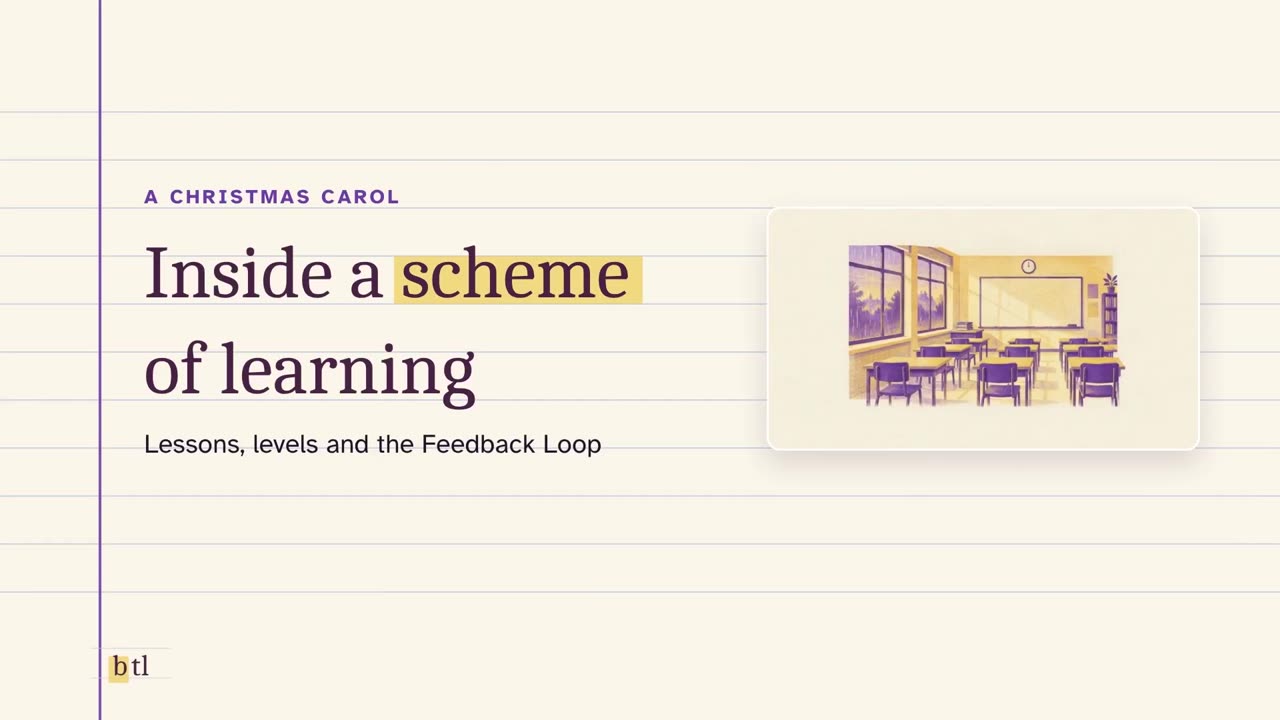
Every folder in the A Christmas Carol scheme: the teacher handbook, the slides, the student packs at three levels, the Feedback Loop kits, the end-of-unit essay, the stretch booklet and the catch-up and inclusion sheets.
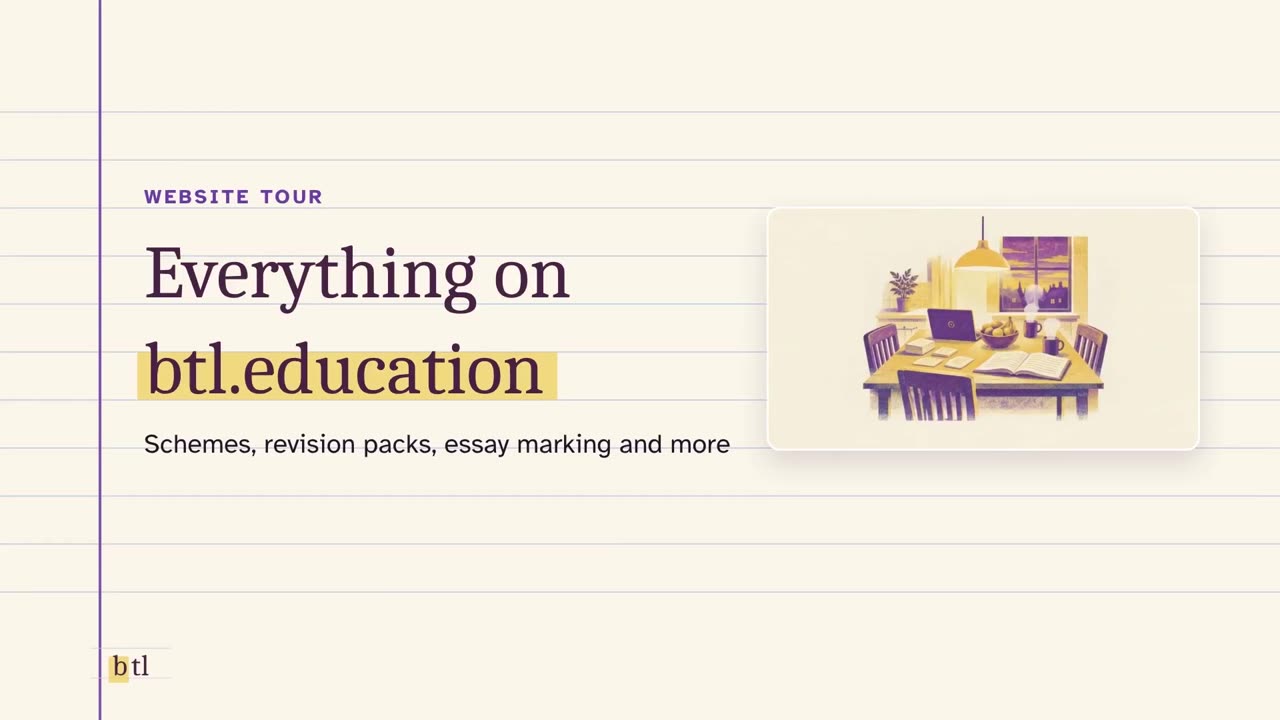
The schemes and licences, the free resources, revision packs for home, essay marking, the Knowledge hub and the display settings for reading on screen.
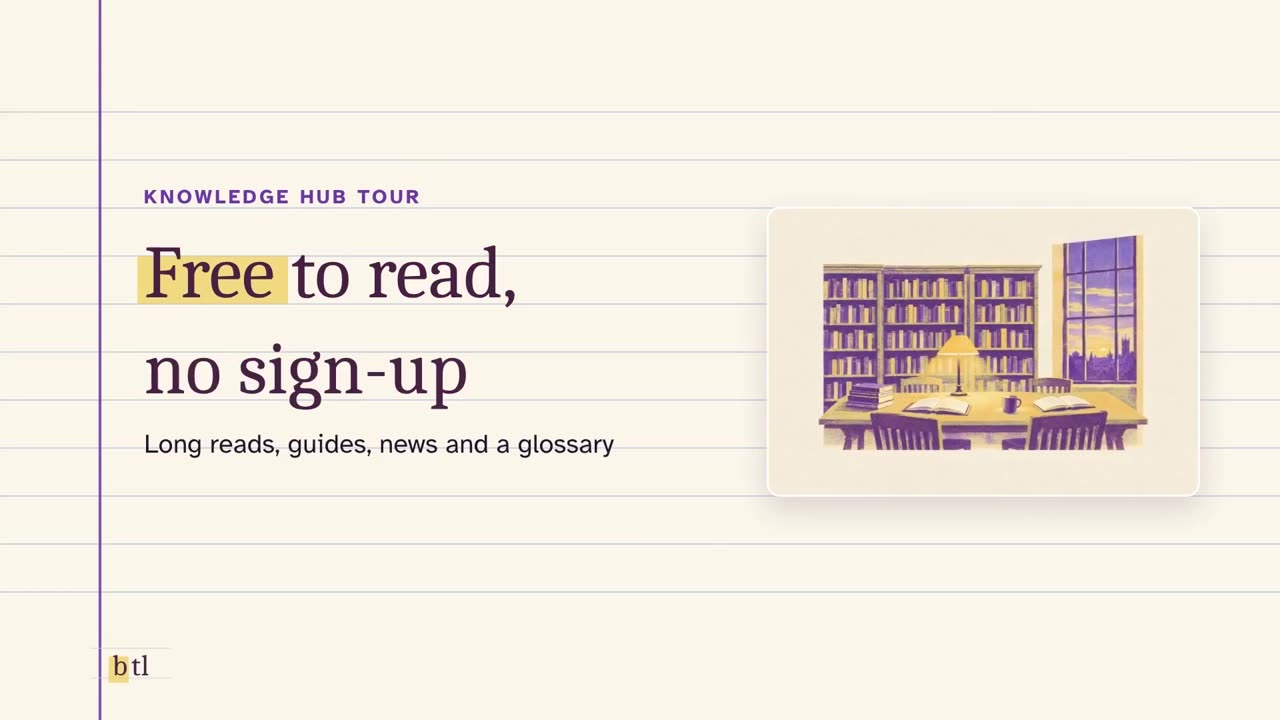
Long reads on the thinking behind the schemes, guides for teachers, students and parents and carers, education news and a glossary of 336 terms. Free to read, no sign-up.
Get our emails
About once a month: new free resources and the dates that matter for GCSE English.