

Knowledge hub › For students › Jane Eyre: the story
Jane Eyre: the story, part by part
An orphan girl survives a cruel aunt and a harsh school, falls in love with her employer and discovers his terrible secret. The novel is retold in nine parts, with the characters and ideas.
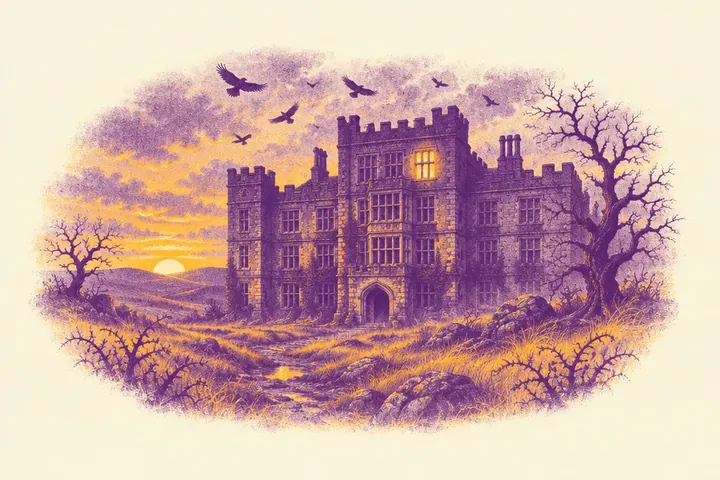
In Charlotte Brontë’s novel Jane Eyre (1847), an orphan grows up unloved, survives a harsh charity school and becomes a governess at Thornfield Hall, where she falls in love with her employer, Mr Rochester. On their wedding day she learns he already has a wife, locked in the attic, and she runs away rather than lose her self-respect. She returns, free and independent, to marry him at the end. It is Section B of AQA GCSE English Literature Paper 1.
Jane Eyre is a long novel by Charlotte Brontë, who was born in Yorkshire in 1816 and died in 1855. It was first published in October 1847 in three volumes, under the name Currer Bell, so readers did not know who had written it. Its full title was Jane Eyre: An Autobiography, and Jane tells her own story, often speaking straight to the reader.
- 38chapters in the novel, told by Jane herself, looking backProject Gutenberg text
- 1847the year Jane Eyre was first published, in three volumesEncyclopaedia Britannica
- 30marks for the Jane Eyre question, with no marks for spelling, punctuation and grammarAQA specification
The story follows Jane through five houses: Gateshead, Lowood, Thornfield, Moor House and Ferndean. The exam question prints an extract, then asks about the novel as a whole, so you need the whole story.
Part 1: Gateshead
This part covers Chapters 1 to 4. Jane is ten years old and an orphan. She lives at Gateshead Hall with her aunt by marriage, Mrs Reed, and her cousins Eliza, John and Georgiana. Mrs Reed promised her dying husband to raise Jane as her own child, but treats her coldly.
One winter afternoon, John Reed, who is fourteen and a bully, throws a heavy book at Jane and cuts her head. For the first time she fights back: “Wicked and cruel boy!” She is blamed and locked in the red-room, the cold, grand bedroom where Mr Reed died. As it grows dark, she feels she is in a prison, and “no jail was ever more secure”. She thinks she sees a light moving and fears it is her uncle’s ghost. She screams and faints.
A kind apothecary, Mr Lloyd, suggests she go away to school. Months later Mrs Reed calls her in to meet Mr Brocklehurst, the clergyman who runs Lowood School. To Jane he looks like “a black pillar”. Asked how she can avoid going to hell, she answers, “I must keep in good health, and not die.” Mrs Reed tells him Jane is a liar. When he has gone, Jane stands up to her aunt: “I am not deceitful”.
Part 2: Lowood
This part covers Chapters 5 to 10. Jane arrives at Lowood, a charity school for orphan girls, on a cold January night. The girls are always hungry and cold. When the porridge is burnt, the kind superintendent, Miss Temple, orders bread and cheese for everyone.
Jane makes friends with an older girl, Helen Burns. Helen is punished unfairly by a teacher, Miss Scatcherd, but never complains. She tells Jane, “It is far better to endure patiently”, and that she should forgive her enemies. Jane cannot agree: she believes in standing up for herself.
Mr Brocklehurst visits. He says the girls must be made “hardy, patient, self-denying”, and he orders a girl’s naturally curly hair to be cut off. His own daughters wear velvet and furs. Jane drops her slate, and Brocklehurst makes her stand on a stool in front of the whole school while he calls her a liar. Later Miss Temple writes to Mr Lloyd, learns the truth and clears Jane’s name in front of everyone.
In spring, typhus fever sweeps through the damp school and many girls die. Helen is dying of consumption. Jane creeps into her bed at night. Helen says calmly, “God is my father; God is my friend”, and Jane falls asleep beside her. In the morning Helen is dead.
Jane stays eight years at Lowood, six as a pupil and two as a teacher. When Miss Temple marries and leaves, Jane feels restless: “I desired liberty; for liberty I gasped”. She advertises for a post as a governess and is offered one at Thornfield Hall.
Part 3: Thornfield and Mr Rochester
This part covers Chapters 11 to 15. At Thornfield, Jane is welcomed by the kind, chatty housekeeper, Mrs Fairfax. Her pupil is Adèle Varens, a lively French girl who is the ward of the owner, Mr Rochester. He is almost never at home. On the third storey Jane hears “a curious laugh; distinct, formal, mirthless”. Mrs Fairfax says it is a servant, Grace Poole.
Jane is restless. She paces the roof and thinks that “women feel just as men feel”, and that they need work and action as much as men do.
One icy January evening, walking in Hay Lane, Jane meets a rider whose horse slips on the ice. She helps him, and only later finds out that he is Mr Rochester. He is dark, moody and in his mid-thirties. He tests her with sharp questions, looks at her paintings and talks to her as an equal. When he asks, “do you think me handsome?”, she answers honestly that she does not. He likes her for it.
One night Jane hears a strange laugh outside her door and smells smoke. Rochester’s bed is on fire: “Tongues of flame darted round the bed”. She throws water over him and wakes him. He goes up to the third storey, then tells her to say nothing, and thanks her warmly.
Part 4: Blanche Ingram and the stranger
This part covers Chapters 16 to 20. The next day Rochester leaves to stay with friends, and Mrs Fairfax mentions the beautiful Blanche Ingram. Jane scolds herself for hoping. She draws her own plain face and an imagined, lovely Blanche, to remind herself who she is.
Rochester returns with a party of rich guests, including Blanche. Blanche and her mother talk about governesses with scorn while Jane sits in the room. Everyone expects Rochester to marry Blanche.
A stranger arrives, Mr Mason from Jamaica, and Rochester is shocked to hear his name. While Rochester is away one afternoon, an old gypsy woman comes to tell fortunes. When Jane’s turn comes, the gypsy talks about her feelings and then reveals herself. It is Rochester in disguise.
That night a terrible scream wakes the house. Rochester asks Jane to sit in a room on the third storey with Mason, who is bleeding from a knife wound and has been bitten. She must not speak to him. At dawn a surgeon arrives and Mason is sent away.
Part 5: Return to Gateshead and the proposal
This part covers Chapters 21 to 24. A message comes: John Reed has died, people say by his own hand, and Mrs Reed has had a stroke and is asking for Jane. Jane goes back to Gateshead. Mrs Reed still hates her, but on her deathbed she gives Jane a letter from Jane’s uncle, John Eyre, in Madeira. Three years ago he wanted to adopt Jane and leave her his money. Mrs Reed told him that Jane had died at Lowood. Jane forgives her.
Jane returns to Thornfield. One midsummer evening Rochester talks to her in the orchard. He says that he will soon marry Blanche, and that Jane must leave for a post in Ireland. He says he feels as if he has “a string somewhere under my left ribs” tied to her, which would snap if she went so far. Jane breaks down and tells him what she feels: “because I am poor, obscure, plain, and little”, that does not mean she has no soul or heart. She tells him, “I am no bird; and no net ensnares me”.
Then Rochester asks her to marry him. Blanche was a trick to make Jane jealous. He calls her his bride “because my equal is here, and my likeness”. She accepts. That night lightning splits the great horse-chestnut tree in the orchard.
In the weeks before the wedding, Rochester wants to buy her silks and jewels. Jane refuses to be dressed up like a doll. She says, “I am not an angel”, and that she will be herself.
Part 6: The wedding and the secret
This part covers Chapters 25 to 27. Two nights before the wedding, Jane wakes to see a frightening woman in her room, who puts on Jane’s wedding veil, tears it in two and stamps on it. Rochester says it was Grace Poole, or a dream.
At the church, the service is stopped. A lawyer, Mr Briggs, says that “Mr. Rochester has a wife now living”. Mason is with him. Rochester admits it. He married Bertha Mason in Jamaica fifteen years ago, and she has a serious mental illness. On the third storey, behind a locked door, a figure runs back and forth on all fours. Jane cannot tell “whether beast or human being”. The figure attacks Rochester. Jane’s uncle, who knows Mason, sent Briggs to stop the wedding.
Rochester begs Jane to go to France with him and live as his wife. He was pushed into his marriage for money, he says, and he loves Jane truly. She loves him too, but she will not live with a married man. “I care for myself,” she tells herself. That night she dreams of the moon, which speaks to her: “My daughter, flee temptation.” Before dawn she leaves Thornfield with almost nothing.
Part 7: Moor House and the Rivers family
This part covers Chapters 28 to 33. A coach leaves Jane at Whitcross, a crossroads on the moors, with no money. She sleeps on the heather and begs for food, and is close to death when she reaches a house called Moor House. The servant, Hannah, turns her away, but the clergyman of the house, St John Rivers, takes her in. His sisters, Diana and Mary, nurse her back to health. She gives a false name, Jane Elliott.
St John is handsome, cold and ambitious. He finds Jane work teaching poor girls at a village school in Morton. St John loves the beautiful, rich Rosamond Oliver, but he gives her up because she would not make a missionary’s wife.
One snowy night St John reveals that he knows who Jane really is. Her uncle, John Eyre, has died and left her twenty thousand pounds. St John, Diana and Mary are her cousins. Jane is overjoyed to have a family, and shares the money equally between the four of them.
Part 8: St John’s proposal and the voice
This part covers Chapters 34 and 35. St John is going to India as a missionary. He asks Jane to learn Hindustani, then asks her to come with him as his wife. He tells her, “you are formed for labour, not for love”. Jane offers to go as his sister, but not as his wife, because he does not love her. She says, “I scorn your idea of love”.
St John keeps up the pressure for days. One night Jane almost gives in. Then she hears Rochester’s voice calling her from far away: “Jane! Jane! Jane!” She answers and breaks free of St John. The next day she sets out for Thornfield.
Part 9: Ferndean
This part covers Chapters 36 to 38. Jane finds Thornfield a blackened ruin. The innkeeper tells her what happened. Bertha set fire to the house. Rochester got the servants out and tried to save his wife, but she threw herself from the battlements and died. Rochester was caught when the staircase fell. He lost a hand and the sight of both eyes. He now lives alone at Ferndean, a lonely house in the woods.
Jane goes to him. She tells him that she is rich: “I am an independent woman now.” He asks her to marry him, and she accepts. He tells her that on the night she heard his voice, he had called out her name.
The last chapter begins, “Reader, I married him.” They have been married for ten years. Rochester gets back the sight of one eye in time to see their first son. St John is working in India and expects to die soon, and the novel ends with his words.
The main characters
- Jane Eyre: the narrator, an orphan who is poor, plain and passionate. She will not give up her self-respect for love, money or comfort.
- Edward Fairfax Rochester: the moody, clever master of Thornfield, older than Jane, who asks her to marry him while hiding that he has a wife.
- Mrs Reed: Jane’s cold aunt by marriage, who hides a letter from Jane’s uncle.
- Mr Brocklehurst: the clergyman who runs Lowood and keeps the girls cold and hungry while his own family wear furs.
- Helen Burns: Jane’s first friend, who forgives her enemies and dies of consumption.
- Miss Temple: the kind superintendent of Lowood, who clears Jane’s name.
- Adèle Varens: Rochester’s young French ward and Jane’s pupil.
- Bertha Mason: Rochester’s wife from Jamaica, locked on the third storey. She is only ever described by others and never tells her own story.
- Blanche Ingram: a proud beauty everyone expects Rochester to marry.
- St John Rivers: Jane’s cold, ambitious cousin, who wants her to marry him and go to India.
- Diana and Mary Rivers: St John’s warm, clever sisters, who become Jane’s friends.
The main ideas and context
Independence and self-respect. Jane wants to be free and to keep her own conscience, and she pays for it at every stage: in the red-room, on the moor and in refusing two proposals. She only marries Rochester when she has her own money and he is free.
Love and equality. Jane will marry only as an equal. She leaves Rochester when he cannot marry her lawfully and refuses St John’s loveless offer. In the 1840s a married woman’s property passed to her husband, and divorce needed an Act of Parliament, so a wife had very little power of her own.
Religion. Brocklehurst, Helen Burns and St John show three kinds of faith: a cruel, false one, a gentle and forgiving one, and a hard, ambitious one. In the preface to the second edition, Brontë wrote that conventionality is not morality.
Class and money. Jane is a dependent, then a charity pupil, then a governess. A governess was usually an educated woman with no money of her own, who belonged neither with the family nor with the servants. Charlotte Brontë worked as a governess herself.
Lowood and Brontë’s life. Charlotte’s two older sisters fell ill at a school for clergymen’s daughters at Cowan Bridge and died in 1825. Lowood is often linked with that school.
The Gothic. Locked rooms, a laugh in the night, a fire, a torn veil and a voice across the moors fill the novel with fear and mystery. Jane compares the third storey to a corridor in “some Bluebeard’s castle”.
Empire. Bertha comes from Jamaica, a British colony where slavery was abolished in 1833, and St John goes to India. Bertha is described in animal terms and never speaks for herself.
Myths about Jane Eyre
Myth Jane Eyre is a simple romance.
What the evidence says
Rochester proposes in Chapter 23, but Jane leaves him in Chapter 27 and spends the next eight chapters on her own. She refuses two men because their offers would cost her self-respect. The love story only ends happily once she is independent.
Source: Charlotte Brontë, Jane Eyre (1847), Chapters 23 to 37 (Project Gutenberg text)
Myth Grace Poole set the fire and tore the veil.
What the evidence says
Jane is told that the laugh and the fire are Grace Poole’s. In Chapter 26 she learns that it was Bertha Mason, Rochester’s wife, and that Grace Poole is the servant paid to keep her locked away.
Source: Charlotte Brontë, Jane Eyre (1847), Chapters 15 and 26 (Project Gutenberg text)
Myth Jane goes back to Rochester because she has nowhere else to go.
What the evidence says
By then Jane has a family and a fortune of her own, and St John has offered to marry her. She goes back by choice, and tells Rochester, “I am an independent woman now.”
Source: Charlotte Brontë, Jane Eyre (1847), Chapters 33 and 37 (Project Gutenberg text)
Jane Eyre in the exam
Jane Eyre is one of the 19th-century novels you can study for Section B of AQA’s Literature Paper 1. Paper 1 lasts 1 hour 45 minutes, and Section A is on your Shakespeare play.
You answer one question. It prints an extract from the novel, then asks you to write about the extract and about the novel as a whole. It is worth 30 marks. There are no marks for spelling, punctuation and grammar in this section. Spend about 50 minutes on it. The exam is closed book, so anything you say about the rest of the novel comes from memory.
What to do next
Learn the quotations on Jane Eyre: quotations to learn, and practise with How to answer the extract question. You can read the whole novel free on Project Gutenberg.
Frequently asked questions
How many chapters are there in Jane Eyre?
There are 38 chapters. The first edition was split into three volumes, but the chapter numbers in a complete modern edition run from 1 to 38.
Who narrates Jane Eyre?
Jane tells her own story in the first person, looking back after ten years of marriage. She often speaks straight to the reader, as in “Reader, I married him.”
Who is the woman in the attic?
She is Bertha Mason, Rochester’s wife, whom he married in Jamaica fifteen years before. He keeps her locked on the third storey of Thornfield, guarded by Grace Poole. She sets the fires and dies when Thornfield burns.
How does Jane Eyre end?
Jane returns to find Thornfield burnt down and Rochester blind and maimed. She marries him, and in time he gets back the sight of one eye. St John goes to India as a missionary.
Is Jane Eyre on Paper 1 or Paper 2?
It is on AQA Literature Paper 1, Section B. You get one question on a printed extract and the whole novel, worth 30 marks.
Sources
- Project Gutenberg, Charlotte Brontë, Jane Eyre: An Autobiography (ebook 1260)
- Encyclopaedia Britannica, Jane Eyre
- Encyclopaedia Britannica, Charlotte Brontë
- AQA, GCSE English Literature 8702 specification