

Teachers › Key Stage 3 › Year 7 › Adventure: Treasure Island
Adventure: Treasure Island
Key Stage 3 · Year 7 scheme of learning · Summer 2 in our Year 7 plan
A half-term scheme of learning for Year 7: 14 one-hour lessons across about six weeks, built around one big question: who can Jim trust on the voyage to Treasure Island? Every lesson has slides, teacher notes and a student booklet with three levels of support.
Robert Louis Stevenson, 1883. Every extract is printed in the booklets, so no class set of books is needed.
Three levels of support · a checkpoint in Lesson 7 with whole-class feedback · an end-of-unit assessment in Lesson 13, placed in five bands
Real pages from the scheme
Choose a page to see it larger. Lesson 5 is free: we email the full editable lesson.
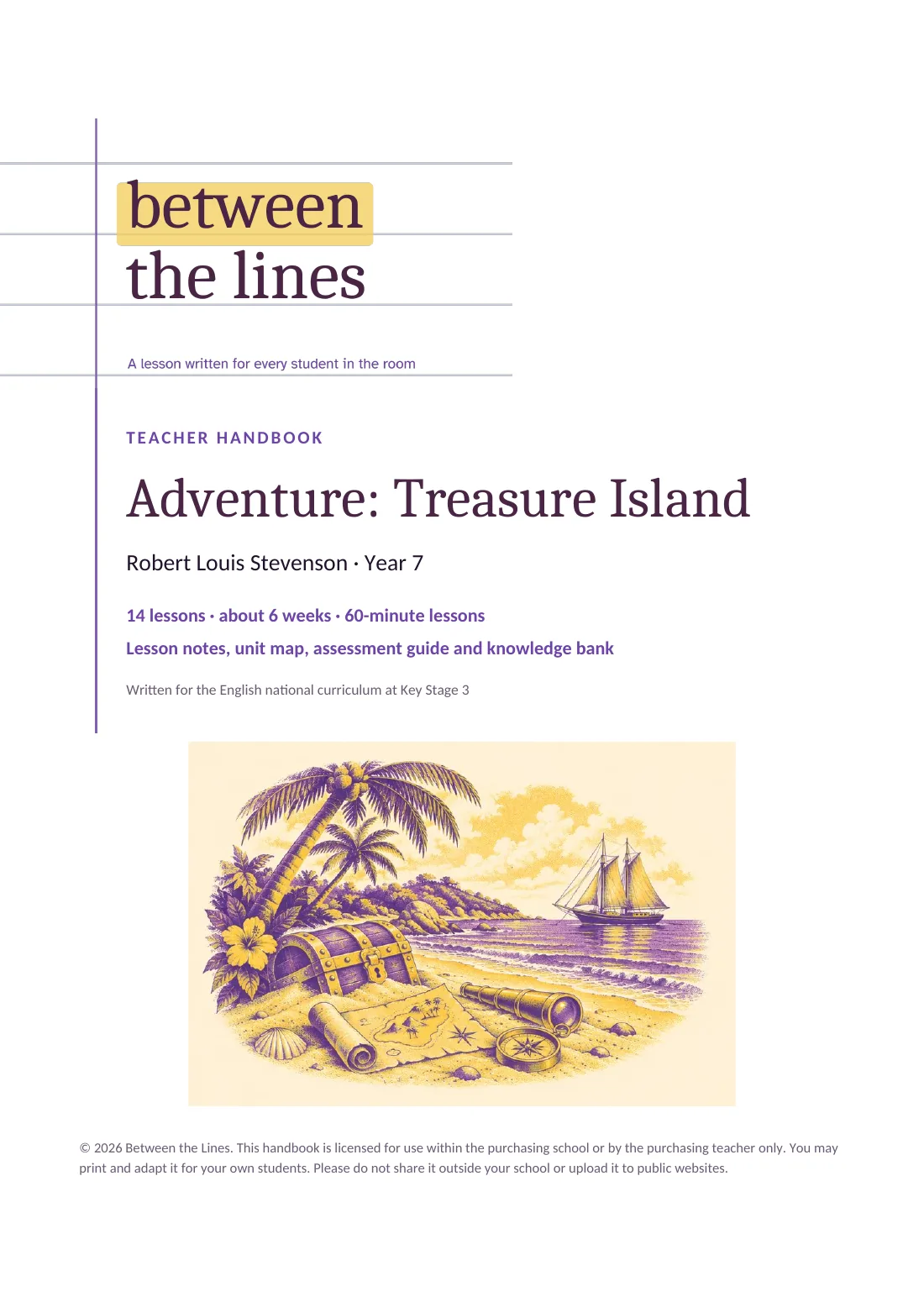 Teacher handbookCover
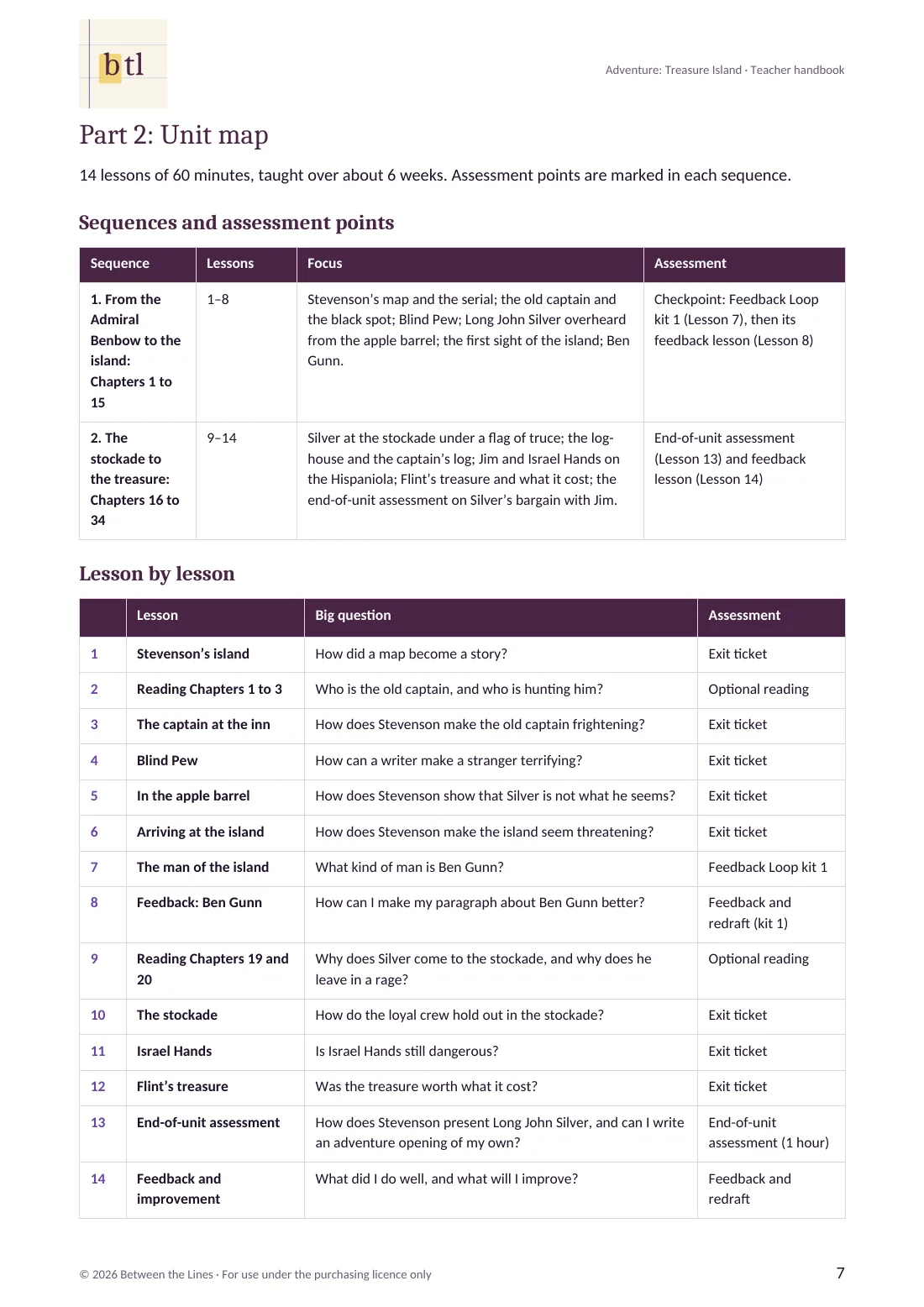 Lesson notesLesson 5 in the teacher handbook
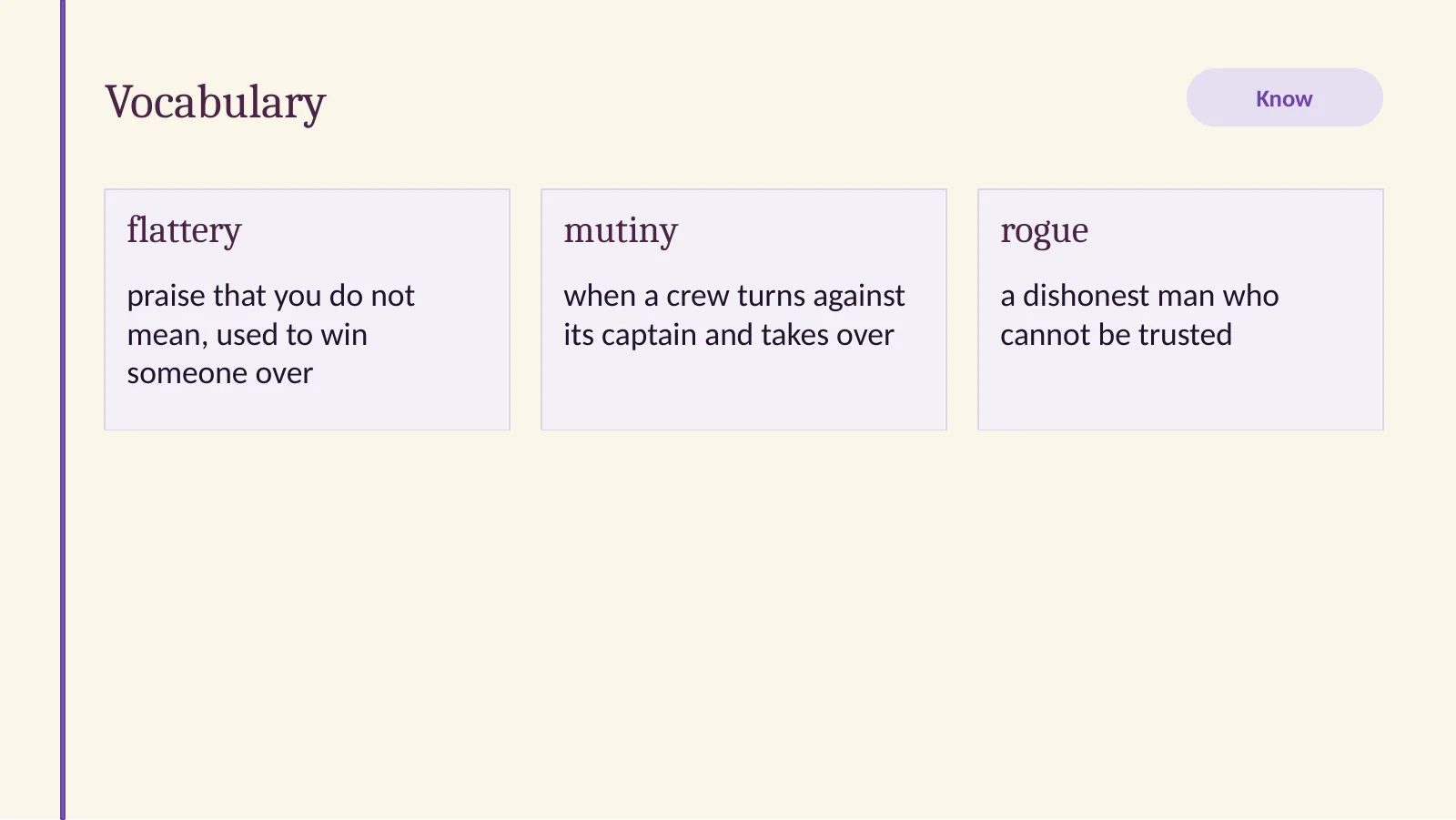 SlidesLesson 5: In the apple barrel
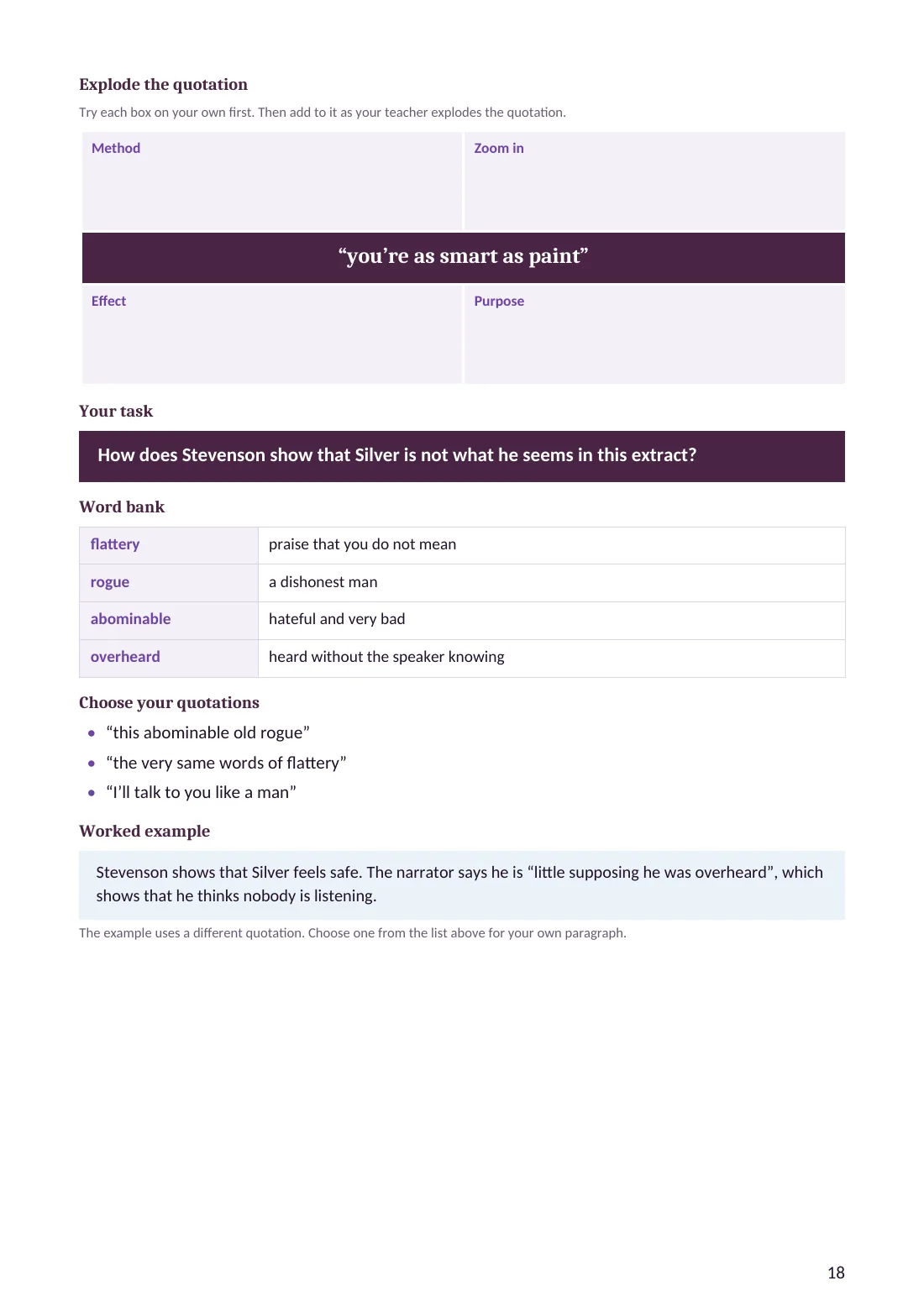 SecuringLesson 5 in the Securing student pack
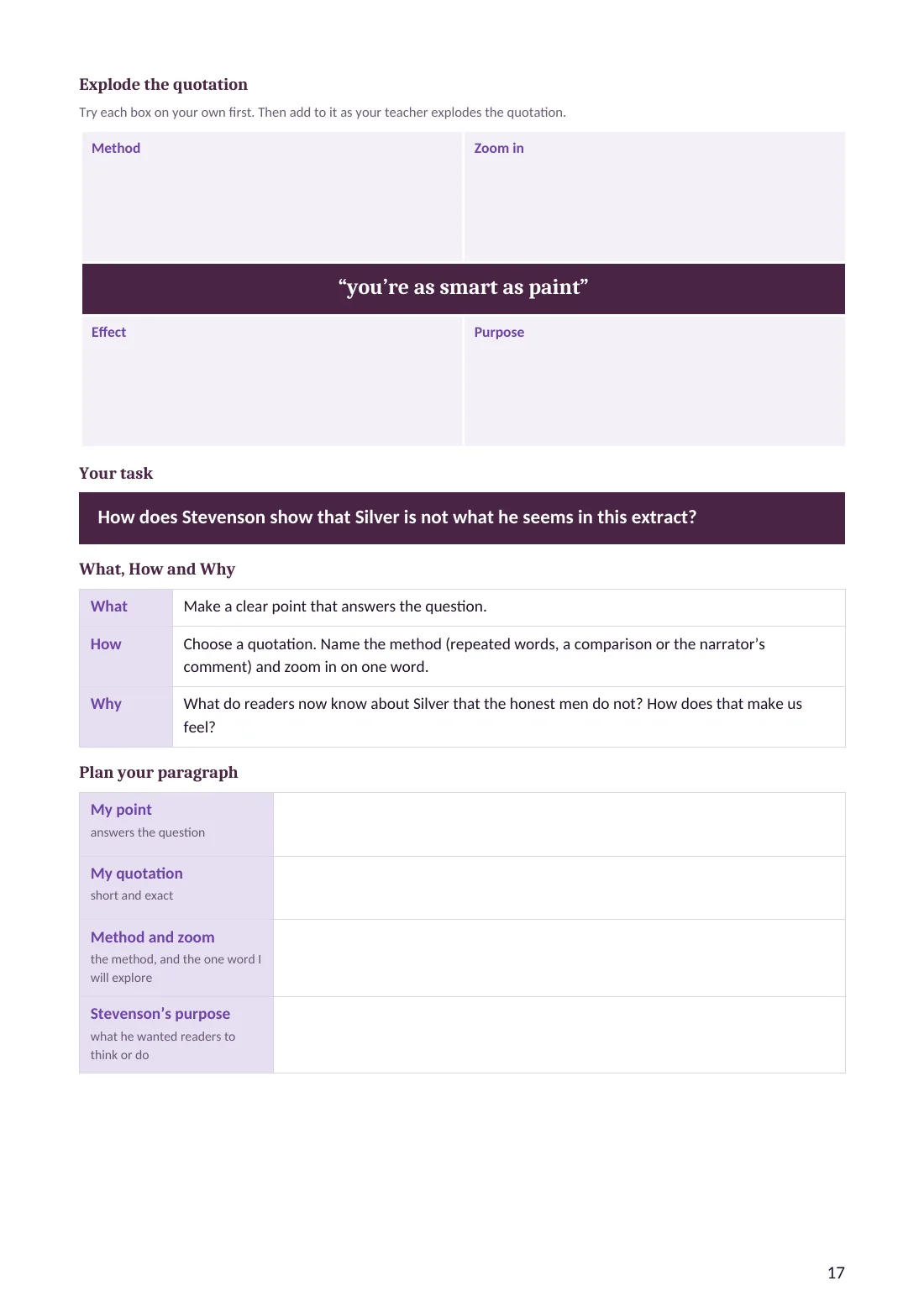 StrengtheningLesson 5 in the Strengthening student pack
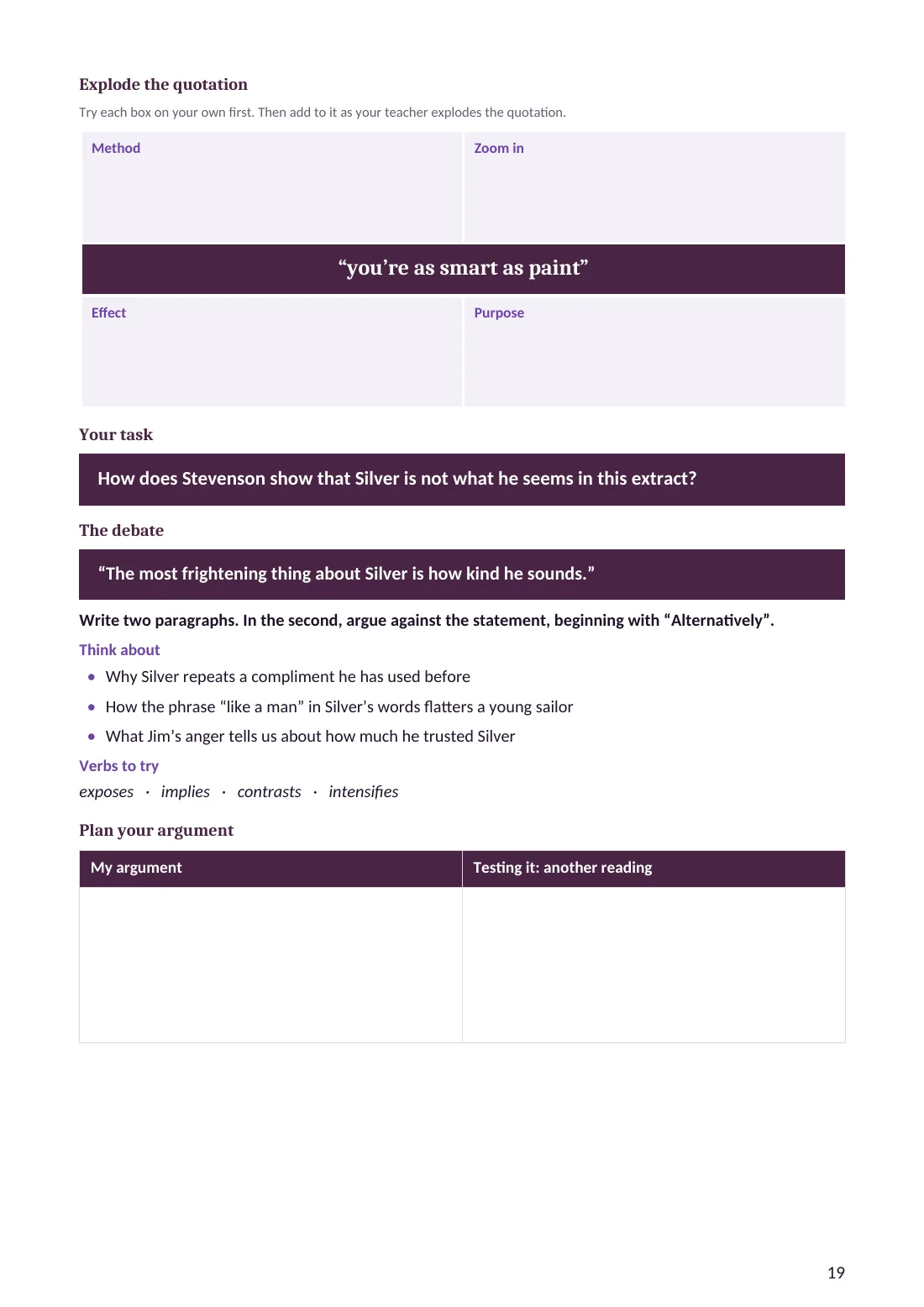 SoaringLesson 5 in the Soaring student pack
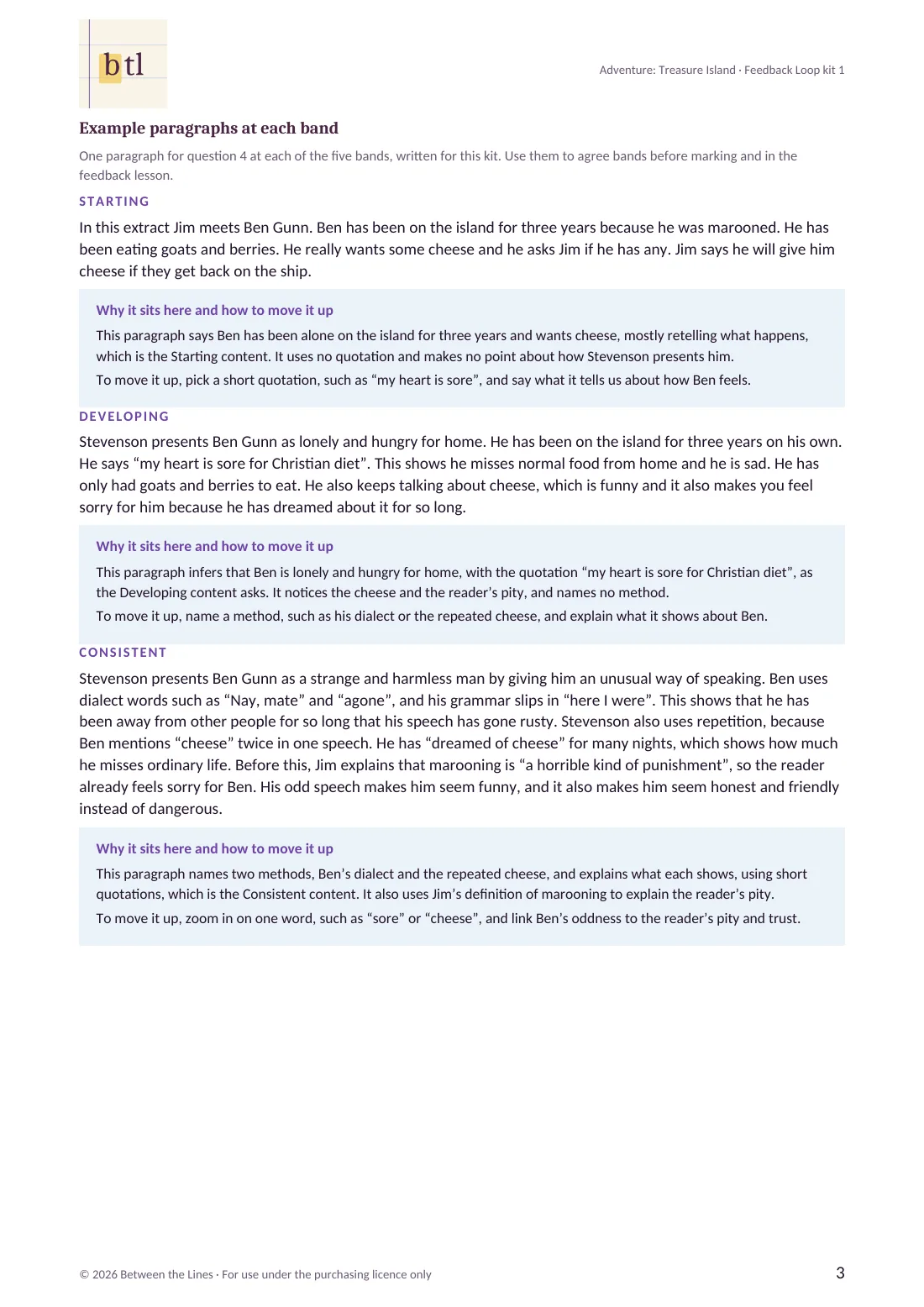 Feedback Loop kitThe checkpoint in Lesson 7
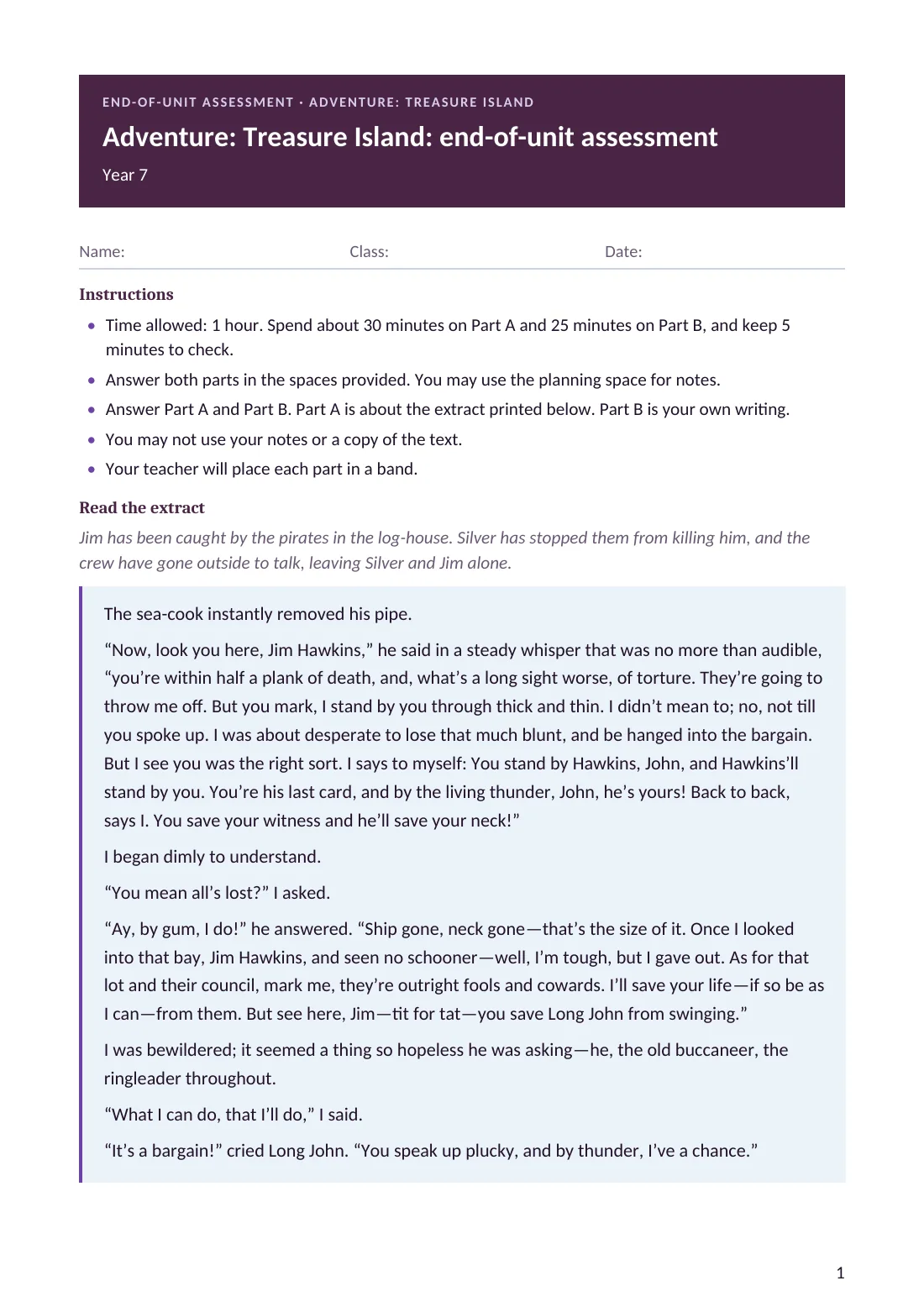 End-of-unit assessmentPart A reading, Part B writing
What students learn
Students read a whole novel together, chapter by chapter, through a half-term. They follow Jim Hawkins from his mother’s inn on the coast to an island full of buried gold and men who would kill for it, and keep asking the big question: who can Jim trust? The close-study lessons stop at the moments that make the story: the old captain at the Admiral Benbow, Blind Pew on the road, Silver overheard from the apple barrel, the first sight of the island, Ben Gunn, the stockade, Israel Hands in the rigging and the treasure itself. Along the way students learn how Stevenson came to write the book and how a ship’s crew worked. Every close-study lesson ends in one shared writing task at three levels of support, alternating What–How–Why paragraphs with a description, a ship’s log and a story opening, so students practise both the reading and the writing that the end-of-unit assessment asks for.
By the end of the unit, students can
- Explain how Stevenson came to write Treasure Island and how a ship’s crew in the 1700s was organised
- Retell the main events of the novel in order, from the captain’s arrival at the inn to the voyage home
- Analyse how Stevenson presents characters and the island, using short exact quotations
- Write What–How–Why paragraphs that name a method and zoom in on one word
- Write a description, a ship’s log entry and a story opening set in the world of the novel
Where it fits
Builds on: Primary school reading of whole novels and adventure stories; retrieving and inferring from a passage with evidence; writing stories and descriptions in paragraphs. Many Year 7 students already know pirates from films and picture books, and this unit sets those pictures beside Stevenson’s own pirates.
Leads to: Longer novels and short stories from the nineteenth century in Years 8 and 9; paragraphs about character and setting that follow a whole text; narrative writing with a clear first-person narrator, suspense and description used with control.
Two sequences, 14 lessons
The checkpoint, its feedback lesson and the end-of-unit assessment are planned into the sequence. Open a sequence to see its lessons. Lesson 5 is free.
From the Admiral Benbow to the island: Chapters 1 to 15Lessons 1 to 8
- 1Stevenson’s islandHow did a map become a story?
- 2Reading Chapters 1 to 3Reading lessonWho is the old captain, and who is hunting him?
- 3The captain at the innHow does Stevenson make the old captain frightening?
- 4Blind PewHow can a writer make a stranger terrifying?
- 5In the apple barrelFreeHow does Stevenson show that Silver is not what he seems?
- 6Arriving at the islandHow does Stevenson make the island seem threatening?
- 7The man of the islandFeedback Loop kit 1What kind of man is Ben Gunn?
- 8Feedback: Ben GunnReview lessonHow can I make my paragraph about Ben Gunn better?
The stockade to the treasure: Chapters 16 to 34Lessons 9 to 14
- 9Reading Chapters 19 and 20Reading lessonWhy does Silver come to the stockade, and why does he leave in a rage?
- 10The stockadeHow do the loyal crew hold out in the stockade?
- 11Israel HandsIs Israel Hands still dangerous?
- 12Flint’s treasureWas the treasure worth what it cost?
- 13End-of-unit assessmentEnd-of-unit assessmentHow does Stevenson present Long John Silver, and can I write an adventure opening of my own?
- 14Feedback and improvementFeedback lessonWhat did I do well, and what will I improve?
Assessment without grades
End-of-unit assessment (Lesson 13): Part A, a reading response to a printed extract; Part B, a piece of the student’s own writing. One hour.
Each part is placed in one of five bands that describe the work (Starting, Developing, Consistent, Confident, Assured), using the Year 7 reading and writing grids and our indicative content for the task. Nothing is scored. The checkpoint in Lesson 7 is one What–How–Why paragraph, placed in a band in the same way.
- Starting
- Developing
- Consistent
- Confident
- Assured
The bands describe the work, never the student. Key Stage 3 has no GCSE grades or marks in our schemes.
Buy the scheme
Both licences include every file in the scheme, as editable Word and PowerPoint files with a PDF copy of each.
One teacher
For your own classes
£40incl. VAT
- Print and adapt for your own students
- Put it on your school’s own secure learning platform
- Upgrade to a school licence for the difference before VAT
School
Every teacher and student at one school
£100+ VAT
- Print and adapt for every class in the school
- Put it on your school’s own secure learning platform
- Each further school in the same trust pays half
Planning the whole year? The Year 7 school bundle has all six schemes, the year plan and the end-of-year assessment for £480 + VAT.
Both licences include 10 folders: see what is in each
- 00Start here6 pages: how the scheme fits together
- 01Teacher handbook64 pages: intent, unit map, lesson notes and the assessment guide
- 02Slides14 PowerPoint decks with teacher notes, and a PDF copy of each
- 03Student bookletEvery lesson with the Securing, Strengthening and Soaring support side by side, 45 pages, plus one pack per level for set classes
- 04Independent practiceAll three levels in one booklet, 45 pages, plus one booklet per level
- 05Feedback Loop kitThe Lesson 7 checkpoint and its whole-class feedback lesson, 8 pages
- 06End-of-unit assessmentThe assessment paper and a teacher guide with the band grids
- 09Missed a lessonA catch-up sheet for every lesson
- 10InclusionNotes for students with SEND, students learning English and pupil premium students, and a key words list
- 11Talk routinesSixteen routines for spoken English in any lesson, with steps, sentence stems and a student sheet
To pay by invoice, to upgrade a teacher licence, or to license another school in your trust at half price, email hello@btl.education. Please don’t share the files outside your school or upload them to public websites. Licence terms
Extracts from Treasure Island are taken from the public-domain text of the novel (1883), in the free Standard Ebooks edition. That edition uses American spelling, so a few extracts print "saber", "defense", "amphitheater", "labor" and "colors"; we copy them as printed.
Teach Lesson 5 of Adventure: Treasure Island, free
One complete lesson from every Key Stage 3 scheme: the slides with teacher notes, and the teacher notes and student pages at Securing, Strengthening and Soaring. Choose a scheme and we email you the files straight away.
The rest of Year 7
- Heroes and monsters: The Odyssey Autumn 1
- Dickens’s London: Oliver Twist Autumn 2
- Ballads and story poems Spring 1
- A Midsummer Night’s Dream Spring 2
- Journeys Summer 1
Get our emails
About once a month: new free resources and the dates that matter for GCSE English.