Knowledge hub › For students › The Charge of the Light Brigade
The Charge of the Light Brigade: GCSE poem guide
Six hundred horsemen ride into a valley of guns because someone gave the wrong order. Here is what happens in each stanza, how Tennyson makes the poem gallop and the lines worth learning.
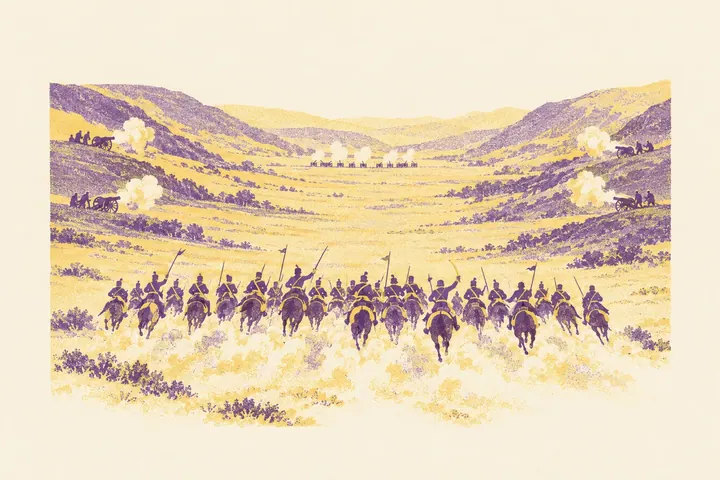
Alfred, Lord Tennyson (1809 to 1892) was Poet Laureate, the nation’s official poet, when he wrote ‘The Charge of the Light Brigade’. It describes a real event in the Crimean War, when Britain and France fought on the side of the Ottoman Empire against Russia. At the Battle of Balaclava, on 25 October 1854, a confused order sent the Light Brigade, a force of cavalry (soldiers on horseback), charging down a valley at the Russian guns. The National Army Museum says that 247 of the 673 men who rode in the charge were killed or wounded.
- 673men in the Light Brigade who rode in the chargeNational Army Museum
- 247of them killed or woundedNational Army Museum
Tennyson was not there. He read about the battle in The Times, and his poem was published in The Examiner on 9 December 1854, about six weeks after the charge.
Read the transcript
This is ‘The Charge of the Light Brigade’ by Alfred, Lord Tennyson, from the Power and Conflict cluster of the AQA anthology. I’m Hannah, and I teach English. The question we’ll answer: How does every part of ‘The Charge of the Light Brigade’ turn a military mistake into a story of courage? We’ll go through the context, the poem section by section, one quotation explored closely, a model paragraph, the quotations to learn and which poems to compare it with. First, the context.
The Crimean War. In 1854 Britain was at war with Russia in the Crimea. At the Battle of Balaclava, a mistaken order sent about six hundred cavalrymen of the Light Brigade to charge the Russian guns. News from the front. People in Britain read about the battle in newspaper reports, so Tennyson’s readers already knew the outline of the story before they read his poem.
The Poet Laureate. Tennyson was Poet Laureate, the poet chosen to write for the nation. He wrote ‘The Charge of the Light Brigade’ only weeks after the battle. A disaster made heroic. The poem admits that someone made a mistake, then moves straight on to the soldiers’ obedience and courage, and ends by telling readers to honour them.
Here’s the poem. Read it with me. Half a league, half a league, Half a league onward, All in the valley of Death Rode the six hundred. “Forward, the Light Brigade! Charge for the guns!” he said.
Into the valley of Death Rode the six hundred. “Forward, the Light Brigade!” Was there a man dismayed? Not though the soldier knew Someone had blundered. Theirs not to make reply, Theirs not to reason why, Theirs but to do and die. Into the valley of Death Rode the six hundred.
Cannon to right of them, Cannon to left of them, Cannon in front of them Volleyed and thundered; Stormed at with shot and shell, Boldly they rode and well, Into the jaws of Death, Into the mouth of hell Rode the six hundred. Flashed all their sabres bare, Flashed as they turned in air Sabring the gunners there, Charging an army, while All the world wondered. Plunged in the battery-smoke Right through the line they broke; Cossack and Russian Reeled from the sabre stroke Shattered and sundered. Then they rode back, but not Not the six hundred. Cannon to right of them, Cannon to left of them, Cannon behind them Volleyed and thundered; Stormed at with shot and shell, While horse and hero fell.
They that had fought so well Came through the jaws of Death, Back from the mouth of hell, All that was left of them, Left of six hundred. When can their glory fade? O the wild charge they made! All the world wondered. Honour the charge they made!
Honour the Light Brigade, Noble six hundred! Lines 1 to 8: Into the valley. “Half a league, half a league,”. Repetition in a falling dactylic rhythm (one stressed syllable, two unstressed) that sounds like galloping hooves. The poem starts at full speed.
“All in the valley of Death”. A metaphor: the valley belongs to Death, written with a capital letter as if Death were a person waiting for them. The reader knows the danger at once. “Charge for the guns!”. he said.” The order comes from an unnamed “he”.
Writing for the nation weeks after Balaclava, Tennyson gives the order and moves on without naming any officer. “Rode the six hundred.”. The men are named only by their number, so they ride as one body. The reader sees a united group, all equally brave. Lines 9 to 17: The blunder.
“Was there a man dismayed?”. A rhetorical question with the answer no. Tennyson wants the reader to see that not one soldier lost his nerve. “Someone had blundered.”. At Balaclava a mistaken order sent the brigade at the guns.
The pronoun “Someone” admits the error to readers who knew the story, but blames no one. “Theirs not to make reply,”. Anaphora: “Theirs” opens three lines in a row in a short, firm beat, like a drill. The repeated negatives leave the soldiers no voice and no choice. “Theirs but to do and die.”.
Alliteration ties “do” to “die”: duty leads straight to death. The reader admires their obedience and may also feel uneasy that they had to die for a mistake. Lines 18 to 26: Surrounded by cannon. “Cannon to right of them,”. Three lines begin with “Cannon”, one for each side.
The structure traps the men on the page as the guns trap them in the valley. “Stormed at with shot and shell,”. Sibilance and the verbs “Volleyed and thundered” make the gunfire sound like a storm, a force of nature the men cannot stop. “Into the jaws of Death,”. Metaphor: Death is a beast with “jaws” and a “mouth”, and the riders go straight in.
The parallel lines speed them towards it. “Boldly they rode and well,”. In the middle of the gunfire Tennyson stops to praise them. The adverbs “Boldly” and “well” ask the reader to see skill and courage, whatever the odds. Lines 27 to 38: At the guns.
“Shattered and sundered.”. Two violent past participles joined by sibilance. The sound breaks apart like the enemy line it describes. Lines 39 to 49: The ride back. “Cannon behind them”.
Stanza 3 returns with one change: “behind” replaces “in front of”. The same structure carries the men back through the guns. “While horse and hero fell.”. The noun “hero” turns every man who falls into a hero. Tennyson asks the reader to grieve and admire at once.
“Came through the jaws of Death,”. The metaphor of stanza 3 is repeated, but “Into” becomes “through” and “Back from”. The survivors have passed through death and out again. “Left of six hundred.”. Tennyson never says how many came back.
Readers who had followed the newspaper reports already knew that many had not. And lines 50 to 55. “When can their glory fade?”. A rhetorical question that expects the answer never. The poem moves from the battle to how the men will be remembered.
“O the wild charge they made!”. An exclamation opened by “O”. The adjective “wild” suggests both thrilling daring and recklessness. “Honour the Light Brigade,”. Imperative verbs: “Honour” opens two lines and commands the reader directly.
The poem ends by telling us what to feel. So, to sum it up in one sentence: Tennyson admits that someone blundered, then uses a galloping rhythm, the repeated “six hundred” and commands to honour the men, so readers feel pride in the soldiers’ obedience and courage more than anger at the mistake. One quotation, explored closely: “Theirs not to reason why”. Try it yourself first: method, zoom in, effect, and the context or purpose. Method: Repetition at the start of three lines in a row, in a short, firm rhythm.
Zoom in: “reason” means to think and question. The soldiers do not question the order; their duty is to obey. Effect: The reader admires their obedience, and may also feel uneasy that they rode to death without asking why. Context: Tennyson was Poet Laureate, writing weeks after the Battle of Balaclava for a public who read newspaper reports of it. He praises the men and says little about who gave the order.
And here’s a model What–How–Why paragraph for the question: How does Tennyson present the soldiers of the Light Brigade as heroes? Tennyson presents the soldiers as heroes whose courage matters more than the mistake that killed them. He admits in one short line that someone had blundered, then turns at once to the men: “Theirs not to reason why” and “Theirs but to do and die”. The dactylic rhythm carries them forward, and the metaphor “Into the jaws of Death” makes the Russian guns a monster that they ride into anyway. The final stanza becomes commands to the reader: “Honour the Light Brigade”.
Tennyson was Poet Laureate, writing weeks after the Battle of Balaclava for a public who had read newspaper reports of the battle. He wants readers to mourn and admire the men, and the closing “Noble six hundred” turns a blunder into a story of glory. The quotations from ‘The Charge of the Light Brigade’ worth learning by heart. “Someone had blundered”. Tennyson admits the mistake, then moves straight on to the soldiers’ courage.
“Theirs not to reason why”. Obedience is praised, and the reader may question it. In our scheme, ‘The Charge of the Light Brigade’ is compared with ‘Bayonet Charge’. The question: How do Tennyson and Hughes present soldiers in the moment of battle? In the exam you choose your own second poem, so have two or three ready for each theme.
Everything in this video comes from our Power and Conflict poetry scheme of learning for schools. If you’re a teacher, Lesson 3 of every scheme is free at btl.education. Thank you for watching.
What happens in the poem
- Stanza 1: the six hundred ride forward into “the valley of Death”. Their commander gives the order to charge the guns.
- Stanza 2: none of the men is afraid, even though they know “Someone had blundered”. It is not their place to argue or ask why: their job is to obey and die.
- Stanza 3: cannon fire at them from the right, the left and the front. They ride bravely on, “Into the jaws of Death”.
- Stanza 4: they reach the guns, slash at the gunners with their swords and break through the Russian line. Then they ride back, but far fewer of them.
- Stanza 5: the cannon now fire from behind. Horses and men fall. Only what is “left of six hundred” comes back.
- Stanza 6: the speaker asks when their glory can fade, and tells the reader to honour them.
The main ideas
Courage and duty. The soldiers obey an order they know is wrong and ride on without fear. Tennyson praises them for it.
Leaders make mistakes, and soldiers pay. “Someone had blundered” is a short, plain admission. Tennyson does not name who, and moves straight back to the men.
Glory. The last stanza turns the disaster into a story of honour. The poem tells the public how to remember the men.
Obedience. “Theirs not to reason why” can be read as praise for loyal soldiers, or as a question about men sent to die without being allowed to ask why. You can argue either reading, as long as you back it up.
How Tennyson does it
Rhythm: the sound of galloping
Most lines have two beats, each followed by two light syllables: HALF a league, HALF a league. This is a dactyl (one stressed syllable and two unstressed ones). The rhythm sounds like horses galloping, so the reader is carried along with the charge.
Structure: repetition and a changing refrain
Every stanza ends with the number six hundred, and the words around it change: “Rode the six hundred”, then “Not the six hundred”, then “Left of six hundred”, then “Noble six hundred!” The refrain tracks what happens to the men, from charge, to losses, to honour.
The stanzas are different lengths, and stanza 4, where the men reach the guns, is the longest, at twelve lines. The order of the cannon changes too: in stanza 3 they are “in front of them”, and in stanza 5 they are “behind them”, so we know the survivors are on their way back.
Language: one word zoomed in each time
“Half a league, half a league”. A league is about three miles. Zoom in on “Half”: the repetition makes the distance feel long, and it starts the galloping beat.
“Someone had blundered.” Zoom in on “blundered”: a blunder is a clumsy, stupid mistake. It is a surprisingly blunt word in a poem of praise.
“Theirs not to reason why, / Theirs but to do and die.” Anaphora (the same word starting several lines) and rhyme make the soldiers’ duty sound like a rule. Zoom in on “die”: obeying means dying, and the rhyme with “why” makes that sound fixed.
“Into the jaws of Death, / Into the mouth of hell”. Personification turns the valley into a huge monster swallowing the men. Zoom in on “jaws”: the guns on both sides close in like teeth.
“Volleyed and thundered”. Zoom in on “thundered”: onomatopoeia (a word that sounds like its meaning). The guns are as loud and as deadly as a storm.
“Honour the charge they made!” An imperative (an order), this time aimed at the reader. Zoom in on “Honour”: the poem ends by telling us what to feel.
Context that matters
As Poet Laureate, Tennyson wrote for a public who read about the war in the newspapers. The poem tells that public to see the men as heroes, even though the charge was a disaster.
The phrase “the valley of Death” echoes Psalm 23 in the Bible: “the valley of the shadow of death”. Tennyson’s first readers would have known it well. It gives the charge a religious feeling, as if the men were walking through death itself.
Use context like this in a sentence or two, to explain Tennyson’s purpose. Using context in your answers shows how.
Poems to compare it with
- Bayonet Charge: two charges at the enemy. Tennyson shows a brave group with one purpose. Hughes shows one terrified soldier who forgets why he is running.
- Exposure: Owen wrote that his book was “not about heroes”, and his soldiers die slowly with nothing happening. Tennyson’s die in a rush of glory.
- Remains: soldiers obey orders in both poems. Tennyson stops at the glory. Armitage follows one soldier home and shows the guilt that stays with him.
- War Photographer: both are about how people at home learn about war. Tennyson read the newspaper, and Duffy writes about the photographs in one.
How to compare two poems shows how to turn a pair into an answer.
Lines to learn
- “Into the valley of Death / Rode the six hundred.” (the speaker, stanza 1). The refrain, with a religious echo.
- “Someone had blundered.” (the speaker, stanza 2). A blunt admission of the mistake.
- “Theirs not to reason why, / Theirs but to do and die.” (the speaker, stanza 2). Duty is obedience, even to death.
- “Cannon to right of them, / Cannon to left of them,” (the speaker, stanza 3). Repetition traps the men between the guns.
- “Into the jaws of Death, / Into the mouth of hell” (the speaker, stanza 3). The valley becomes a monster.
- “Then they rode back, but not / Not the six hundred.” (the speaker, stanza 4). The repeated “not” shows how many are missing.
- “When can their glory fade?” (the speaker, stanza 6). A rhetorical question: the answer is never.
- “Honour the charge they made!” (the speaker, stanza 6). The poem ends by telling the reader what to feel.
Test yourself
8 quotations from this page. For each one, choose who says it and where it comes from. Ten at a time, in a new order every round.
Where is it? Open each quotation to check your answer.
“Into the valley of Death / Rode the six hundred.”
The speaker, stanza 1
“Someone had blundered.”
The speaker, stanza 2
“Theirs not to reason why, / Theirs but to do and die.”
The speaker, stanza 2
“Cannon to right of them, / Cannon to left of them,”
The speaker, stanza 3
“Into the jaws of Death, / Into the mouth of hell”
The speaker, stanza 3
“Then they rode back, but not / Not the six hundred.”
The speaker, stanza 4
“When can their glory fade?”
The speaker, stanza 6
“Honour the charge they made!”
The speaker, stanza 6
Frequently asked questions
What is The Charge of the Light Brigade about?
At the Battle of Balaclava in 1854, during the Crimean War, a mistaken order sent the Light Brigade charging down a valley at the Russian guns. Tennyson tells the story of the charge and asks the reader to honour the men’s courage.
Is The Charge of the Light Brigade for or against war?
Tennyson mostly praises the soldiers’ courage and tells the reader to honour them. But he also admits that “Someone had blundered”, so you can argue that the poem questions the leaders while it honours the men.
How many soldiers died in the Charge of the Light Brigade?
The poem says six hundred rode. The National Army Museum says 247 of the 673 men were killed or wounded.
What poems compare well with The Charge of the Light Brigade?
‘Bayonet Charge’ is the closest match: two charges, one heroic and one terrified. ‘Exposure’ and ‘Remains’ show war without the glory.
Sources
- National Army Museum, Crimean War (the Battle of Balaclava, the order and the losses of the Light Brigade)
- Edgar Shannon and Christopher Ricks, ‘The Charge of the Light Brigade: The Creation of a Poem’, Studies in Bibliography, volume 38 (1985) (The Times as Tennyson’s source, and first publication in The Examiner, 9 December 1854)
- Poetry Foundation, Alfred, Lord Tennyson
- Project Gutenberg, The King James Bible (Psalm 23)
- Project Gutenberg, Wilfred Owen, Poems (Owen’s preface)
- AQA, GCSE English Literature 8702 specification (Paper 2, Section B)