Knowledge hub › For students › Storm on the Island
Storm on the Island by Seamus Heaney: GCSE poem guide
An island community feels ready for the weather, until the storm arrives. What happens in the poem, how Heaney builds the fear, and which poems to compare it with.
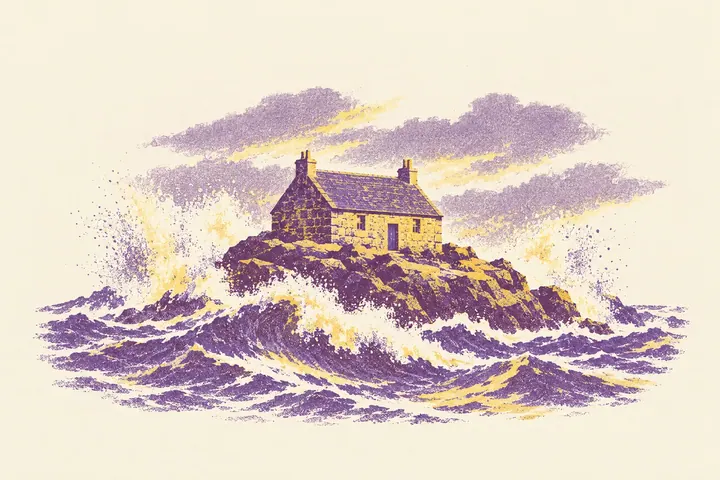
‘Storm on the Island’ is by Seamus Heaney. It comes from his first collection, Death of a Naturalist, published in 1966. It is one of the fifteen poems in AQA’s Power and Conflict cluster, and one of the nine still in copyright, so we quote only a few short phrases here. Read the whole poem in your anthology.
The poem is about the power of nature. An islander speaks for the whole community, and at first he sounds calm and sure of himself. By the last line he admits that they are all afraid of something they cannot even see.
Read the transcript
This is ‘Storm on the Island’ by Seamus Heaney, from the Power and Conflict cluster of the AQA anthology. I’m Hannah, and I teach English. The question we’ll answer: How does every part of ‘Storm on the Island’ turn a community’s confidence into fear? We’ll go through the context, the poem section by section, one quotation explored closely, a model paragraph, the quotations to learn and which poems to compare it with. First, the context.
A farming childhood. Seamus Heaney was born in 1939 and grew up on a farm in County Derry, Northern Ireland. Many of his early poems use the words and work of farm life. His first collection. ‘Storm on the Island’ comes from Death of a Naturalist (1966), Heaney’s first collection, which draws on his rural childhood and often shows nature as harsh and frightening.
A possible second meaning. The title can be heard as ‘Stormont’, the Northern Ireland parliament building. Some readers find political tension in the poem; this is one reading, and the poem works first as a poem about a storm. Later life. Heaney won the Nobel Prize in Literature in 1995 and died in 2013.
‘Storm on the Island’ is still in copyright, so I won’t read it here. Open your anthology at the poem and read it twice: once for what happens, once for who is speaking and what changes. Lines 1 to 5: We are prepared. “We are prepared”. A confident opening statement in the first person plural.
The speaker talks for the whole community, sure that they are ready for anything. “build our houses squat”. The adjective squat (low and wide) shows houses built to sit tight against the wind. The present tense makes this a habit of island life. “The wizened earth”.
Personification: the earth is old and wrinkled like a face. The land is too poor to grow crops, so there is little to lose. “stooks that can be lost”. Heaney grew up on a farm. Words such as stacks and stooks (bundles of cut crops) come from the farming life he knew.
Lines 6 to 11: No trees for company. “you know what I mean”. Direct address in a chatty, spoken voice. The speaker talks to us like a neighbour, which makes the fear that follows feel real. “a tragic chorus in a gale”.
A metaphor from the theatre: trees in a storm would wail like the chorus in a tragedy. At least then the islanders could hear what they fear. “no natural shelter”. Heaney’s early poems often show rural life as hard. Here the island is bare: nature gives the islanders nothing to hide behind.
Lines 12 to 16: The sea turns savage. “the sea is company”. The speaker imagines a listener who thinks the sea is friendly. He corrects us: the familiar sea becomes the attacker. “Exploding comfortably”.
An oxymoron: a violent verb with a gentle adverb. From a distance the waves seem safe; up close they are a bomb. “spits like a tame cat”. A simile: the spray hits the windows like a pet that has turned wild. Something familiar becomes a threat, and the mood darkens.
And lines 17 to 19. “strafes invisibly”. War language: to strafe is to attack from low-flying aircraft with gunfire. The adverb invisibly makes the enemy impossible to see or fight. “Space is a salvo”.
A short sentence and a metaphor: a salvo is many guns fired at once. The sibilance (repeated s sounds) hisses like the wind. “bombarded by the empty air”. Heard as ‘Stormont’, the title opens a political reading of this war language. Keep it to one possible reading, tied to these words.
“a huge nothing that we fear”. The ending admits fear. The oxymoron huge nothing shows an enemy that is everywhere and yet invisible, and the confidence of “We are prepared” has gone. So, to sum it up in one sentence: Heaney shows a community that believes it is ready for any storm, then uses the language of war to show that an invisible enemy, the empty air, can still fill them with fear. One quotation, explored closely: “a huge nothing that we fear”.
Try it yourself first: method, zoom in, effect, and the context or purpose. Method: An oxymoron in the final line: something huge that is also nothing. Zoom in: “nothing” is the enemy. The wind is empty air, with no shape the islanders can see or fight. Effect: The poem ends on fear, and the reader feels how helpless the islanders are against something invisible.
Purpose: Heaney shows confidence draining away. The community that began with “We are prepared” now admits its fear. And here’s a model What–How–Why paragraph for the question: How does Heaney present the power of nature in ‘Storm on the Island’? In ‘Storm on the Island’, Heaney presents nature as an invisible army that breaks down a community’s confidence. The poem opens with “We are prepared”, a short, calm statement in the first person plural, as if the islanders speak with one voice.
Once the storm begins, Heaney uses a semantic field of war: the wind “strafes invisibly”, like a fighter plane firing on people below. Then “We are bombarded by the empty air”: the violent verb “bombarded” puts the islanders under siege, yet their attacker is only air. Heaney grew up on a farm in Northern Ireland, and he shows how small people are beside the power of nature. By the end the confidence has gone, and the last line admits that it is “a huge nothing that we fear”. The quotations from ‘Storm on the Island’ worth learning by heart.
“We are prepared”. A confident start that the storm will prove wrong. In our scheme, ‘Storm on the Island’ is compared with ‘The Prelude’. The question: How do Wordsworth and Heaney present the power of nature over people? In the exam you choose your own second poem, so have two or three ready for each theme.
Everything in this video comes from our Power and Conflict poetry scheme of learning for schools. If you’re a teacher, Lesson 3 of every scheme is free at btl.education. If this helped, give the video a like and subscribe, so the next poem turns up in your feed. There’s another video on screen now to watch next. Thank you for watching.
What happens
The poem opens with a confident claim: the islanders are ready for storms. They build their houses low and strong, with solid walls and roofs, so the wind has little to grip.
Next the speaker lists what the island does not have. There are no haystacks or stooks (bundles of cut crops) for the wind to scatter, because the land is too poor to grow much. There are no trees either. He turns this bare land into a kind of comfort: with so little on the island, there is little to lose.
Then the storm arrives, and the mood changes. Trees, he says, would at least make a noise in a gale, so you could hear what you were afraid of. Here there is only silence and wind. A visitor might think the sea is good company, but in the storm it throws spray at the windows like a pet cat that has suddenly turned wild.
In the last few lines the language turns to war. The wind dives at the island like a fighter plane, and the islanders sit tight indoors while the empty air attacks them. The final line names what they fear: nothing. The wind has no shape, and nobody can fight it.
The main ideas
Nature is stronger than people. The islanders do everything they can to prepare, and it is not enough. Heaney shows human beings as small beside the forces of nature.
Confidence turns into fear. The poem moves from “We are prepared” at the start to “a huge nothing that we fear” at the end. Trace that change and you can explain the whole poem.
A community facing danger together. The speaker uses we, our and us all the way through. The fear belongs to everyone on the island, and nobody faces the storm alone.
Conflict. The war words bring human conflict into a poem about weather. Some readers link this to Northern Ireland (see Context below), but the poem works first as a poem about a storm.
Language, form and structure
The first person plural. “We are prepared” is short and calm. The word prepared suggests careful planning, as if the islanders have thought of everything.
Adjectives about the houses. The islanders “build our houses squat”. The word squat means short, wide and low to the ground. The houses crouch against the wind: the islanders know how dangerous storms can be.
Simile. The sea “spits like a tame cat” that has turned savage. The word tame is the surprise: a pet is something you trust. Heaney shows something familiar becoming a threat.
A semantic field of war. The wind “strafes invisibly”. To strafe is to attack with gunfire from a low-flying aircraft. The word invisibly is the frightening part: the islanders cannot see their enemy, so they cannot fight back. Soon after, the short sentence “Space is a salvo” turns the whole sky into guns firing at once, and the repeated s sounds hiss like the wind.
Oxymoron. The poem ends with “a huge nothing that we fear”. An oxymoron puts two opposite ideas together. The word nothing is the enemy: the wind is empty air, and yet it fills the whole island.
Form. The poem is one stanza of nineteen lines in blank verse: lines with a regular rhythm and no rhyme. There are no stanza breaks, so the poem gives the reader nowhere to pause or shelter, much like the bare island.
Structure. The words change as the poem goes on. The opening uses the language of farming and building. Once the storm begins, the language belongs to war. The change in words follows the change in mood, from calm to fear.
Context
Seamus Heaney was born in 1939 and grew up on a farm in County Derry, Northern Ireland. Many of his early poems use the words and work of farm life, and stooks and stacks in this poem come from that world. Death of a Naturalist was his first collection. He won the Nobel Prize in Literature in 1995 and died in 2013.
The title can be heard as Stormont, the building where Northern Ireland’s parliament meets. Some readers find political tension in the poem because of this and because of the war words. Treat it as one possible reading. Keep it to a sentence, and tie it to words in the poem.
Poems to compare it with
Exposure. Both poems show the weather as an enemy, using the language of attack. Owen’s soldiers freeze in a trench in the First World War; Heaney’s islanders shelter at home. Compare the poems’ methods, and keep any politics brief (see the myths below).
The Prelude. Both poems move from confidence to fear of nature. Wordsworth’s boy is alone and proud; Heaney’s islanders are a whole community, and they were never proud, only prepared.
Kamikaze. A useful contrast. In ‘Kamikaze’ the sea is beautiful and draws the pilot back towards life. In ‘Storm on the Island’ the sea turns on the people who live beside it.
For how to plan the comparison, read How to compare two poems.
Lines to learn
- “We are prepared” (the islander, the opening). A short, calm statement for the whole community. Remember it so you can show how far the mood has changed by the end.
- “build our houses squat” (the islander, the opening). The low houses show that the islanders respect the storm even before it arrives.
- “spits like a tame cat” (the islander, the middle). The familiar sea turns wild, and the mood darkens.
- “strafes invisibly” (the islander, the ending). War language for the wind: an attacker the islanders cannot see.
- “a huge nothing that we fear” (the islander, the ending). The oxymoron in the last line, and the moment the community admits its fear.
Test yourself
5 quotations from this page. For each one, choose who says it and where it comes from. Ten at a time, in a new order every round.
Where is it? Open each quotation to check your answer.
“We are prepared”
The islander, the opening
“build our houses squat”
The islander, the opening
“spits like a tame cat”
The islander, the middle
“strafes invisibly”
The islander, the ending
“a huge nothing that we fear”
The islander, the ending
Myths about Storm on the Island
Myth The poem is really about the conflict in Northern Ireland, so that is what you should write about.
What the evidence says
The title can be heard as Stormont, and the war words allow a political reading, but the poem works first as a poem about a storm. In 2025 AQA’s examiners found that students who compared it with ‘Exposure’ “were often less successful in trying to write about conflict in Northern Ireland”. Keep any political reading short and tied to the poem’s words.
Source: AQA, Report on the examination, Paper 2, June 2025
Frequently asked questions
What is Storm on the Island about?
An islander describes how his community prepares for storms, and then what happens when one arrives. Their confidence turns to fear as the wind and sea attack the island. Heaney shows that nature is stronger than people, however well they prepare.
Is Storm on the Island about Stormont?
The title can be heard as Stormont, the Northern Ireland parliament building, so some readers find a political meaning. It is one possible reading. Write about the storm first, and keep any political reading to a sentence tied to the poem’s words.
What is the form of Storm on the Island?
It is one stanza of nineteen lines of blank verse, which means a regular rhythm with no rhyme. It is not free verse. The single block of lines, with no breaks, suits a bare island with no shelter.
Which poem goes best with Storm on the Island in the exam?
‘Exposure’ and ‘The Prelude’ are the usual partners, because both show nature as stronger than people. ‘Kamikaze’ works as a contrast, because its sea is beautiful. Choose the poem that fits the focus of the question.
Sources
- AQA, GCSE English Literature 8702 specification (Paper 2, Section B)
- AQA, Report on the examination: Paper 2, June 2025
- Poetry Foundation, Seamus Heaney