Knowledge hub › For students › Exposure
Exposure by Wilfred Owen: GCSE poem guide
Soldiers wait through a freezing night in the trenches, and the weather is the enemy that kills them. Here is the poem stanza by stanza, how Owen makes us wait with them and the lines worth learning.
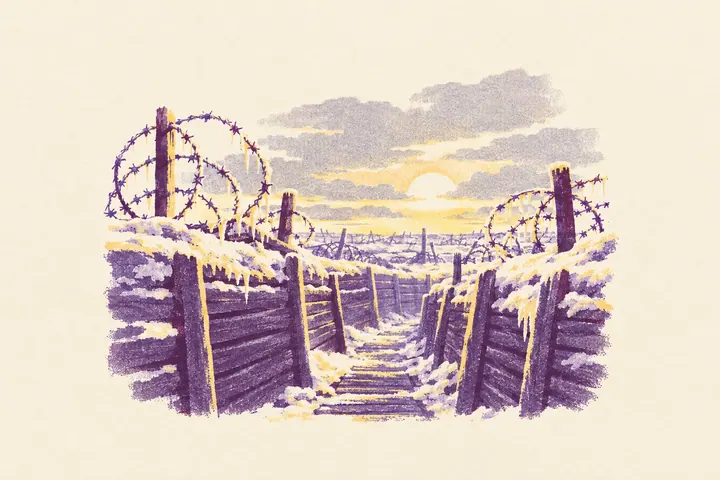
Wilfred Owen (1893 to 1918) was a soldier and a poet. He served as an officer on the Western Front in France from December 1916 until he was sent home in June 1917, so he spent a winter in the trenches. He went back to the front in 1918, won the Military Cross, and was killed on 4 November 1918, a week before the fighting stopped.
‘Exposure’ comes from that experience of winter in the trenches. Owen did not live to see his poems in a book: they were collected and published in 1920, with an introduction by his friend, the poet Siegfried Sassoon. In this guide we count the poem’s eight stanzas of five lines.
Read the transcript
This is ‘Exposure’ by Wilfred Owen, from the Power and Conflict cluster of the AQA anthology. I’m Hannah, and I teach English. The question we’ll answer: How does every part of ‘Exposure’ show soldiers worn down by cold and waiting? We’ll go through the context, the poem section by section, one quotation explored closely, a model paragraph and the quotations to learn. First, the context.
The Western Front. In the First World War (1914 to 1918), soldiers in France and Belgium spent weeks in trenches, often waiting for an attack that did not come. A soldier poet. Owen fought in the war. ‘Exposure’ describes soldiers in the trenches in the bitter winter of early 1917, where the cold is as deadly as the enemy.
Published after his death. Owen was killed in November 1918, a week before the war ended. Most of his poems were published after his death, so readers met them as the words of a soldier who did not come home. A double title. The men are exposed to wind, frost and snow, and the poem exposes to readers at home what the war was really like.
Here’s the poem. Read it with me. Our brains ache, in the merciless iced east winds that knive us . . .
Wearied we keep awake because the night is silent . . . Low, drooping flares confuse our memory of the salient . .
. Worried by silence, sentries whisper, curious, nervous, But nothing happens. Watching, we hear the mad gusts tugging on the wire, Like twitching agonies of men among its brambles. Northward, incessantly, the flickering gunnery rumbles, Far off, like a dull rumour of some other war. What are we doing here?
The poignant misery of dawn begins to grow . . . We only know war lasts, rain soaks, and clouds sag stormy. Dawn massing in the east her melancholy army Attacks once more in ranks on shivering ranks of grey, But nothing happens.
Sudden successive flights of bullets streak the silence. Less deadly than the air that shudders black with snow, With sidelong flowing flakes that flock, pause, and renew, We watch them wandering up and down the wind’s nonchalance, But nothing happens. Pale flakes with fingering stealth come feeling for our faces— We cringe in holes, back on forgotten dreams, and stare, snow-dazed, Deep into grassier ditches. So we drowse, sun-dozed, Littered with blossoms trickling where the blackbird fusses. —Is it that we are dying?
Slowly our ghosts drag home: glimpsing the sunk fires, glozed With crusted dark-red jewels; crickets jingle there; For hours the innocent mice rejoice: the house is theirs; Shutters and doors, all closed: on us the doors are closed,— We turn back to our dying. Since we believe not otherwise can kind fires burn; Nor ever suns smile true on child, or field, or fruit. For God’s invincible spring our love is made afraid; Therefore, not loath, we lie out here; therefore were born, For love of God seems dying. Tonight, this frost will fasten on this mud and us, Shrivelling many hands, puckering foreheads crisp. The burying-party, picks and shovels in shaking grasp, Pause over half-known faces.
All their eyes are ice, But nothing happens. Lines 1 to 10: Waiting in the cold. “But nothing happens.”. The short refrain ends the stanza flat. Repeated through the poem, it makes the waiting itself the horror.
Lines 11 to 20: Dawn and snow attack. “Attacks once more in ranks on shivering ranks of grey”. The repeated “ranks” lines the clouds up like rows of soldiers, and “shivering” gives the cold to the sky itself. Lines 21 to 30: Dreams of home. “So we drowse, sun-dozed,”.
Freezing men drift into warm dreams. Readers may sense the danger: falling asleep in the cold can mean dying. “Is it that we are dying?”. The question is quiet and calm. The reader feels the horror of men who cannot tell dreaming from dying.
And lines 31 to 40. “For love of God seems dying.”. The last short line of the stanza changes the pattern: faith itself now seems to be dying, along with the men. “Tonight, this frost will fasten on this mud and us,”. The verb “fasten” personifies the frost, gripping the men, and the future “will” makes their death sound certain.
So, to sum it up in one sentence: Owen shows soldiers in the winter of 1917 slowly killed by cold and endless waiting, so that readers at home understand that the weather and hopelessness were as deadly as the enemy’s guns. One quotation, explored closely: “merciless iced east winds that knive us”. Try it yourself first: method, zoom in, effect, and the context or purpose. Method: Personification, with sibilance in the hissing s sounds. Zoom in: “knive” turns a noun into a verb.
The wind stabs the men like a blade. Effect: The reader feels the cold cutting into the soldiers, and the s sounds hiss like the wind. Context: Owen fought in the First World War, and the poem describes the bitter winter of early 1917. The weather attacks as an enemy soldier would. And here’s a model What–How–Why paragraph for the question: How does Owen present the weather as an enemy in ‘Exposure’?
In ‘Exposure’, Owen presents the weather as a deadlier enemy than the guns, one that attacks slowly and never stops. The poem opens with “Our brains ache, in the merciless iced east winds that knive us”. The personified wind is cruel, and the brutal verb “knive” is made from a noun, so the cold stabs the men like a blade. Later, “Dawn massing in the east her melancholy army” turns daybreak into enemy troops. The refrain “But nothing happens” closes stanzas with a short line, so the waiting drags.
Owen fought in the First World War, and the poem describes the bitter winter of early 1917. He wants readers at home to see men dying of cold while they wait, and the question “What are we doing here?” makes the reader ask what the war is for. The quotations from ‘Exposure’ worth learning by heart. “But nothing happens”. The refrain: waiting, boredom and slow death in the cold.
“merciless iced east winds that knive us”. Personified weather attacks like an enemy soldier. Everything in this video comes from our Power and Conflict poetry scheme of learning for schools. If you’re a teacher, Lesson 3 of every scheme is free at btl.education. Thank you for watching.
What happens in the poem
- Stanza 1: the soldiers lie awake through a cold, silent night. The wind cuts into them. “But nothing happens.”
- Stanza 2: the wind tugs at the barbed wire. Far off, guns rumble like another war. The speaker asks, “What are we doing here?”
- Stanza 3: dawn comes, grey and miserable, like an enemy army gathering. Still nothing happens.
- Stanza 4: a burst of bullets breaks the silence, but the snow is more deadly than the bullets.
- Stanza 5: snowflakes touch their faces. The men drift into a dream of a sunny spring. The stanza ends with a question: “Is it that we are dying?”
- Stanza 6: in the dream, their ghosts go home. They see the fire and the house, but the doors are closed to them. They turn back to the trench, and to dying.
- Stanza 7: they believe they must stay and suffer so that home stays safe. But the stanza ends, “For love of God seems dying.”
- Stanza 8: tonight the frost will kill more of them. A burying party finds frozen bodies whose eyes have turned to ice. “But nothing happens.”
The main ideas
Nature is the deadliest enemy. The men barely see the other side. The cold, the wind and the snow attack and kill them.
War is boredom, waiting and slow suffering. The repeated “But nothing happens” shows days of misery without any action, still less any glory.
Soldiers feel forgotten. In stanza 6 the doors at home are “closed”. The men feel shut out of the life they are fighting for.
Faith is failing. By stanza 7 even the love of God “seems dying”. Owen asks what all this suffering is for.
How Owen does it
Form: half-rhymes that never settle
Each stanza has five lines, and the last one is short. The line endings almost rhyme, but not quite: “silent” and “salient”, “wire” and “war”, “silence” and “nonchalance”. This is half-rhyme (pararhyme, when the consonants match but the vowels change). The sounds never settle, just as the men never get any rest or relief.
Structure: a refrain and a lot of questions
“But nothing happens.” ends four of the eight stanzas. Each time, the reader waits with the men, and nothing comes. The other short last lines are mostly questions or thoughts about dying. They turn the waiting into fear.
The poem starts and ends in the trench. The dream of home in stanzas 5 and 6 is the only escape, and the doors shut on it.
Language: one word zoomed in each time
“the merciless iced east winds that knive us”. Personification: the wind attacks like a soldier with a knife. Zoom in on “merciless”: the weather shows no pity at all.
“What are we doing here?” A rhetorical question with no answer. Zoom in on “here”: the soldiers cannot see why they are in this place at all.
“Less deadly than the air that shudders black with snow”. Zoom in on “Less”: Owen says plainly that the bullets are less dangerous than the weather.
“Pale flakes with fingering stealth come feeling for our faces”. The snow is personified as a creeping enemy. Zoom in on “fingering”: the flakes feel their way over the men’s faces, like hands.
“All their eyes are ice”. Zoom in on “ice”: the dead men’s eyes are frozen. The cold has finished them.
Context that matters
Owen wrote a short preface for the book of poems he planned. It says “This book is not about heroes.” and “The Poetry is in the pity.” Exposure shows what he meant: no glory, only men suffering, written so that the reader feels pity for them.
Owen knew the trenches at first hand, while Tennyson wrote ‘The Charge of the Light Brigade’ at home from newspaper reports.
Using context in your answers shows how to use context in a sentence or two.
Myths about Exposure
Myth Exposure is a poem about bad weather.
What the evidence says
The weather is how Owen shows his ideas. When ‘Exposure’ was the named poem in 2025, AQA’s examiners found that the most successful answers started with “a ‘big idea’ from the poem, such as the horrific nature of trench warfare”. Less successful answers wrote mainly about the weather.
Source: AQA, Report on the examination, 8702/2, June 2025
Myth ‘Storm on the Island’ is the obvious poem to compare it with.
What the evidence says
The same report found that students who chose it “wrote about the weather in each”, but were often less successful when they tried to write about conflict in Northern Ireland. The pair can work, if you know what conflict means in Heaney’s poem. ‘Remains’ was the most popular second poem that year.
Source: AQA, Report on the examination, 8702/2, June 2025
Myth The more you write about one word, the better.
What the evidence says
The 2025 report warned about “the tendency to overuse single word analysis”. Zoom in on a word in a sentence or two, then step back to the method and the idea.
Source: AQA, Report on the examination, 8702/2, June 2025
Poems to compare it with
- Remains: the most popular partner in 2025. Owen’s men die slowly in the cold. Armitage’s soldier lives, but his memory will not leave him.
- Bayonet Charge: both are set in the First World War. Owen’s soldiers wait and nothing happens. Hughes’s soldier is thrown into sudden, terrifying action.
- The Charge of the Light Brigade: Tennyson praises glory and courage in battle. Owen shows the misery of waiting, and there are no heroes.
- Storm on the Island: nature as an enemy that attacks, in both poems. Have a clear idea of the conflict in each before you choose it.
How to compare two poems shows how to turn a pair into an answer.
Lines to learn
- “Our brains ache, in the merciless iced east winds that knive us” (the soldiers, stanza 1). The weather attacks like an enemy.
- “But nothing happens.” (the soldiers, stanza 1). The refrain that makes the reader wait with them.
- “What are we doing here?” (the soldiers, stanza 2). A question about the whole war.
- “Dawn massing in the east her melancholy army” (the soldiers, stanza 3). Personification: even the morning is an enemy, and “melancholy” means deep sadness.
- “Less deadly than the air that shudders black with snow” (the soldiers, stanza 4). The weather is worse than the bullets.
- “Is it that we are dying?” (the soldiers, stanza 5). The dream gives way to fear.
- “on us the doors are closed” (the soldiers, stanza 6). Shut out from home.
- “All their eyes are ice” (the soldiers, stanza 8). The cold has killed them.
Test yourself
8 quotations from this page. For each one, choose who says it and where it comes from. Ten at a time, in a new order every round.
Where is it? Open each quotation to check your answer.
“Our brains ache, in the merciless iced east winds that knive us”
The soldiers, stanza 1
“But nothing happens.”
The soldiers, stanza 1
“What are we doing here?”
The soldiers, stanza 2
“Dawn massing in the east her melancholy army”
The soldiers, stanza 3
“Less deadly than the air that shudders black with snow”
The soldiers, stanza 4
“Is it that we are dying?”
The soldiers, stanza 5
“on us the doors are closed”
The soldiers, stanza 6
“All their eyes are ice”
The soldiers, stanza 8
Frequently asked questions
What is the main message of Exposure by Wilfred Owen?
War is slow, miserable suffering, and nature is a deadlier enemy than the other side. The soldiers wait, freeze and die while “nothing happens”, and Owen wants the reader to feel pity for them.
Why does Owen repeat But nothing happens?
The line ends four of the eight stanzas. Each time, the reader waits with the soldiers and nothing comes, so we share their boredom and despair.
What poem should I compare with Exposure?
‘Remains’ and ‘Bayonet Charge’ were the most popular choices when ‘Exposure’ was set in 2025. ‘The Charge of the Light Brigade’ makes a strong contrast, glory against pity.
Sources
- Project Gutenberg, Wilfred Owen, Poems, with an introduction by Siegfried Sassoon (Owen’s service in France, his death on 4 November 1918, and his preface)
- Poetry Foundation, Wilfred Owen
- AQA, Report on the examination: Paper 2, June 2025 (‘Exposure’ as the named poem, popular second poems and single-word analysis)
- AQA, GCSE English Literature 8702 specification (Paper 2, Section B)