Knowledge hub › For students › Bayonet Charge
Bayonet Charge by Ted Hughes: GCSE poem guide
A soldier runs at the enemy, stops for one frozen moment to wonder why, then runs on in terror. What happens, how Hughes does it, and which poems to compare it with.
‘Bayonet Charge’ is by Ted Hughes. It was published in 1957 in his first collection, The Hawk in the Rain. It is one of the fifteen poems in AQA’s Power and Conflict cluster, and it is still in copyright, so we quote only short phrases here. Read the whole poem in your anthology.
The poem follows one soldier in the First World War through a few seconds of a charge across a field towards the enemy. A bayonet is a blade fixed to the end of a rifle. In those few seconds the soldier loses the ideals that sent him to war, and only fear is left.
Read the transcript
This is ‘Bayonet Charge’ by Ted Hughes, from the Power and Conflict cluster of the AQA anthology. I’m Hannah, and I teach English. The question we’ll answer: How does every part of ‘Bayonet Charge’ show a soldier’s beliefs giving way to terror? We’ll go through the context, the poem section by section, one quotation explored closely, a model paragraph, the quotations to learn and which poems to compare it with. First, the context.
The First World War. The war lasted from 1914 to November 1918 and killed millions of soldiers. On the Western Front, in Belgium and France, both sides dug long lines of trenches. A father’s war. Ted Hughes was born after the war, but his father fought in it and survived Gallipoli.
Hughes imagined the war a generation later, perhaps helped by his father’s memories. The Hawk in the Rain. ‘Bayonet Charge’ was published in Hughes’s first collection, The Hawk in the Rain (1957). Hughes was later Poet Laureate, from 1984 until his death in 1998. Against the glory of war.
Like Owen, Hughes turns against the older idea that war is glorious. His soldier stops believing the patriotic words he was given. ‘Bayonet Charge’ is still in copyright, so I won’t read it here. Open your anthology at the poem and read it twice: once for what happens, once for who is speaking and what changes. Lines 1 to 8: Running into fire.
“Suddenly he awoke and was running”. In medias res: the adverb “Suddenly” drops us into the charge with no build-up. The verb “awoke” suggests he has only now seen what war is. “raw-seamed hot khaki”. The uniform rubs and burns.
The soldier is a body in pain, sweating and stumbling, and the reader feels the charge physically. “smacking the belly out”. Personification: the air has a belly that bullets tear open. The harsh verb “smacking” makes the whole space around him violent. “The patriotic tear”.
The love of country that sent men to the First World War once brought a tear to his eye. In the charge it turns to sweat and burning heat. Lines 9 to 15: The frozen moment. “cold clockwork of the stars”. A metaphor: the war is a vast cold machine run by fate and by governments.
Hughes’s father was one soldier among millions in a war decided far above him. “jumped up in the dark”. A simile of someone woken in the night: he runs without knowing why. The reader sees a man who has lost the reason he came to fight. “Statuary in mid-stride”.
Enjambment leaves his foot hanging at the end of line 14, then the simile freezes him like a statue. Time stops for one moment of doubt. And lines 16 to 23. “rolled like a flame”. A simile: the yellow hare, thrown up by the shellfire, burns and writhes.
Nature is wrecked by the battle along with the men. “its eyes standing out”. The hare’s open, silent suffering mirrors the soldier’s. The reader may see in it the pain he cannot show, and every living thing hurt by war. “King, honour, human dignity, etcetera”.
These are the ideals soldiers of the First World War were told they fought for. Writing a generation later, Hughes cuts the list off with “etcetera”. “Dropped like luxuries”. A simile: the ideals are luxuries he can no longer afford. The verb “Dropped” shows him throwing them away as he runs.
“His terror’s touchy dynamite”. The poem ends on terror, an explosive about to go off. He keeps charging out of fear, with no belief left, and the reader is left uneasy. So, to sum it up in one sentence: Hughes follows one soldier through a single charge to show that patriotic ideals like king and honour fall away under fire, until only terror drives him on. One quotation, explored closely: “King, honour, human dignity, etcetera”.
Try it yourself first: method, zoom in, effect, and the context or purpose. Method: A list of the ideals that send men to war, ending in a throwaway word. Zoom in: “etcetera” cuts the list short. The great ideals become an afterthought that the soldier cannot be bothered to finish. Effect: The reader sees patriotism fall away.
In the moment of attack only fear and survival are left. Context: Hughes’s father fought in the First World War and survived Gallipoli. The poem questions the ideals that men were told they were fighting for. And here’s a model What–How–Why paragraph for the question: How does Hughes show the soldier’s patriotism disappearing in ‘Bayonet Charge’? Hughes shows patriotism as a feeling that cannot survive the reality of battle.
The soldier once felt “The patriotic tear”, and in stanza 1 it has turned to sweat and heat in his chest, so a noble emotion becomes physical pain. By stanza 3 the list “King, honour, human dignity, etcetera” is “Dropped like luxuries”. The dismissive adverb “etcetera” makes the ideals sound like an afterthought, and the simile suggests extras he cannot afford while he runs for his life. Hughes’s father fought in the First World War and survived Gallipoli. Hughes shows that in the moment of attack a soldier thinks only of escape, and the reader sees that the words used to send men to war mean little under fire.
The quotations from ‘Bayonet Charge’ worth learning by heart. “King, honour, human dignity, etcetera”. Patriotic ideals reduced to a list ending in ‘etcetera’. In our scheme, ‘Bayonet Charge’ is compared with ‘The Charge of the Light Brigade’. The question: How do Tennyson and Hughes present soldiers in the moment of battle?
In the exam you choose your own second poem, so have two or three ready for each theme. Everything in this video comes from our Power and Conflict poetry scheme of learning for schools. If you’re a teacher, Lesson 3 of every scheme is free at btl.education. If this helped, give the video a like and subscribe, so the next poem turns up in your feed. There’s another video on screen now to watch next.
Thank you for watching.
What happens
The poem has three stanzas.
Stanza 1 drops us into the middle of the action. The soldier seems to wake up and find himself already running. He is hot, heavy and clumsy, his uniform rubs and burns, and his rifle feels useless in his hands. Bullets tear through the air around him. The love of his country, which once brought a tear to his eye, has turned into sweat and burning heat in his chest.
Stanza 2 is a frozen moment. The soldier almost stops. He wonders what he is doing there and why he is running at all, as if he has lost the reason. Hughes compares him to a statue caught in mid-step.
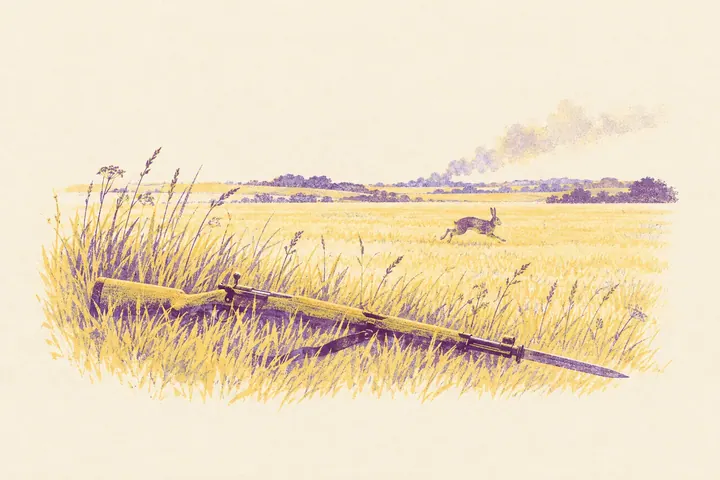
Stanza 3 starts with a yellow hare, thrown up by the gunfire. It rolls and twists in pain, its eyes wide, its mouth open. Then the soldier plunges on towards a hedge. The ideals of king, honour and human dignity fall away from him, and he runs on driven by terror alone. The poem ends with him still charging.
The main ideas
Patriotism does not survive battle. The soldier joined up believing in big ideas. In the charge, those ideas mean nothing, and he thinks only of staying alive.
The reality of war is physical. Hughes fills the poem with heat, sweat, weight and noise. War here is a body in pain, far from the glory of recruitment posters.
Soldiers have no power. In stanza 2 the soldier sees himself as a tiny part of a huge machine run by fate and governments. He does not control what happens to him.
War hurts every living thing. The hare suffers in the open, and its pain mirrors the pain the soldier cannot show.
Language, form and structure
In medias res. The poem opens with “Suddenly he awoke and was running”. In medias res means starting in the middle of the action. The word awoke suggests that the soldier has only now seen what war really is, as if he had been dreaming before.
Contrast in stanza 1. “The patriotic tear” is a gentle, noble feeling. Hughes sets it against the hot, sweaty body of the soldier. The word tear makes us think of quiet emotion at home, far from the noise of the charge.
Metaphor in stanza 2. The soldier is caught in the “cold clockwork of the stars and the nations”. The word clockwork makes the war a machine that ticks on, whatever one man thinks. He is a small part of it.
Simile and enjambment in stanza 2. A line ends with his foot in the air, and the next begins “Statuary in mid-stride”. Statuary means statues. Enjambment, where the sentence runs on past the end of the line, leaves his foot hanging, and time seems to stop with him.
Imagery in stanza 3. The hare “rolled like a flame”. The word flame suggests both its yellow colour and the fire of the guns. Nature is wrecked by the battle along with the men.
A list. “King, honour, human dignity, etcetera” are the ideals soldiers were told they fought for. The word etcetera cuts the list off, as if the soldier cannot be bothered to finish it. Then they are “Dropped like luxuries”: extras he can no longer afford.
Form and structure. The three stanzas follow the charge: running, a pause, running again. The pause sits in the middle of the poem, the one moment when the soldier thinks. There is no regular rhyme, and the lines are long and uneven, like a man stumbling over rough ground.
Context
The First World War lasted from 1914 to November 1918 and killed millions of soldiers. Many young men joined up believing in duty to king and country.
Ted Hughes was born in 1930, after the war, so he did not fight in it. His father did, as a soldier on the front line, and survived. Hughes imagined the war a generation later. Like Wilfred Owen before him, he turns against the older idea that war is glorious. Hughes was Poet Laureate from 1984 until his death in 1998.
Poems to compare it with
The Charge of the Light Brigade. The clearest pairing. Both poems show soldiers charging at the enemy. Tennyson honours the men’s courage and obedience as a group. Hughes stays inside one frightened man, and the ideals that Tennyson praises fall away.
Exposure. Both are set in the First World War, and both show war as suffering, with no glory. Owen’s soldiers wait and nothing happens; Hughes’s soldier is in the middle of the action.
Remains. Both show what war does to one soldier’s mind. Hughes’s soldier is terrified in the moment; Armitage’s soldier is haunted long afterwards.
For how to plan the comparison, read How to compare two poems.
Lines to learn
- “Suddenly he awoke and was running” (the narrator, stanza 1). The opening line throws the reader into the charge with no warning.
- “The patriotic tear” (the narrator, stanza 1). The love of country that sent him to war, now turned to sweat and heat.
- “Statuary in mid-stride” (the narrator, stanza 2). The frozen moment when he stops to wonder why he is running.
- “King, honour, human dignity, etcetera” (the narrator, stanza 3). The ideals of war, cut short by a throwaway word.
- “Dropped like luxuries” (the narrator, stanza 3). The soldier throws the ideals away and runs to survive.
Test yourself
5 quotations from this page. For each one, choose who says it and where it comes from. Ten at a time, in a new order every round.
Where is it? Open each quotation to check your answer.
“Suddenly he awoke and was running”
The narrator, stanza 1
“The patriotic tear”
The narrator, stanza 1
“Statuary in mid-stride”
The narrator, stanza 2
“King, honour, human dignity, etcetera”
The narrator, stanza 3
“Dropped like luxuries”
The narrator, stanza 3
Myths about Bayonet Charge
Myth Ted Hughes fought in the First World War, and the poem is his own memory.
What the evidence says
Hughes was born in 1930, after the war ended. His father fought in it, on the front line, and survived. Hughes imagined the charge a generation later.
Source: The Ted Hughes Society, Life
Myth The soldier dies at the end of the poem.
What the evidence says
The poem never says he dies. It ends with him still charging, driven by terror. What dies is his belief in the ideals he was given.
Source: Ted Hughes, Bayonet Charge, in The Hawk in the Rain (1957)
Frequently asked questions
What is Bayonet Charge about?
A soldier in the First World War charges across a field towards the enemy. He stops for a moment to wonder why he is there, sees a hare suffering in the gunfire, and then runs on, driven by terror. His belief in king, honour and dignity falls away.
What does the hare mean in Bayonet Charge?
The hare is thrown up by the gunfire and twists in pain. Its suffering mirrors the soldier’s, and it shows that war hurts every living thing, animals as well as men.
Which war is Bayonet Charge about?
The First World War, which lasted from 1914 to 1918. Hughes published the poem in 1957, but he wrote about the war his father had fought in.
What poem should I compare with Bayonet Charge?
‘The Charge of the Light Brigade’ is the closest partner, because both show a charge, with very different attitudes to war. ‘Exposure’ and ‘Remains’ also work well for the suffering of soldiers.
Sources
- AQA, GCSE English Literature 8702 specification (Paper 2, Section B)
- The Ted Hughes Society, The Hawk in the Rain and Life